
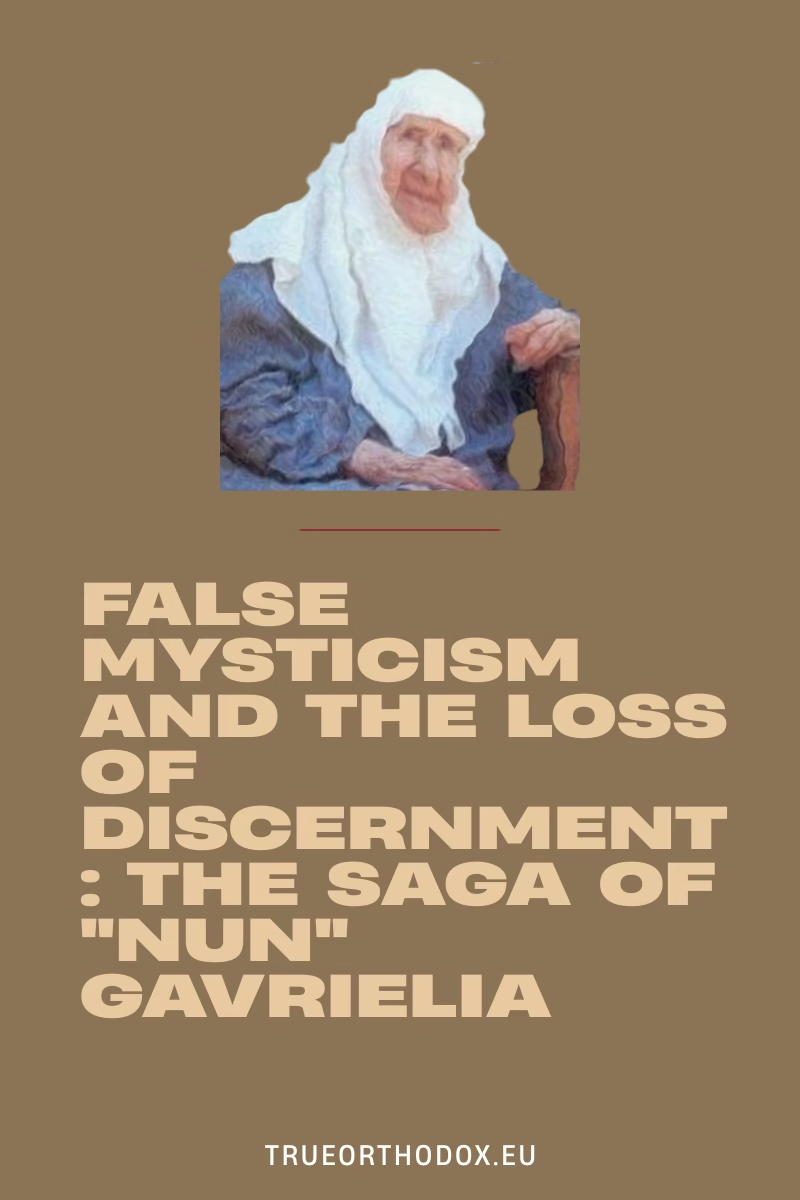

Gavrielia Papagianni died on 28 March, 1992. On the 3rd of October, after a recommendation from “Patriarch” Bartholomew, the Synod of the Patriarchate of Constantinople declared Nun Gavrielia a saint.
Since many serious state-church of Greece theologians had objected to the teachings of this nun, writers rushed to fabricate some anti-ecumenist statements that Gavrielia had supposedly made.
The authors below belonged to the new-calendarist state “church” of Greece and thus were not biased fanatics, as one might think.
Eldress Gabriella
Critiques and Commentary on the contents of the book:
“The Ascetic of Love”
By Nun Gabriella
Athens 2003
PROLOGUE
(Fr Sarantos Sarantos)
In the widely circulated book, “The Ascetic of Love”, by Nun Gabriella,
my name is mentioned as one of those who knew the nun. Indeed, we had
met once and briefly exchanged some views. This fact cannot constitute
my own “guarantee” for the book, which was subsequently written by the
homonymous author.
I take the opportunity, therefore, to present with great joy the
critique of the aforementioned book, which has been done by the most
reverend Deacon Fr Basil Spiliopoulos.
The reading of this critique is very useful for the readers of
Gabriella’s voluminous book, but also for the entire Christ-named
fullness of the Orthodox, so that they may learn to distinguish the
wheat from the chaff, the light from the darkness, the truth from the lie.
Unfortunately, the plethora of messages and incessant information of the
“New Age” blunt the Orthodox consciences of us all, immobilises the right
judgment given by our Lord Jesus Christ, aiming to deceive, if possible,
even the elect, and to integrate them into the charming panorama of the
Pan-religion.
Divine-human institutions and principles, self-evident until now, are
being relativised in insidious ways and are ultimately disputed by the
“rulers of the world-ruler of this age”, both within the global
community and within our most beloved Orthodox homeland, Greece, which
foreign and local “modernisers” are anxiously striving to modernise, as
supposedly unmodernised and third-world.
It is very sad that members of our Orthodox Church, and particularly
members institutionally dedicated to Christ are becoming entangled in
this mentality and in the New Age “missionary work”, and even try to
entangle the fullness of the faithful in the pan-heresy of the New Age
and of the Pan-religion.
Within the five hundred pages of the book under critique, a methodical
attempt is made through a heroised missionary figure, Nun Gabriella by
Nun Gabriella, her disciple, to level the adamantine, truthful Orthodox
teaching, with all the remaining false dogmas of all confessions and all
religions.
The Holy Uniqueness of the God-man person of our Lord Jesus Christ is
non-existent. The Church expects from Orthodox nuns the Orthodox
teaching and the Orthodox ethos that are both imprinted upon the persons
of the Saints of our Church. Every male and female Saint of our
Orthodoxy does not fall short at all in heroism, in feats, and in
miracles, which Christ performs through them for the good, for the
salvation, for the edification of the Body of the Church and of Her
myriad members.
Conversely, in the numerous pages of the book “The Ascetic of Love”,
Orthodox asceticism is absent, and simultaneously, the Orthodox
Divine-human Love in Christ is distorted. Syncretism, that is, the
mixing of all the obsolete confessions and religions, nullifies the
Unique, Soteriological work of our Lord Jesus Christ, His miracles, His
Sacrificial offering, His glorious Resurrection, and His Holy Ascension
into the heavens.
The indirect promotion of Hinduism and Guruism, the supposed
glossolalia, Vegetarianism, the holistic view of the world, the Global
or Universal Spirit, Yama, Non-existence and Mortification, Meditation,
Positive Thinking, the superstitions, the advertisement of Rama Krishna,
the false visions of Gabriella, along with the “healing gift”, the
blunts”alternative therapies”, complete the bombardment of our Orthodox,
divine-human Tradition—which is in all things tested within our Greek
society—the only one that truly saves the human personality.
It is indeed worthy of the greatest bewilderment how it is possible for
Orthodox nuns to alienate, to such a degree and to such an extent, the
life in Christ! It is not worthy of bewilderment to us how it managed to
circulate in thirteen editions, since the aforementioned book is flooded
with the post-lapsarian syndrome of a diffuse sentimentalism, which
motivates the reading public in its circulation.
Countless readers, however, incessantly “bother” us with the identical
question regarding our opinion of this book.
Ultimately, it appears that after a sober, internal critique by
unprejudiced readers, the heretical content of “The Ascetic of Love” is
realised, informally or consciously, and the book is placed on the
highest shelves of the bookcase so that the erosion it initially caused
may not be transmitted.
A careful study of the well-intentioned and absolutely documented
critique by Hierodeacon Fr Basil is needed, so that the reader may
acquire correct, Divine-human criteria, in order not to be misled by
base, demonic sentimentalities.
Archimandrite Sarantis Sarantos
Parish Priest of the Holy Church of the Dormition of the Theotokos,
Amarousion
GENERAL
“The Ascetic of Love” is already traversing its 13th edition, it is now
also circulating in the English language, and its volume extends to 500
pages. In many parishes of our country, it has unfortunately been used,
or is still being used, as a manual for catechetical schools.
In our opinion, this book aims at the promotion of popular ecumenism,
that is, the promotion among simple Orthodox Christian clerics and laity
of the teaching that all religions possess a part of the truth, and
consequently, not only are we not justified in rejecting their various
teachings, but we have a sacred duty to accept them, so that we may one
day reach the desired, for the bearers of this idea, union of all
religions into one. It constitutes, therefore, an act of hatred,
fanaticism or “fundamentalism” according to modern terminology, and
intolerance to persist in the dogmas, the canons, and the traditions of
our Church and to reject the remaining confessions and beliefs, a
phenomenon which, according to the author, is due to various complexes
and phobias that possess us.
We must emphasise that this teaching is the foundational teaching of the
“NEW AGE” movement[1], which proclaims that God is everywhere, and which
systematically manipulates the union of religions and the creation of
the PAN-RELIGION. The Truth, however, is not, nor can it become a
negotiable quantity. The Truth is “possessed” solely by us as Orthodox
Christians and always as members of the One Holy Catholic and Apostolic
Church, and indeed in its entirety, because it is not an abstract or
impersonal concept, but the very person of the Lord, Who most clearly
revealed to us that He is “the Way, the Truth, and the Life” (John 14:6).
Let us look, however, at the most obvious and revealing points that
verify both the existence of a ruthless and New Age syncretism, and the
delusions of the Eastern religions, which are scattered throughout the
book, carefully “disguised” as Orthodox spirituality.
A. SYNCRETISTIC ELEMENTS
As we mentioned previously, this book attempts to convince the reader
that Christian and non-Christian confessions are not far from the truth.
This is achieved in various ways, such as by referring to numerous
friends of the eldress of other religions and heterodox beliefs with
whom she maintained relations throughout her life, without, however,
converting them or even making the slightest effort. On the contrary,
she frequently considers them even as saints (e.g. p. 212 and 407) or an
example of Christians (p. 72)[2] and for this reason she converses with
them about God (about which God, I wonder?).
Let us refer to this, however, in more detail: On page 15, an Anglican
“theologian” recognises her “life in Christ”. It goes without saying
that this presupposes a common experience and a common faith regarding
Christ, which naturally cannot be equated with the Orthodox faith,
because in that case the Anglican would have persistently requested and
received Orthodox Baptism.
On page 27, the author wonders in what way the cooperation, and even the
receiving of a salary from Jews, could possibly bother the eldress? How
much is this tactic, which is presented as a virtue and is projected as
proof of the immeasurable love that the eldress had towards everyone, in
agreement with the words of the Evangelist John, who tells us, “If any man
come unto you, and bring not this teaching, receive ye him not into your
house, and bid him not greeting” (2 John 10)? Did the eldress, in the
end, possess a greater love than the one whom the Church Herself named
the “disciple of love”?
On page 33, we see the close relationship of the eldress with the heresy
of the Quakers[3]. Their work in Thessalonica is advertised as
important, while she herself holds the position of directress at their
school, as well as a teacher of the Gospel. What naive person could ever
believe that if her views and the interpretation she gave to the Gospel
were not in absolute alignment with those of the heresy, they would have
entrusted her with the two, undoubtedly, most sensitive positions in
such a heresy? Concurrently, the reader is given the deliberate
impression that the Quakers are a group of Orthodox Christians with an
important work and activities, a mistaken and highly dangerous
impression which is even proselytising. On pages 40-41, her relationship
with two more Quakers is presented, while she is also hosted in their
hostel (p. 46).
On page 63, a Methodist missionary asks for her prayers so that they
might receive yet more grace from God. This remains uncommented upon and
teaches for yet another time that Grace is not a privilege of the
Orthodox. The Grace of God, however, the Holy Spirit, operates only in
the bosom of the Orthodox Church and “upholdeth the whole institution of
the Church”. (Idiomelon of the Feast of the Holy Spirit).
On page 42, the “brazen syncretism” far exceeds the limits, as we
read, Aurelia, the eldress as a laywoman, leaving for India, took with
her only two books. One was the Gospel, and the other a book by the guru
Sivananda[4]. And while there is no word at all regarding the Gospel,
the book of the guru enthuses her so much that she desperately seeks
its author. He in his turn, “as if by a miracle”, follows her everywhere
and helps her much more in her beginnings in India[5], to prove to us,
even informally, how many powers are hidden in Hinduism and in the
gurus, which, although we ignore them, we can nonetheless gradually discover
and benefit from them.
On pp. 50-51, a comparison is made between guruistic techniques and
Orthodox views. The eldress considers, that is, that in Orthodox
monasticism, just as in Hindu monasticism, the ascetic’s attempt to
become invisible to men is a common phenomenon, a thing entirely alien
and unknown to our own ascetic tradition.
On p. 53, Hindu worship is also compared with Orthodox worship, without
the constant invocation of the name of God being absent from the list of
“similarities”, which supposedly exists in both forms of worship with
the sole difference being the name of the God which the ascetic
invokes[6]. Naturally, the difference is much more substantial, while
the message is once again artfully conveyed that all religions have the
truth with the sole difference being the name they attribute to the Divine.
On p. 54 Rama Krishna is advertised as supposedly being influenced by
Christianity, whilst on p. 47, several names of great gurus whom the
eldress knew are cited, obviously so that those interested in Indian
philosophy and its techniques might know where they ought to direct
themselves.
A little further down, the author attempts to convince us that her Jewish
friend drinks from the crucified water, when simultaneously the Apostle
Paul tells us that the Cross is “unto the Jews a stumbling block”.
What is the aim of this deception, other than to make us believe that
the followers of other religions are not possessed by the same
“fanaticism” by which we Orthodox are possessed?
Furthermore, monasticism is compared with ancient Greece, in an era when
neo-idolatry and the worship of the Twelve Gods are on the rise, and
particularly in our country (p. 106).
Elsewhere, the eldress is invited to pray inside mosques (p. 44), without
it being mentioned whether she ultimately accepted this invitation,
although this act is praised by the author.
In any case, the veneration of mosques is not contrary to the spirit of
the book, since Muslims, Hindus, and also Jews, have God within them and
are guided by the same spirit of God, as Gabriella herself maintains (p.
325)[7]. Moreover, Ramasandra is mentioned as a great man who lives
according to Christ (p. 234), whilst the reference to the gifts of Baba
Amte is also constant (p. 403). It becomes obvious, therefore,
Gabriella’s view that everyone can live and walk according to Christ
and, consequently, Holy Baptism is entirely useless, and the opposite
view is an indication of hatred.
The most characteristic points of syncretism in the book, however, are
the following:
a) On p. 101, it is mentioned that after she became a nun, one day
met with two Indian monks from Sivananda’s Ashram, they said to her:
“Now you are a true sister of ours. You wear the habit, we wear the
habit.” In this phrase is condensed the entire teaching of the book, but
also of the New Age. Indeed, in the way it is formulated, it conveys the
message both that as Orthodox we require a recognition from the other,
more “spiritual” and mystical religions, and that the Indians, as
magnanimous and unfanatical, grant us this recognition and completely
accept our asceticism, which naturally differs little from theirs. It is
the basis of a comparison between our own ascetic tradition and the
Hindu one, namely yoga and meditation, with prayer, particularly noetic
prayer, and our Orthodox worship in general. Besides, within the same
framework move the thoughts of the eldress on pp. 245-246, where there
too she does not fail, with a deliberately convoluted sentence, to tell
us that that which saves is simplicity, poverty, and the narrow way,
which, however, covertly below, is experienced both in Orthodox
monasteries and in the Ashrams[8].
b) We locate the second point on p. 39. There it is mentioned that as
Greeks we nurture an “innate” respect for Indian philosophy, because the
Indians too, just like us, have a spiritual refinement, which is a
result of their cultivation. She further writes that there are wise men
in India who have completely dedicated themselves to God, without the
slightest hint at the fact that they do not serve the same God, the only
God, Whom we serve. Indeed, if we take the word Greeks with its usual
scriptural meaning, that is, as idolaters, then we cannot but agree. If,
however, we accept that the Greeks, as Romans, that is, as an Orthodox
people, have always remained immovable in our faith and in our
traditions, then what commonality can we find between Light and
darkness, Truth and falsehood, and the father of it, the Devil?
Absolutely none, particularly if we take into consideration the fact
that our wise and holy Fathers did not accept to place in our Symbol of
Faith not even once any word that begins with the letter Ψ (Psi), the
initial of the word “Ψεῦδος” (Falsehood), teaching us that we cannot and
must not have any communion with falsehood, and that our faith is the
only one that does not contain a trace of Falsehood, the only one that
contains the Truth.
We must, however, emphasise that truly wise is only he who communes with
the wisdom of God, the True Wisdom, our Lord Jesus Christ, and becomes a
god by grace, a thing which the Hindus are unable to accept, who hope
only in their internal powers and in the possibility of
self-deification. On p. 184, finally, the sanctified figures of the
Prophets are also compared with the figures of the yogis and the gurus.
We must not, however, exclude from this chapter “The Imitation of
Christ”. “The Imitation of Christ” is a very well-known book which
expresses all the pietism and rationalism of the West and which has no
relation whatsoever with Orthodox spirituality and the Orthodox and
patristic imitation of Christ. The eldress particularly loved this book
as well as its author, as is seen on p. 205, where “The Imitation of
Christ” is included among the books she recommended to others for study,
as well as on p. 77, where she walks alongside its author, Thomas à
Kempis, and yet another heterodox monk. Highly informative on this
subject is an article by His Eminence, the Metropolitan of Nafpaktos and
Agiou Vlasiou, Hierotheos, one of the most erudite and traditional
bishops of our Church. His Eminence states, among other things: “It
(‘The Imitation of Christ’) has been attributed to Thomas à Kempis, who
was a papal ascetic writer… It seems that this book is integrated
within the Western framework and expresses the spirituality of Western
man… One can verify that its translation, with the parallel neglect of
the neptic patristic texts contributed to the Westernisation of the
Orthodox. Of course, it is a fact that when one reads ‘The Imitation of
Christ’ one is emotionally warmed, but however one is diverted, without
realising it, from the genuine expression of the Orthodox tradition…”.
We believe, therefore, that the book we are studying also has exactly
the same and even more harmful effects, because apart from the morbid
sentimentalism which it emits, it also promotes dangerous techniques and
beliefs. We recommend, consequently, without reservation, the reading of
the specific article as well[9].
We have mentioned only a few points in the book where an attempt is made
to compare Orthodox with Hindu “spirituality”, between which,
unfortunately, no difference is found by the author. But a careful and
unprejudiced look from a “critical” eye will relatively easily retrieve
countless such points, since this is also the purpose of the book in
question.
B. “SECURITY MEASURES”
It is mathematically certain, however, that if all these elements were
given to the reader without the necessary covering, then he would easily
fall into the trap. For this reason, the author has taken care to take
the appropriate, mainly psychological, security measures, so that
someone would find it difficult to suspect whether all this is perhaps
not so correct or Orthodox. Apart, then, from the covert way in which
certain information is given as well as the barrage of it, so that the
reader does not have time to process it, we will mention by way of
sample a few of the psychological “security measures”.
On p. 44, the invitation to the eldress to venerate in the small mosques
of the hotels is mentioned, but it is simultaneously emphasised that
this constitutes a heroic act “in our own era of Fundamentalism”.
Automatically, therefore, whoever does not look favourably upon this act
is characterised as a fundamentalist.
On the following page, the author refers to the words of a certain
hierarch, who says that “we Christians are endangered only by our
weaknesses”. Therefore, those who, following the tactic of the Fathers
and of the Church, do not develop special relations with heretics and
people of other religions, and mainly do not pray with them, are weak in
the faith, according to this hierarch. Conversely, those who literally
negotiate God and the Truth are very faithful. With these words, and
indeed from the mouth of an Orthodox hierarch, the author believes—and
unfortunately partly justifiably—that she will eliminate every possible
objection. Is it perhaps preferable for us, however, to obey the words
of Saint John the Theologian, which we mentioned in the introduction,
and also of the Lord Himself Who commands: “Beware of false prophets”
(Matthew 7:15), rather than a hierarch, whoever he may be? How is it
possible, besides, to believe that countless foreigners saw the light of
Orthodoxy, as is mentioned a little further down, when no more than one
or two are named? Would not the author make a systematic reference to
the real successes of Gabriella when she does the same for all her
delusions? Has it not already been understood that any attempt to
convert people of other religions and heterodox to Orthodoxy is
perceived by the eldress as a sign of fanaticism?
On p. 49, it is written that the eldress became a “window to Orthodoxy”
for others and to the world for us, opening a deep rift in our “acquired
phobia”. The author, that is, boosts our ego so that it functions as a
deterrent to our objections, since no one wants to carry the title of
being frightened.
On p. 122 possible objections are anticipated for yet another time since
the author tells us that Gabriella was the only one who had the courage
for this kind of opening, and that our remaining monks are not so
industrious either, but remain closed in their monastery, as well as
that the eldress had the blessing for something like this from a
recognised elder (Amphilochios). However, this elder had fallen
asleep much earlier (1976) than the first edition of the book (1996), as
had, of course, many others who are mentioned in it to support the
holiness of Eldress Gabriella. This fact, in combination with other
elements, must make us suspicious of the author’s motives.
Finally, on p. 288, the love that we owe to all is misinterpreted
and the eldress is projected as a confessor of the faith, whilst those
who disagree are named persecutors of love. It is necessary, however, to
escape from all the aforementioned well-laid traps. Let us answer the
accusations we are in danger of attracting by disagreeing with these
tactics (fanatic, fundamentalist, frightened, faithless, intolerant,
etc.), with the words of Christ and of the Evangelist of love, which we
have already mentioned, but also of the Apostle Paul who entreats us to
“mark them which cause divisions and offences contrary to the doctrine
which ye have learned; and avoid them” (Romans 16:17), who clarifies to
us that “I would not that ye should have fellowship with devils” (1
Corinthians 10:20) and draws our attention to “beware lest any man spoil
you through philosophy and vain deceit, after the tradition of men…
and not after Christ” (Colossians 2:8). Let us also answer with the
words of our Spirit-bearing Fathers who clearly warn us saying that “If
any clergyman or layman shall enter into a synagogue of Jews or heretics
to pray, let him be deposed and excommunicated” (Canon 65 of the Holy
Apostles)[10]. The question arises, therefore: Did Eldress Gabriella
have a greater love than that of the Fathers, of the Apostles, and even
of the Lord? Whom, ultimately, ought we to obey and whom to trust and
follow: the Truth itself, or a deluded nun?
C. HINDUISM – GURUISM
Let us move on, however, to something more dangerous and important. One
of the characteristic features of the New Age is the inversion of
Christian terms. This, very simply, means that the various groups of the
New Age take a term common in Orthodox spirituality and attribute to it
a completely different and alien meaning. They take, e.g., the term
prayer and equate it with the content of the term meditation in order to
attract their unsuspecting victims more easily, bending possible
hesitations and dragging away, if possible, even the elect, since mention
is made of Christian virtues and methods. The phenomenon of inversion is
very common in this book as well. In an admittedly clever way, the
reader is prepared to accept Hindu philosophy and life, especially since
it is presented as a genuine form of Orthodox spirituality; he is
catechised and gradually initiated, even involuntarily, into it, and is
in danger of distancing himself from the life of the Church or of
remaining formally in it, worshiping other gods, demons in reality, who
will acquire increasing authority over him, alienating him from Divine
Grace and tarnishing his baptismal garment. However, “No man can serve
two masters” (Matthew 6:24). We will examine the points in the book
where an inversion of certain terms occurs, contrasting them with
relevant excerpts from the books of Fr Antonios Alevizopoulos[11].
On p. 3, the author wishes to “initiate” us—and the term has great
significance—into the asceticism of love, a poem that was found among
the papers of the eldress, and that the whole book might open for us a
window into her heaven. Principally, it is known that we use the word
initiation when we transmit to an “outsider” something of our own
experiences and indeed religious experiences, that is, when we gradually
introduce him to our own mysteries, to the worship of our own God. “To
initiation belongs the disciple following the commandments of his guru,
regardless of whether he lives near the guru or not”[12]. Perhaps this
parallel seems exaggerated, but we believe that subsequently you will
justify our suspicions. We read, besides, that the initiation will take
place in the asceticism of love. Here we must mention that the
world-famous guru, Sai Baba, believes that “there is only one religion,
the religion of Love… there is only one language, the language of the
heart”[13]. These are beliefs that equate, unfortunately, absolutely
with those of the eldress. Furthermore, our suspicions are strengthened
by the fact that according to the father of positive thinking[14]…
“man creates his own heaven and his own hell”[15]. Must we consider
these as random coincidences and indeed in a little paragraph, which
happens(?) to be the first of the book? At the very end of this
paragraph, indeed, it is mentioned that it (i.e. her heaven?) is our
destiny! This does not surprise us since “karma means action and action
is inevitable… and in this sense our destiny is already decided”[16],
since “every man plays his role which is detailedly determined in the
personal film of his life, and this role changes constantly from life to
life”[17], words which the eldress repeats almost verbatim on p. 396[18].
Glossolalia: On p. 10, the “gifts” of the eldress are mentioned, among
which the “gift” of glossolalia is not absent. “The phenomenon of
glossolalia is not new. It is known in ancient Greece (Pythia) and in
other extra-Christian religions, e.g. among the Dervishes… In England
the phenomenon appeared among the Quakers and the Methodists, among the
Mormons and in other American sects”[19]. From the above, we safely
conclude from where the eldress inherited the “gift”, since she
associated so much with the Quakers and the Methodists. “The phenomenon
of the autonomy of the tongue which speaks independently of the mind of
man, constitutes for these groups proof of the baptism of the Holy
Spirit”[20].
Vegetarianism: Leaving the introduction, we go to p. 28. There she writes
that the eldress stayed initially with a certain Mrs Bright, near whom
she obligatorily became a vegetarian. We must note here the hypocrisy of
the author, the deception, and the contradictions concerning the life of
Gabriella. An attempt is made, that is, to convince the reader that
vegetarianism has no relation to religious “beliefs”, but was almost
imposed on her by the circumstances. But if things are so, why did she
not simply participate, but was invited to a conference on healthy
nutrition and natural healing, which was an inspiration of Gandhi
himself (pp. 67-68)? Who could have known that she was a vegetarian
since it was imposed on her? Why (p. 91), even in the monastery, does
she not obey and not participate in the common meal but, as the author
mentions with contempt towards the other nuns, “she does not eat taramas
and cod”?
The answer is one: Ahimsa (non-violence). “This non-violence, Ahimsa,
includes all expressions of creation, even insects and animals and
plants”, because “by harming someone or something else, one does nothing
but harm exactly oneself”[21]. According to these views, Jainist monks
are forbidden to eat in the dark and without a cover over their mouths
so as not to eat an insect by mistake. Is it irrelevant to all this the
fact that she scolds someone who killed a mosquito (pp. 134-135)? That
she sends greetings with her spiritual children (?) to specific trees
whose branches she holds? That she feels so sorry for the plants that
wither and indeed buries them instead of throwing them away, when
naturally she does not resurrect them, as on p. 58? Much more so, how is
her view irrelevant that if we are tired and touch a tree, it will give
us from its strength which God gives to it (p. 134)?
Holistic View of the World: All the above refers us to the so-called
“holistic view of the world”, which includes even God and which is
projected by all the movements and groups of the New Age. “God is not
perceived as a Person; he is equated with the Global or Universal Spirit
or the living energy of the universe which is projected in varied forms.
Man himself is a projection of this Cosmic Super-consciousness”[22],
“even nutrition is chosen with the central aim of expanding
consciousness”[23], “we seek a mode of existence of the harmony of man
with himself and with all living beings, with nature and the world”[24],
because “everything is concentrated quantities of energy”[25]. Perhaps
again our thoughts seem exaggerated to some. Let them explain to us,
however, why the eldress urges us: “Thou shalt love the Lord thy God
with all thy soul, and with all thy heart, and with all thy mind” and
hastens to explain: “the universe, that is” (p. 199)? Therefore,
according to her, the universe is equated with God, the creation with
the Creator, a fact that proves the adoption on her part of the holistic
view of the world which, as we have already said, summarily teaches that
“There is no separation, everything is one, and man equates himself with
this one”[26]. She indeed calls man “Prey” and wonders on p. 489, how we
can eat meat while the animal suffers and is martyred. Surely she would
love the animals more than their Creator Himself, Who said to the
Apostle Peter, “kill, and eat” (Acts 10:13) and to Adam, “Every moving
thing that liveth shall be meat for you” (Genesis 9:3). She would love
them more than the Apostle Paul who wrote to Timothy that “every
creature of God is good, and nothing to be refused, if it be received
with thanksgiving” (1 Timothy 4:4), and even than our Church which,
based on these, deposes clerics who “abstain from meat due to abhorrence
and not for asceticism” (51st and 53rd of the Holy Apostles, 14th of
Ancyra). We must say here that the holistic view is closely related to
vegetarianism. Indicative of this correlation are the words of the guru
Sai Baba who says, initiating even 7-year-old children into
vegetarianism: “you are what you eat”[27].
Also closely related to the holistic view is Gabriella’s opinion that a
black garment worn next to the skin removes a person’s vitality[28]
(read: vital or universal energy), which opposes the Church’s adoption
of the colour black as a priestly colour, as a colour, that is, which
“rests” upon men who are bearers of the Holy Spirit, the sole true
Vitality (The Life-giving).
Yama. Erroneous, however, and clearly anti-ecclesiastical is also the
eldress’s belief that sex, even within marriage, is anti-godly (p. 386).
In Hinduism, this is called Yama and constitutes the first stage of
yoga, incorporated into self-restraint[29]. Naturally, Yama is in
opposition to the words of God to the first-formed concerning the
reproduction of the human race, to the entire Old and New Testament, but
also to the canons of the Fathers[30]. All this, however, does not
surprise us at all. The Apostle Paul has sufficiently warned us
regarding the views of the eldress and every eldress, writing to
Timothy: “Now the Spirit speaketh expressly, that in the latter times
some shall depart from the faith, giving heed to seducing spirits, and
doctrines of devils… Forbidding to marry, and commanding to abstain
from meats, which God hath created to be received with thanksgiving of
them which believe and know the truth” (1 Timothy 4:1-3).
Non-existence – Mortification. Another dangerous Hindu view that
permeates the book is that the goal of Christians is non-existence. It
is, we imagine, superfluous to say that this is entirely mistaken and
betrays a Hindu perception of things. We read regarding this on p. 39:
“I had died” and further down: “in a few minutes, mortification”. What
does the word “mortification” mean? If the term is equated with the
patristic term “mortification of the passions”, then we truly object. It
constitutes the greatest delusion for someone to believe that what our
Fathers achieved, indeed without acknowledging it, with the Grace of God
and fierce ascetic struggles of dozens of years, withdrawing even into
the depths of the desert, Eldress Gabriella achieved in only a few
minutes and without expending the slightest effort. Furthermore,
effortless conversion under the term “rebirth” is very “in” in the
Protestant sphere[31], the various parts of which Gabriella knew very
closely. The same term, note well, the author also uses on p. 193 and
also on p. 3, indeed equating it with the “mortification” we saw above.
But we encounter similar things in other parts of the book: On p. 215,
the eldress does not feel cold, does not feel hungry and the exhaust
fumes do not bother her because she does not exist; she even
misinterprets the words of Venerable Neilos which refer to humility, in
order to support the Hindu dogma of mortification. On p. 356 she gives
instructions for us to reach that point where we will have no
hypostasis[32]. On p. 365, she mentions again that she does not exist
(!), on p. 153 she speaks of apathy equating it with insensibility and
accepts destiny but also reincarnation (“if God wanted He could have
made me something else”), whilst she considers immobility a great
progress in the spiritual life[33].
However, not even these are unknown to us. “According to Sai Baba,
whoever acquires true Peace and experiences it does not feel at all the
turmoil and confusion that prevails in the world… Peace means
resignation from the activities of the senses, that is, for one not to
see what is happening around him, not to hear, not to feel… not to
have the sensation that he exists”[34]. “But even if a being returns to
the unmanifested state of the ONE, that is, to non-existence and to
rest, he will begin the same adventure again, because everything is
subject to periodic existence and non-existence, to action and to
rest”[35] according to Blavatsky[36], founder of Theosophy[37]. Also, Fr
Antonios tells us that “the various techniques of redemption in the
sphere of Hindu religiosity are attempts at freedom both from life and
from death”[38].
Let us look, however, at other elements that confirm the relationship of
the eldress with yoga and meditation, through her experiences. “One such
kind of experience… (which springs from yoga)… is the so-called
astral or out-of-body travels”[39]. We ought here to ask ourselves if
these travels are related to the fact that the eldress became invisible
with the help of angels (p. 192)[40], who also transported her
everywhere (p. 103)! “When one does auto-concentration daily and devotes
oneself to a soft, pure inspiration that does not contain formulated
messages, he can during the course of his experience determine its
content and record it. MC Lean maintains that it concerns messages of
angels or of the Devas, the spirits of nature”[41]. “These
manifestations are not motor, but emotional. When these internal
movements are noble and helpful, they are perceived by spiritists as
guidance from the inner teacher, as the voice of conscience, or even as
the voice of an angel”[42]. Can we, therefore, deny that the teaching of
the eldress is equated with the above occult phenomena, when she herself
proclaims that the voice we hear within us is our guardian angel and
urges us to sit and listen to this voice[43] (pp. 176-177)? Is it
irrelevant to all this the fact that the angels transported her
everywhere, or followed her as a “blue reflection” (p. 482) and wrote
messages to her on the wall (p. 146)?
Meditation. Let us analyse a little, however, what the urging to listen
to our internal voice might mean. This technique is called meditation
and is very dangerous for the one who practices it as it can cause
irreparable damage. Unfortunately, however, it is highly advertised and
widespread globally today, whilst in no case does it run alongside the
capacity of the Orthodox Christian, since it abolishes Christ as a
historical person and considers every man a god. Concurrently,
meditation is projected for promotional purposes as a method of
relaxation, well-being and beauty. Guru Satyananda himself does not deny
that it is a risk[44]. With meditation we try “to meet the god who is
located within us”. According to this teaching, “man is a spiritual
power, a spark of the divine creative essence…”[45]. With this, of
course, Eldress Gabriella also agrees, who says that “God is within us
and speaks to us in silence” (p. 410), that “God gave us Conscience:
Himself” (p. 308), that the good “exists within all men as a spark of
God” (p. 253), that “we all have a spark of Christ in the soul” (p.
325), that “true freedom depends only on the relationship of our self
with our self” (p. 302). It appears, therefore, that the eldress was
ignorant of the word prayer in the Orthodox sense, but knew the method
of meditation very well. This is also seen from the fact that she speaks
of a “state of prayer”[46] (pp. 69, 78), of silent prayer and
contemplation (p. 102) and calls prayer an energy and power (p. 344),
that is, whatever the followers of “self-deification” maintain. “The
power of prayer is a manifestation of energy”[47], Peale mentions,
meaning safely meditation. “The meditator desires external silence… in
order to hear the voice of internal wisdom”[48].
Positive thinking: However, the dogma of “positive thinking”[49], which
is not absent from the book, is also not unrelated to the technique of
meditation. This dogma very simply and summarily teaches the following:
“Man constructs his happiness or his misery in his subconscious. God
(the subconscious), who gave you the desire, will also show you the way
to its fulfilment… Man can activate God within him by thought”[50].
Correspondingly, the eldress believes that the mind and the imagination
create cold (p. 66) and illness (p. 71), whilst she herself cures these
conditions which men create by themselves, with her “charismatic” hands.
Peale (a “missionary” of “positive thinking”) proclaims that “as you
think, so shall you be” and that “you can make yourself ill with your
thoughts”[51]. But the Silva Mind Control movement also maintains that:
“One can heal with the hands”[52]. The eldress professes the same,
saying that we can acquire even money “as long as we think about it” (p.
227), that God fulfils them all as long as we have the yearning (p. 362)
and that if a man does not learn his lesson the first time, something is
running in his subconscious (p. 362).
Included in the theory of positive thinking is also the correction of
negative thinking, which for the Silva movement is “every thought of
criticism or malice or jealousy or condemnation of others or
self-condemnation, every thought of illness or accident or, in a few
words, every kind of limiting or pessimistic thought”[53]. This
correction for Silva is something very simple: “If by chance you use
such a phrase, say cancel-cancel and replace the negative with a
positive”[54]. We see this correction on p. 298, as a “lesson straight
to the head”, originating from God (obviously from the Conscience), on
pp. 66-67 as a “healing power” and in other places.
Within these frameworks, however, the follower of positive thinking is
obliged, in order to be rid of the various negative thoughts that
possess him and to impose himself upon them, to write the same phrase
many times on a piece of paper, so as to convince his subconscious. He
writes for example continuously the phrase “I am strong” or “I will
win”, in order to overcome his inferiority complex or anxiety for a
certain struggle. And this method, however, is taught by the eldress
silently, since in the book we have some (around 6) of her, surely many,
papers with the continuous repetition of a certain phrase. On p. 156 we
have one such paper that writes “Christ is born, glorify Him! Lord have
mercy”, on 352 the Jesus prayer, on 392 “Most Holy Theotokos save us”
and others on pp. 2, 8, 14. Naturally many will answer that it concerns
prayers. But what saint established or simply followed such methods of
prayer? There is, therefore, indirect systematic propaganda of the
specific method, since besides, meditation, as we mentioned previously,
can also be referred to the person of Christ.
What Christians name the prayer of faith, Silva calls it energy,
programming, relaxation… Faith is not referred to a person, to God,
but to the mobilisation of energy within us. “When there is enough
desire, there is enough energy available to ensure success”[55]. Under
these conditions, therefore, “Baba Amte and his collaborators had
courage, patience and faith to the supreme degree” (p. 58). If here
faith is given meaning as we Christians give it meaning, then as
Orthodox, we would be literally worthy of our fate, since an individual
of another religion has faith and indeed to the supreme degree. Here,
however, faith is equated with faith in myself and in my internal
powers. Therefore we are not talking about Faith but about “positive
thinking”. What could the name of Baba Amte mean, however, whom the
eldress advertises to us throughout the book? “Baba means beloved father
and signifies the supreme being within him. The guru in his physical
form, the bodily Baba, reminds us with his words, with his actions, of
the supreme consciousness”[56]. Must we, therefore, also accept Amte as
our own Baba?
Advertisement of Hindu teachers: Yet another unquestionable proof of the
fact that Gabriella had been deluded by Hindu and demonic philosophy is
the systematic advertisement of Hindu teachers. Apart from the simple,
but prideful, reference made to the gurus she knew, the poet Kahlil
Gibran is also advertised by the author, as for example on p. 72.
Without it being mentioned anywhere that he is a teacher of Hinduism, he
is presented as a great poet whose works the eldress knows very well
since she referred to them[57]. However, many gurus also refer to Kahlil
Gibran, such as for example Satyananda in his Ashram[58], and the Silva
Mind Control movement[59], which distributes his books as manuals and
naturally adopts his views, and even the “Harmonious Life”[60] of Robert
Najemy. We understand, therefore, what danger lurks, especially if we
consider that all these Sects[61] operate in our country completely
unchecked.
But no less is the danger from the advertisement of Rama-Krishna, as
supposedly having been influenced by Christian missionaries (p. 54),
whom the eldress accuses of being “barbarians”, but uses them when she
needs them, as here. Rama Krishna also operates in Greece[62] and, like
all the gurus, does not reject Christ, but accepts Him, however, as a
guru who was liberated from ignorance and delusion and reached the
sphere of eternal peace. “Whoever has reached this state is named a
Saviour of the world. Such were Buddha, Krishna, Christ, Rama Krishna
and others”[63]. Does Gabriella perhaps call this Christian influences,
or the fact that at a Christmas celebration of the order of Rama
Krishna, those present meditated upon the person of Christ, who was
supposedly within them, and felt his presence, whilst, as Swami
Prabhavananda confesses, he realised for the first time that Christ is
the same as Buddha, Krishna and all the other teachers[64]? She rather
means this latter one, if we take into consideration that even she
herself preferred to return to the Ashram to celebrate Christmas (p.
56). However, this one upon whom they meditated and meditate and about
whom they speak, is not nor has any relation to the person of Christ[65].
Superstitions. Finishing this section we mention epigrammatically the
superstitious views of the eldress regarding sleep, that we must sleep
with our head towards the South or towards the East (p. 331); regarding
non-existence, that those who became a shadow are happy because they
approach it (p. 382); regarding evening readings, that they do not
remain in the soul (p. 383), whereas conversely the Church proposes
vigils as the best opportunity for communication with God; regarding
Gysis’s painting, that it captures better than the Fathers and the
centuries-old hymnology of our Church the “ever-virginity” of the
Theotokos (p. 374), a reason which led the author to write “joyful
Christian songs” that cover the great void of our “uncivilised” Fathers;
regarding our place in church, that it must always be the same so that
the “myopic”, as it seems, angels can find us! (p. 363); regarding
children, that we must not leave them next to sick people because they
absorb their strength (p. 331); regarding melancholic people, that we
must open the windows so that their negative energy leaves (p. 331) and
other similar things which seem silly, but originate from specific
religio-philosophical movements and ideologies.
D. MESSAGES – VISIONS – DELUSIONS
The Fathers from early on clarified the word of the Gospel, that the
demon, because he is a spirit, has the ability to transform himself and
to appear to men not only as an angel of darkness but also as an angel
of light. This is exactly the reason why the Evangelist John urges us:
“Believe not every spirit, but try the spirits whether they are of God”
(1 John 4:1). For this reason, besides, monks have the elder, to whom on
a daily basis they entrust their thoughts and their experiences, and
laypeople have the spiritual father, so that they may discern the
spirits, with the help, naturally, of Divine Grace. The Gerontika are
full of stories of monks who hid their “experiences” from their elder
and, literally, Satan swallowed them up, or they were saved at the last
minute by the prayer alone of the elder. In this book we do not see this
act of humility and safety, but conversely, if we follow the model of
Gabriella which the author projects to us, then we must indiscriminately
believe in every vision and “miracle”, consider ourselves saints and be
obedient to any thought of ours.
Dozens of “messages” and visions are mentioned in the book, but nowhere
is recourse to a spiritual father for a “diagnosis” mentioned. On the
contrary, the eldress not only had no need of a spiritual father to
guide her, but she herself becomes a guide of others, who are referred
to in the book as her spiritual children. Consequently, this alone is
sufficient for someone to characterise the book as a dangerous and
mistaken model for the spiritual life and struggle of the Christian. We
have various “messages” on pages 23, 40, 41, 47 and elsewhere, whilst
visions on pp. 39, 78 and in many other places. On p. 47 indeed, and on
268 more analytically, the eldress receives the “message” from the
angels to become a nun, and implements it without the slightest advice
from a spiritual father. Mention has also already been made of her
“invisibility” (p. 192) and her close relationship with the angels,
regarding whom the eldress unfortunately mentions that they see the
essence of God (p. 443) and naturally the fact causes an impression that
whilst they kept her company so much they did not inform her about this
erroneous position! “No man hath seen God at any time” (John 1:18).
Healing gift: It would be the greatest omission, however, if we did not
refer to the “gift” of the hands; on the one hand because it is an
element which, without the need of other arguments, proves the pitiable
delusion into which the eldress had fallen, and on the other hand we
would deprive the reader of the laughter that such nonsense offers.
Sometimes, she says, her hands burned and reddened supposedly from the
Holy Spirit. If at that time someone with health problems happened to be
there and she touched him, the sick person was healed and she herself
was relieved of the burn; otherwise she washed her hands with abundant
water, to be relieved (p. 137). Let us make here some necessary, albeit
self-evident for Orthodox Christians, observations:
a) The Holy Spirit does not burn, nor does It torment man, but
conversely It “rests”, It “cools” and It illumines him, and indeed It is
not restricted to a part of the body but sanctifies him entirely in both
soul and body. The only one who is burned by the presence of the Holy
Spirit is the Devil, so either the eldress was truly overshadowed by the
Holy Spirit but she herself had been possessed by a demon, a rather
improbable thing, or the spirit which “overshadowed” the eldress was
none other than the unclean and evil spirit. b) When a Spirit-bearing
man transmits the Holy Spirit, he does not lose It himself because we
are not talking about something material and quantitative. If such a
thing happened, then the Apostles would not have been able to ordain
other hierarchs than only 12, one each, and afterwards they themselves
would have lost the Holy Spirit, so we would not be speaking today in
the Church about holy Apostles. c) It constitutes a great blasphemy
against the Holy Spirit for It to be treated like a stain that is washed
out in a basin of water and leaves. This is more reminiscent of a
detergent advertisement than a “gift” of the Holy Spirit.
E. LOVE
Despite all the above, someone could put forward the objection that the
eldress, moved by love, the greatest Christian virtue, did whatever she
did, since “God is love”. As we shall see, however, love is not an
exclusive “privilege” of the Orthodox, but all the movements place it
very high on the scale of virtues. What matters is how one gives meaning
to the word love. If we accept Gabriella’s interpretation which equates
love with syncretism and the denial of the exclusivity of our Orthodox
Church regarding the Truth, then neither is Christ love, nor does the
evangelist of love have a trace of it, since both urge us to avoid
associating with heretics. This kind of love, which levels all religions
and all beliefs, is an invention of the New Age, the followers of which
are presented as flooded with and flooding all things with infinite
love, as well as being most meek and unperturbed people. We must know,
however, that this calmness is not a gift and bestowment of the Holy
Spirit, but the result of a painful and persistent effort for the easy
deception of “sentimental” people, and many times also the result of
stupefaction after systematic brainwashing. The projection of this
calmness and imperturbability is perhaps also the purpose of the
circulation of cassettes with the most meek (?) voice of the eldress
answering questions of a spiritual nature. Let us not be influenced,
however, by such external elements, which keep us far from the required
vigilance. The Fathers clearly warn us that exactly thus will the
Antichrist come: “He will be humble, quiet, he will hate injustice, he
will turn away from idols, he will prefer piety, good, loving the poor,
exceedingly comely, wealthy, cheerful to all” (St Ephraim the Syrian).
Thus, however, will also be his forerunners and followers. Sai Baba,
e.g., believes that all disciplines such as yoga and meditation are a
waste of time and dangerous if there is no “moral basis”: “Truth
(sathya), Virtue (Dharma), Peace (santi), Love (Prema), and non-violence
(ahimsa)”[66]. He himself again “floods everyone with infinite love,
seeks love everywhere and installs it in the heart of every man”[67],
whilst even on the cover of the book “Introduction to the teaching of
Sri Sathya Sai Baba”, it is mentioned: “there is only one religion, the
religion of love, there is only one social class, the social class of
humanity, there is only one language, the language of the heart”[68].
Furthermore he himself tells us elsewhere that as soon as we overcome
our fear and realise that everything in life is One, we will be capable
of letting ourselves love an ever greater circle of people[69]”.
But, someone will insist, whatever the case may be, the eldress
ministered to Christ in the person of her neighbour. Are things,
however, thus? For the good to be good, it must also be done well. If,
for example, under the pretext of love, which the Church teaches, we
distance ourselves from every other teaching of Hers and accept
delusions and false teachings as true, then the good is not done well
and ceases to be considered good. This is our first objection. The
second objection has to do with whether the eldress did all this work of
“love” entirely freely and out of love for her neighbour. “So-called
unselfish service is incorporated into the first path of yoga, the
so-called ‘Karma yoga’. It is service without attachment to the result
of your action… This path prepares for other forms of yoga, of a
higher order. For this reason, unselfish service is emphasised in the
self-knowledge seminar during the first year, whilst during the second
year meditation techniques are offered which move beyond the stage of
unselfish service[70]”. After the reading, therefore, of the specific
book, we believe that the reader is absolutely ready to follow the
second year of the seminar, without the slightest difficulty.
Besides, the question is raised: How did an Orthodox nun stay in an
Ashram, where the goal of those residing there is the service of the
guru[71], indeed following faithfully the programme of the Ashram even
when she found herself far away from it, so the excuse of coercion does
not stand? Let us see what the Satyanandashram says about this:
“Unselfish service constitutes an attempt for the purification of the
mind from its grossest desires”, whilst for those who are in the Ashram,
it mentions: “The Ashram is not a place where the Sannyasins[72] sit
lazily and talk about God or Brahman all day… They work incessantly
from morning until evening… The work they do is not selfish or with an
egotistical motive… When you come to the Ashram and serve the guru and
work for him, you unconsciously clear the path and allow the energy to
pass to higher and more powerful centres… The day begins at 4 in the
morning and ends at 9 in the evening[73]”. We hear another sannyasin
say: “I get up at 4 in the morning and sit in silence listening only to
the birds… then I go down to the Ganges… at 12 I eat lunch… 5 to 6
a walk, until 8 quiet time. From 9 until 4 in the morning, lock up”. And
yet this is the programme of the eldress (p. 71) and indeed far from the
Ashram, and which, not only is the same as that of the sannyasins, but
does not include prayer anywhere, which is replaced by the admiration of
nature and the hearing of the birds, a thing which proves the influence
of and participation in Hindu worship and philosophy.
Finally, let us listen to what Elder Porphyrios Bairaktaris said about
the love of these groups: “You fool, what love do they teach? You idiot.
Be quiet, you. True love is the love of Christ[74]”.
F. PHYSIOTHERAPY
Finally we will expose our perplexity about how much physiotherapy,
which is mentioned as being practiced by the eldress, has to do with the
known, classical, globally accepted and unquestionable medical science.
If, therefore, she had any relationship with medicine, how could she
heal before she even began her studies in physiotherapy (p. 28)? What
does the term “chiropodist” mean (p. 29)? What is the specialty that
heals soul and body (p. 30)? What doctor heals with a touch, a
phenomenon common in neo-Pentecostal[75] and guruistic groups, but
entirely alien and unknown to medical science? Furthermore, the
combination of physiotherapy with positive thinking on p. 337 provokes
suspicions, where the eldress says: “…without the mind and the soul
suffering, the body does not get sick. Now all doctors know this…
Illness begins from the head. With a thought. With an anxiety… But
there is also another thing… He who does physiotherapy must not speak
at the same time. Speech, as you know, is the greatest energy that man has”.
Finally, the question is reasonable: For what reason does an Ashram
publish, and indeed at its own expense, the book of Gabriella, which
contains photographs with the various positions of her hands and the
method of her own inspiration (p. 51), if they have no relation to their
own methods and perceptions? Do the Hindus and the gurus appreciate
science so much and exert themselves for its progress, or was the
eldress perhaps such a great scientist that she invented methods of
healing without the slightest scientific and laboratory research and
study? All the above refers us, unfortunately, to the so-called
“alternative therapies”, which, naturally, are incompatible with the
Orthodox faith and the capacity of the Orthodox Christian, since they
are based on worldviews and influences of Eastern origin and mainly on
the holistic view of the world.
We must note here that in our country “in the 80s, attempts were made
for the unification of metaphysical groups, for the creation of a
Federation of Occult Movements… The first meeting took place at the
Spiritual Centre of the Roman Catholic Church of Greece… The text of
the meeting… mentions that there are infinite aspects and branches of
metaphysical philosophy. It even cites an incomplete draft which is
characterised as a first study… The text cites 4 columns: Religion,
Esotericism, Yoga Schools and Health” in which physiotherapy was also
included[76]. Moreover, the views of the eldress run alongside in many
points the views of other “alternative therapies”, since they besides
all have the same basis and essentially constitute “adaptations of the
same work”.
We will cite, therefore, some similarities of the “physiotherapy” which
the eldress practiced (using her own thoughts as a guide), with
something seemingly unrelated, homoeopathy, as they are presented in the
book of the Parents’ Initiative of Northern Greece, so that the
relationship of these “therapies” becomes more understandable and apparent:
a) “…Based on this worldview of absolute pantheistic monism, which is
expressed by the known dogma of occultism ‘all is one’, homoeopathy also
interprets the phenomenon of illness: Life exists as long as the supreme
God who is a substance, flows continuously towards the beings… This
divine substance or energy… is what homoeopathy names ‘Vital
energy[77]'” (Compare the views of the eldress regarding the colour
black and see also the chapter concerning the holistic view of the
present text).
b) “According to George Vithoulkas, apart from homoeopathy and
acupuncture, another therapeutic method is that ‘by the laying on of
hands’ by an individual of a high spiritual level… who in reality is a
channel of global energies[78]” (See p. 28 of “The Ascetic of Love”
concerning the gift of her hands and also the fact that she healed
before she began her studies but, as she herself says, “the healer was
another”. Obviously she was the channel.)
c) “Another important point of the theory of homoeopathy is the theory
of the ‘miasms’, by which homoeopaths attempt to interpret the creation
of various illnesses… Man was created free, he was created with the
possibility to think and to do either good or evil. In order for him to
become susceptible to the psoric miasm, therefore… the desire for what
is wrong and evil must exist. Thus man by thinking and desiring evil
prepares the body to receive the illness[79]” (See in the subsection of
our study concerning positive thinking).
d) Besides, homoeopathic treatment proceeds from the soul towards the
mind and the body[80], or as the eldress says it: “Whatever has a
relationship with the body of man, also has a relationship with his
soul. If you ever go to treat a hand that hurts or a leg, you see that
the soul hurts more…” (p. 338). There are many more elements which
will not benefit anyone who prejudicedly believes in the holiness of the
eldress any further, whilst these few will help the well-intentioned and
whoever is truly interested in the truth. “He that hath ears to hear,
let him hear”.
In any case, however the matter stands, this book constitutes an
excellent introduction to Guruism and a weapon in the hands of the New
Age for the erosion of the Orthodox conscience and the opening of the
way for the establishment of the Pan-religion. But, as Elder Porphyrios
said very beautifully: “Only the religion of Christ unites, and we must
all pray that they come to this religion. Thus will the union happen,
not by you believing that we are all the same and all religions are the
same. They are not the same[81]”. Also according to Fr Antonios
Alevizopoulos “he who will compare Mount Athos with the Himalayas, and
will hasten to draw the conclusion that it is the same thing, ignores
something very basic… There is no common element, therefore, between
the ascetic tradition of our Church and these groups, or their
techniques. That such a non-existent position is projected inferentially
constitutes a delusion or a trap, even if it is done by Christian
theologians[82]” or missionaries, we would add, although the eldress is
not entitled to bear this title, since she was, as is seen from the
accusations she levels against them, by conviction against missionaries
and their work[83], equating missionary work with only social offering,
and indeed of Hindu origin, as we said, and she catechised no one in the
Orthodox faith but conversely she herself was “catechised” in alien
dogmas without giving the Orthodox witness and confession which she
ought to as a missionary.
On p. 54 for example it is mentioned, and indeed blatantly, that the
eldress participated in ceremonies for the birthday of guru Sivananda,
ceremonies, that is, of worship of the guru, as a god. When according to
the typical order they offered her to drink milk from that in which the
guru had washed his feet, she simply washed her hands saying that this
is what we do in Greece. What is an Orthodox Christian and especially a
missionary seeking in pagan ceremonies of worship of the guru? Where is
the catechism or at least the Orthodox witness and confession? Does she
not teach men with her presence that there do not exist significant
differences between Hinduism and Orthodoxy? We have in the synaxaria of
our holy Church many martyrs who sacrificed their lives because they
refused, not only to give, but also to say that they gave a libellus of
apostasy or even children (in age), who were martyred in order not to
break, not the dogmas of our faith, but unwritten and more recent (as
many today contemptuously say, indeed asking for their abolition)
traditions such as the fast of the 15th of August[84]. In the exact same
geographical area, that of India, the holy Apostle Thomas preached
Christ, baptised many destroying the demonic idols, worked miracles and
was finally martyred, however much the eldress takes these acts as an
indication of hatred and fanaticism.
Christians are not called to seek some non-existent common religious
ground or a common road of salvation. Apart from the love they owe to
all, they must be ready to offer also the confession “…of the hope
that is in us to every man that asketh with meekness and fear.” (1 Peter
3:15). This constitutes our own debt, particularly when we verify that
today there are so many voices which bring confusion and disorient even
people of the Church[85]. As for the author of the book, however, that
which Fr Antonios has written about Najemy fits her: “He claims to be a
Christian. Simultaneously he recognises the guru Sai Baba as a Teacher
and considers his teaching at least equal to the New Testament. Is he
aware that the two realities, prayer and meditation, are mutually
incompatible? If he truly cannot distinguish these two things, he is in
a pitiable delusion and drags unsuspecting Christians into this
delusion. If, however, he has it in mind, then it concerns dishonest
behaviour and an impermissible way of proselytism[86]”.
EPILOGUE
“For those who are outside the Church, persistence in dogmas is
considered fanaticism. For us Orthodox, this is a term of life and
existence. The exclusivity of the person of Christ, that is, the
Christological dogma, is that which founds prayer and particularly
noetic prayer. Without this dogma, prayer does not exist. Every spirit
that confesseth not that Jesus Christ is come in the flesh is not of
God: and this is that spirit of antichrist. (1 John 4:3). It is not,
therefore, a matter of ecumenical breadth and brotherly love or
‘goodness’, so that we might overlook this differentiation. This
exclusivity is a sign of real love towards our fellow men[87].
Abbreviations
· Guruism: Occultism, Guruism, “New Age”, Athens 1997
· Meditation: Meditation or Prayer? Athens 1997
· Self-knowledge: Self-knowledge, Self-realisation, Salvation, Athens 1991
(All by Fr Antonios Alevizopoulos)
[1] It concerns an old thought encountered in extra-Christian religions.
According to it, humanity passes through a continuous alternation of
certain eras and does not follow a horizontal trajectory. The modern
term New Age is taken from astrology, which believes that for the solar
system to pass from one Zodiac sign to another, more than 2100 years are
needed. in our days, as they believe, the era of Pisces is ending, that
is of Christianity, an era, according to them always, of restriction and
narrowness, and we are entering the era of Aquarius. See Fr Antonios
Alevizopoulos: Occultism, Guruism, New Age, p. 7 et seq. and “Astrology
in the light of Orthodoxy” p. 58.
[2] Writing to the non-Christian Amte, she says: “Reading yesterday the
Acts of the Apostles in chapter 4:34, I searched within my heart to find
such a Christian. You and Yehouda came to my mind! And to think that
neither of the two of you is a Christian by name!”. (Acts 4:34). This
last phrase proves the syncretistic character of the book, emphasising
that works and not faith and holy Baptism—which, as it appears, offers
only the name of the Christian and nothing more—save. Therefore,
everyone is able to be saved wherever they believe, as long as they are
moral and “virtuous” men. Christianity is thus demoted to a moral ideology.
[3] “The Quakers, on the other hand, contributed to the subjective and
sensitive quality of our nation, something equivalent, but on a
religious level, to the sovereign slogan of Rousseau, ‘return to
nature’, which characterises the movement of Romanticism… The almost
complete subjectivisation and privatisation of the spiritual ‘calling’
and of the ‘inner light’ were popularised by the Quakers… Teaching,
liturgy and guidance were replaced by personal conscience and intuition”
(Frank Schaeffer, Dancing Alone: The Quest for Orthodox Faith in the Age
of False Religions). According to the above, therefore, we will be able
to interpret phenomena we shall encounter further down, such as the
eldress’s excessive love for nature, the intense
sentimentalism-romanticism, the absence of a spiritual father and guide
or the distancing from him even in great decisions such as becoming a
nun, her view that freedom depends only on the relationship of our self
with our self and other similar things. We must note, however, that
Schaeffer knows Protestantism very well, since he originates from it and
converted to Orthodoxy from it.
[4] “Leaving she took with her two books only. The Gospel and a book
which a friend of hers gave her at the last minute who heard she was
leaving for India. A very well-known Indian at that time, Guru
Sivananda, had written it” (The Ascetic of Love p. 42). Perhaps here the
popular saying is appropriate: With such friends, what do you need
enemies for?
[5] “As soon as she spoke to him about Sivananda’s book he offers
himself and refers her to his brother who, oh! what a miracle, was an
employee at the Indian consulate!” (p. 43).
[6] The Orthodox ascetic or Christian invokes, according to the urging
of the Apostle Paul, the name of God unceasingly, in order to attract
His mercy, feeling his sinfulness, but also his inability to escape from
it without the help of God and the overshadowing of His divine Grace.
Conversely, the Hindu invokes God as a means to penetrate into his very
self. We read relatively: “For example, we can begin to concentrate on
the name and form of Jesus Christ. After intense practice, we will begin
to feel Christ, not as a man with a form anymore, but as energy, as
light, as consciousness, as vibration, as the Word…”, Robert Najemy
(Fr Antonios Alevizopoulos: Meditation or Prayer? p. 63). It is
therefore evident that we are not talking about the historical and
existing person of our Lord, but about an aid in the effort for
SELF-DEIFICATION, for a purely demonic presence and experience,
something analogous to the words of the serpent to Eve.
[7] “They told me many times: Why do you consider the Indians as your
own? or the Muslims, or the Jews? Why, because I see Christ Himself
within them, Whom perhaps consciously they have not yet known… And I
saw many of them with their actions doing that which the spirit of God
led them to do…”. The word perhaps causes an impression, which means
that even without the Grace of Baptism, some have possibly consciously
known Christ.
[8] “But the Lord said it. Strait is the gate, and narrow is the way,
which leadeth unto the Truth… And He took me by His hand. And again
the next day, elsewhere and elsewhere, to the Hospital of a large
Cenobium with Monks where there too everything was simple, just as in
our own Monasteries…”. (The Ascetic of Love p. 245-246). If we notice
the words written with the initial letter capitalised, we can conclude
the following: a. Whoever walks the narrow way is led to the Truth,
therefore to Christ. It is enough, therefore, for one to live simply in
order to become holy. b. Cenobium and Monks and Monasteries, Hindus and
Orthodox monasteries are the same thing. This besides is seen from the
phrase which we underlined.
[9] It concerns the article with the title “The imitation of Christ
according to the Orthodox tradition”, in which the most reverend author
develops with patristic documentation who is the Orthodox way for the
imitation of Christ, contrasting it with the deviation of the specific
book. The article was published in the journal “Gregorios Palamas”,
issue 764, 9/10 1996 p. 587.
[10] Similar things are mentioned by Canons 7, 45, 71 of the holy
Apostles, 11 of the 6th Ecumenical Council, 1 of the Council of Antioch,
6, 32, 33, and 38 of the Council of Laodicea and others.
[11] “…Fr Antonios was a pioneer, unrepeatable, original, systematic
and profound apologetic father of our Church, with amazing intuition and
a sensitive Orthodox sense. His offering is precious for the Church…
He dedicated his whole life to informing Pastors and the Orthodox
fullness about the dangers and problems created by the activity of
heresies and para-religious groups of the so-called ‘New Age’, for the
individual, the family, and society. He bequeathed to the Orthodox Greek
bibliography 40 precious and unrepeatable books, which for many years
will constitute the basis of the pastoral work of our Church in the
sensitive and vital sector of its anti-heretical activity… I think
that for many years the voice of our Church regarding heresies and
para-religious organisations will be the ‘voice of Antonios
Alevizopoulos’. And I think that I do not exaggerate in maintaining that
we (who remain), if we wish to speak correctly in this sensitive
pastoral sector, must speak ‘according to Alevizopoulos’… They accused
him, they slandered him, they maligned him, they ironised him, they
mocked him, the enemies of Orthodoxy… yet Fr Antonios remained
unshakable, conquering through the grace of Christ, which strengtheneth
him” (Article by Fr Kyriakos Tsouros, secretary of the synodal
Committee of the Church of Greece on heresies, and is responsible for the
anti-heretical struggle of the Holy Archdiocese of Athens, published in
the journal “Dialogos” issue 22, 10/12 2000 pp. 9-11).
[12] Guruism p. 30
[13] Meditation p. 163
[14] Joseph Murphy is considered the father of positive thinking, who
“accepted only an Endless Power that is located in each man and makes
possible the fulfilment of every desire. It is the God who is located
within us”, Self-knowledge p. 15.
[15] Ibid p. 16.
[16] Guruism p. 15
[17] Meditation p. 185
[18] “Each of us will be free to fulfil his destiny and his
destination,”says the Eldress, writing to Amte.
[19] Fr Antonios Alevizopoulos, Manual of heresies and para-religious
groups p. 175
[20] Ibid. p. 163.
[21] Meditation p. 183.
[22] Ibid. 71.
[23] Ibid. p. 117.
[24] Ibid. p. 72.
[25] Ibid. p. 74.
[26] Ibid. p. 71.
[27] Meditation p. 164.
[28] “In the photograph, observe the white blouse she wore over her
inner cassock to hold the baby. She said that the black garment absorbs
vitality when we wear it next to the skin.” (The Ascetic of Love, p. 131).
[29] Guruism p. 171.
[30] See e.g. 1 Corinthians 7:1-9 and 28; Mark 1:6-10; Canon 5 of the
Holy Apostles; John Chrysostom, Homily 17, P.G. 255, et al.
[31] “The Protestant, Enlightenment-type, political religion of America
has at its core a faith in the dogma of instantaneous, effortless, and
in a magical way conversion and change. For conservative Protestants,
this change manifests itself on its own as ‘rebirth’. But the modern
descendants of the humanists of the Enlightenment and our own
secularised American Roman Catholics also believe in ‘rebirth’ but in
the form of a secular conversion.” (Frank Schaeffer, Dancing Alone: The
Quest for Orthodox Faith in the Age of False Religions, p. 41).
[32] “The spiritually advanced person is he who has reached the point of
not having hypostasis.” (The Ascetic… p. 356).
[33] “I know someone who so became accustomed to immobility, that he
made it his experience and the angels granted him for this invisible
wings of the soul. Thus he turns both on Earth and in heaven and in the
invisible universe.” (The Ascetic… p. 179).
[34] Meditation p. 176.
[35] Guruism p. 98.
[36] “Blavatsky was a Russian woman of German descent… At the age of
17 she married General Blavatsky and after three months she abandoned
him… she became active as a medium in America… She founded a
spiritualist circle under the name ‘Miracle Club’. This circle was
renamed on 17-11-1875 as the ‘Theosophical Society’.” (Fr Antonios
Alevizopoulos, Guruism… p. 91). Cf. also the highly informative book
of N. Stavrianidis, Theosophy – New Age, Athens 1997.
[37] Some of the goals of this movement were and are the following:
“Unification of religions without racial, social and religious
differences; study of global religions with the aim of forming a single
global morality; searching for and developing the hidden divine powers
within man.” (Ibid. p. 92). “The teaching of the movement is secret. The
members promise to keep secret ‘everything that is recommended’… the
followers are free to maintain also a second identity, that is to be
members of a church or religion… every follower must accept that all
religions owe their existence to the ‘Great White Brotherhood’ and none
of them can claim exclusivity… On this basis the unity of religions is
pursued… In the view of the movement there is no distinction between
the creator and the creation…” (Ibid. p. 94-95 et seq. for more
information).
[38] Ibid. p. 170.
[39] Ibid. p. 176.
[40] “On the eve that Baba Amte was to leave the hospital, I find the
station master and say to him: ‘I have a small request. Will you permit
me to stay one more night?’ ‘But when did you arrive? Have the 48 hours
that you have a right to already passed?’ ‘Ah, did you not see me? It
seems the angels made me invisible! You know, I have been here 14 days.'”
[41] Guruism p. 203.
[42] Ibid. p. 204.
[43] “Eldress, is this hidden voice that we hear many times our angel?”
“Yes, and we must realise it. To clarify it. And slowly God will give us
holy power…” We have at this point, therefore, the clear urging for
meditation, while the delusion is obvious that the guardian angel dwells
within us. That which we must listen to while meditating is none other
than the evil and unclean spirit. Since, however, the eldress perceives
very well that these things do not run alongside the Orthodox faith and
many will understand the existence of the Evil One in this process, she
hastens to anticipate the objections saying: “Be sure and listen not to
the world that speaks of temptations and temptations…” (p. 176). We
could indeed take this urging as a denial of the existence of the Devil,
which greatly accommodates such temptational situations.
[44] Guruism p. 173.
[45] Self-knowledge p. 95.
[46] The description by Gabriella of the clearly sensual vision that
follows this state of prayer (p. 78), proves its meditative content:
“One day, it was midday, she was in a state of Prayer. And then she
received a Vision, a Visitation…” Eldress Gabriella: “His hair dark
brown. His skin wheat-coloured. I had this experience but I had it thus
far. Only His Eyes did I see. Only His Eyes and Forehead did I see…
Unforgettable… very otherworldly… Brown, full of Life and Light. As
if there were no need for Him to speak. It was only His Eyes and they
were very close to mine.” Indeed she saw this vision in the Himalayas,
the “capital” of Hindu philosophy.
[47] Self-knowledge p. 60.
[48] Meditation p. 65.
[49] “The movement around the power of thought appears already in the
past century. Ralph Waldo Emerson (1803-1882) proclaimed that the only
reality is the divine element, which is found within man; he used
hypnosis with the aim of awakening the inner powers of man, and promised
by his method to lead to the fullness of existence. Similar ideas were
proclaimed also by the French pharmacist Émile Coué (1856-1926).
However, Joseph Murphy (+1981) is considered the father of positive
thinking. Basic missionaries are Norman Vincent Peale, E. Freitag et
al.” (Self-knowledge p. 13).
[50] Ibid., p. 15.
[51] Ibid. p. 51.
[52] Ibid. p. 74.
[53] Ibid. p. 73.
[54] Ibid. p. 73.
[55] Ibid. p. 84-85.
[56] Guruism p. 28.
[57] “As your beloved poet also says… Kahlil Gibran”, The Ascetic of
Love p. 72.
[58] Guruism p. 44.
[59] Self-knowledge p. 81-82.
[60] Meditation p. 136.
[61] By the term “Sects” are characterised the cults that are
destructive and dangerous for the individual and society.
[62] Guruism p. 69.
[63] Ibid. p. 21.
[64] Meditation p. 89.
[65] “The meditator has set as a goal to transcend the object upon which
he meditates even if it concerns the form of the deity whom he
worships… The one meditating upon the form of Christ is called to
transcend it, to equate himself with ‘Christ’, with the Light, with the
other persons, with the universe. This is named ‘Christ consciousness’.
The goal is the union with the universal consciousness! Christ,
therefore… is not the Jesus Christ to whom Christians pray… The form
upon which the meditation takes place here is not valued more than any
other meditative symbol… It could be the form of an idolatrous deity
or—why not?—the form of Lucifer” (Ibid. p. 87-88 et seq.).
[66] Meditation p. 80.
[67] Ibid. p. 158.
[68] Ibid. p. 64, 163.
[69] Ibid. p. 179.
[70] Ibid. p. 182.
[71] See Guruism p. 31-32 et seq.
[72] The Hindu monks, slaves and subordinates and disciples of the guru.
[73] Guruism p. 46-47.
[74] Cassettes and booklets, “The Orthodox spirit is the true one”.
[75] For a full and complete informing regarding the “healing gifts” of
the neo-Pentecostals and their interpretation, we recommend the
wonderful book of Fr Seraphim Rose “Orthodoxy and the Religion of the
Future” from the EGREGORSIS publications, of the Association for the
Protection of the Unborn Child. It would not be an exaggeration if we
characterised this book as an “antidote” to Gabriella since by reading
it, you have the sensation that it was written as an answer to “The
Ascetic of Love” insofar as it interprets almost all the phenomena of
the New Age and the influences of Hinduism in the West.
[76] Guruism p. 68, 83.
[77] “Homoeopathy incompatible with the Orthodox faith”, Parents’
Initiative of Northern Greece, p. 8.
[78] Ibid. p. 12.
[79] Ibid. p. 17.
[80] Ibid. p. 20.
[81] Cassettes and booklets, “The Orthodox spirit is the true one”.
[82] Meditation, p. 232-233.
[83] See p. 48-49 where our missionaries are accused of being “lovers of
comfort” in contrast to Gabriella, a model of a missionary, but also
other heterodox yet holy, according to the eldress, missionaries, such
as e.g. Grundy, p. 211-212.
[84] Saint John of Monemvasia was martyred because he did not accept to
break the fast of the Panagia, despite the fact that his mother
entreated him to the contrary. The Saint, despite his young age,
stubbornly refused, answering his mother: “Mother, I am a priest’s
child, and more than the others I must keep the established traditions.”