
There was a time when to be a Christian meant danger.
To confess Christ meant the possibility of exile, ridicule, poverty, imprisonment, or death. The early Christians entered the Church knowing that they might lose everything for the sake of the Gospel. The martyrs walked into the arena singing hymns. The ascetics fled to deserts. The saints wept over their sins. The faithful fasted, prayed, struggled, repented, and endured.
Today, however, in much of the modern world, Christianity has become something else entirely.
It has become comfortable.
And therein lies the tragedy.
Modern Christianity often asks not, “How can I crucify my passions?” but rather, “How can I remain comfortable while still calling myself a Christian?” The spirit of sacrifice has been replaced by the spirit of convenience. The narrow path spoken of by Christ has been widened to accommodate the passions of the age.
There are still challenges, especially if we choose to be true Christians. Being mocked, ostracized, shunned, and having our lives made somewhat inconvenient. But we try to avoid that too!
Our Lord did not say:
“If anyone wishes to follow Me, let him remain comfortable.”
He said:
“If any man will come after Me, let him deny himself, and take up his cross, and follow Me.”
— Matthew 16:24
Yet self-denial has become almost foreign to contemporary religious culture. Fasting is considered extreme. Modesty is considered outdated. Vigilance over the soul is considered unhealthy. Repentance is replaced with self-affirmation. Spiritual warfare is dismissed as symbolism. The fear of God is exchanged for therapeutic sentimentality.
Many now desire a Christianity without asceticism, without tears, without obedience, without struggle, without sacrifice, and ultimately — without the Cross.
But Christianity without the Cross is not Christianity at all.
The holy Fathers never presented the spiritual life as comfortable. They described it as warfare. They spoke of watchfulness, tears, repentance, fasting, prostrations, silence, humility, and endurance. They understood that fallen man does not drift naturally toward holiness. He drifts toward carefreeness.
And this spiritual nonchalance is perhaps the greatest danger of comfortable Christianity.
A persecuted Christian may fall through weakness. But a comfortable Christian often falls through forgetfulness. His soul becomes lulled into spiritual complacency. He no longer struggles against sin because sin no longer disturbs him. The conscience becomes anesthetized little by little, not through dramatic apostasy, but through gradual accommodation to the world.
The devil does not always destroy Christians through persecution.
Often, he destroys them through comfort.
A “Christianity” that asks nothing of us eventually changes nothing within us.
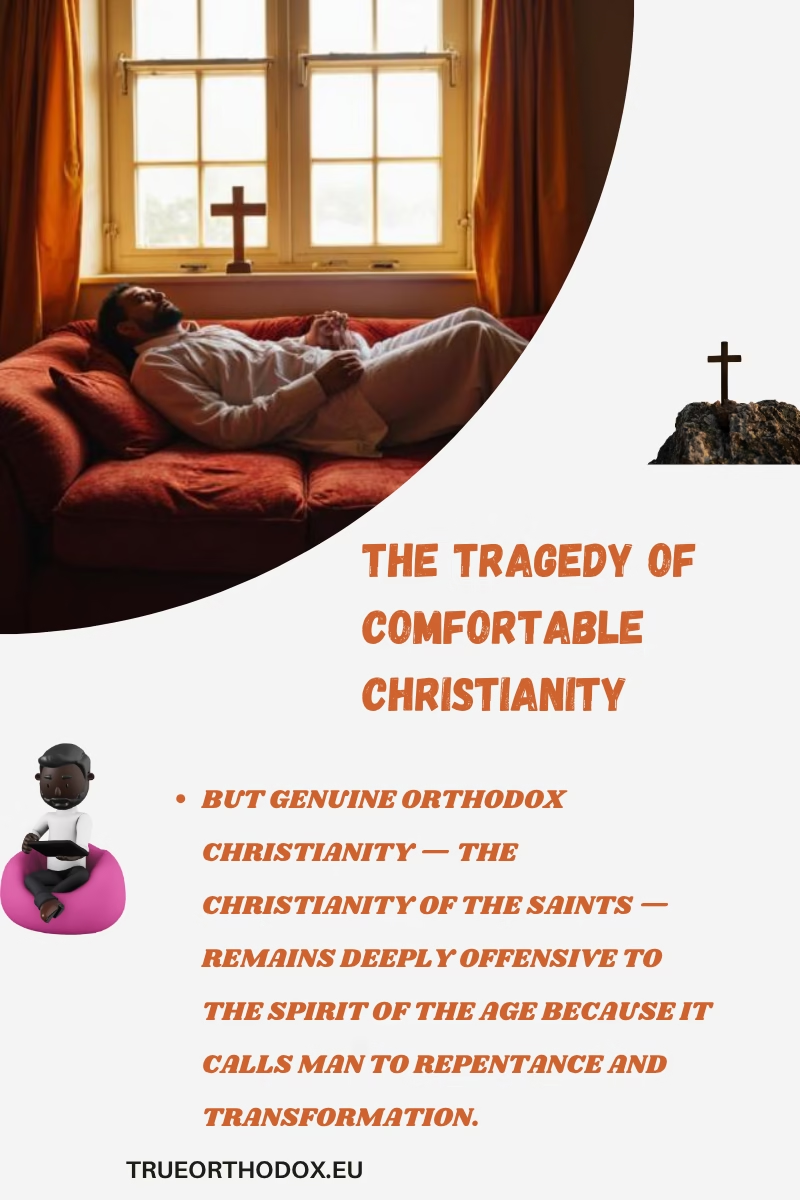
This is why the modern world tolerates so much “religion”. A “Christianity” stripped of asceticism and truth poses no threat to the kingdom of darkness. But genuine Orthodox Christianity — the Christianity of the saints — remains deeply offensive to the spirit of the age because it calls man to repentance and transformation.
The saints did not seek comfort. They sought Christ.
And because they sought Christ, they willingly accepted discomfort.
The martyrs endured torture rather than burn a pinch of incense to idols. The monastics embraced poverty and fasting to wage war against the passions. Holy hierarchs endured exile rather than compromise the Faith. Countless righteous Christians chose to suffer with Christ rather than to seek comfort without Him.
Compare this with the modern mentality which often measures spiritual life according to emotional satisfaction, convenience, or personal preference. Churches are abandoned if sermons are “too strict.” Fasting rules are ignored because they interfere with lifestyle. Ancient Christian morality is modified so that modern society will not be offended.
But truth does not change because society changes.
Christ did not promise us social acceptance. In fact, He promised the opposite:
“Ye shall be hated by all men for My Name’s sake.”
— Matthew 10:22
The tragedy of comfortable Christianity is not merely that it weakens the individual believer. It also weakens the witness of the Church before the world. When Christians become indistinguishable from the secular culture around them, the light grows dim. Salt that loses its savor cannot preserve anything.
The world does not need a Church that imitates its confusion.
It needs a Church that calls it to repentance.
It needs Christians who still believe that holiness is possible.
It needs men and women who are willing to struggle for purity, truth, humility, and salvation.
The True Orthodox Christian life is not a life of despair, but neither is it a life of ease. It is a life of joy born through struggle. The Resurrection comes only after Golgotha. The crown comes only after the Cross.
Comfortable “Christianity” teaches people to avoid suffering at all costs.
Orthodoxy teaches us how to suffer with meaning.
This is why the saints possessed an inner peace unknown to the modern world. Their peace did not come from comfort, wealth, entertainment, or self-indulgence. It came from reconciliation with God through repentance and spiritual struggle.
One tear of genuine repentance is most certainly worth more than years of superficial religiosity.
The great danger today is not only atheism.
It is “Christianity” emptied of repentance.
A “Christianity” that blesses the passions rather than crucifies them.
A “Christianity” that seeks applause from the world instead of salvation from Christ.
A “Christianity” that wears the name of Christ while fearing the very life to which Christ calls us.
May we not become Christians only in appearance!
May we not exchange the narrow path for the broad road of comfort!
And may we remember that the Faith handed down by the martyrs, confessors, ascetics, and holy Fathers was never meant to make us comfortable in this fallen world!
It was meant to make us saints.