
In a time of great spiritual confusion and dogmatic compromise, the small confessing Orthodox community in the province of Padua, Italy, came into being through the labor, sacrifice, and tireless efforts of Archimandrite Adrian and Nun Arsenia, who undertook a difficult spiritual struggle in order to find and preserve true Orthodoxy in its unaltered purity.
With patience, discernment, and steadfastness, they worked unceasingly to gather souls seeking the truth, calling the faithful to a life of Orthodox confession free from the compromises of contemporary ecumenism. Facing misunderstandings, material hardships, exhaustion, and the inevitable isolation that accompanies the confession of truth, they nevertheless continued with humility and zeal to build a community founded upon the teaching of the Holy Fathers and the canonical order of the Church.
Through their tireless labors, through services celebrated in modest conditions, and through their love for Christ and Holy Orthodoxy, this community has become a place of spiritual strengthening for many Orthodox Christians in Italy and beyond. Their work stands as a living testimony that the true unity of the Church is preserved through faithfulness to the Truth and through the unaltered preservation of the Tradition of the Saints.
The small community of faithful Christians in the province of Padua, Italy — the “little flock” (Luke 12:32) — which refuses liturgical compromise with priests and hierarchs who have betrayed the Truth of the Faith and who have been enclosed by the heresy of ecumenism, was formed as a reaction of conscience by a small number of Orthodox Christians who decided to break communion with the priests and hierarchs involved in the betrayal of the Truth of the Faith, following the canonical practice of the Holy Fathers. This community does not represent a schism, but rather a position of active confession for the preservation of the Orthodox Faith in its unaltered purity.
If we love Christ, then we must confess the truth: we must follow the example of the saints, who feared neither poverty, nor insults, nor judgments, nor even death.
The beginnings of the community date back several years in a less organized form, but they intensified especially in the year 2025, after the moment when I personally decided to wall myself off from the Russian Patriarchate and, in particular, to cease commemorating the local hierarch.
This decision of separation and cessation of commemoration, taken in the context of the year 2025, by entering under the omophorion of Bishop Philaretos, Bishop of Pallini and all Western Europe of the RTOC, marks the formation of a community bearing witness to the truth of the Faith.
This confession is carried out on canonical and spiritual foundations, in obedience to the Holy Fathers and with the blessing of Bishop Philaretos. The breaking of ties with the official structures compromised by the heresy of ecumenism was an important step toward preserving the Orthodox Faith.
The participation of Orthodox priests and hierarchs in ecumenical prayer meetings has been perceived by many faithful as a deviation from the teaching of the Holy Apostles and the Ecumenical Councils, which affirm that the Orthodox Church is the sole Guardian of the Truth.
The act of separating myself from those who preach the heresy of ecumenism accelerated the creation of the community in 2025, showing that this decision resonated with other faithful who were seeking the same direction or spiritual clarity.
The spiritual work of this community is centered on an intense ascetic life, the preservation of the Church calendar (Old Style), the rejection of liturgical innovations, and the refusal of any dogmatic compromise. Maintaining unity in Spirit and Truth is accomplished not only through opposition to ecumenism, but also through the efforts of the community to build a strong internal liturgical and spiritual life.
Emphasis is placed on the study of the writings of the Holy Fathers, a life of prayer, confession, and frequent Holy Communion with proper preparation, together with the observance of the traditions handed down by the Holy Fathers, seeing in this separation a form of confession and preservation of pure Orthodoxy for future generations.
This separation is not motivated by hatred, but by the desire to defend the holiness of the True Orthodox Church and to remain in communion with Christ and His Saints.
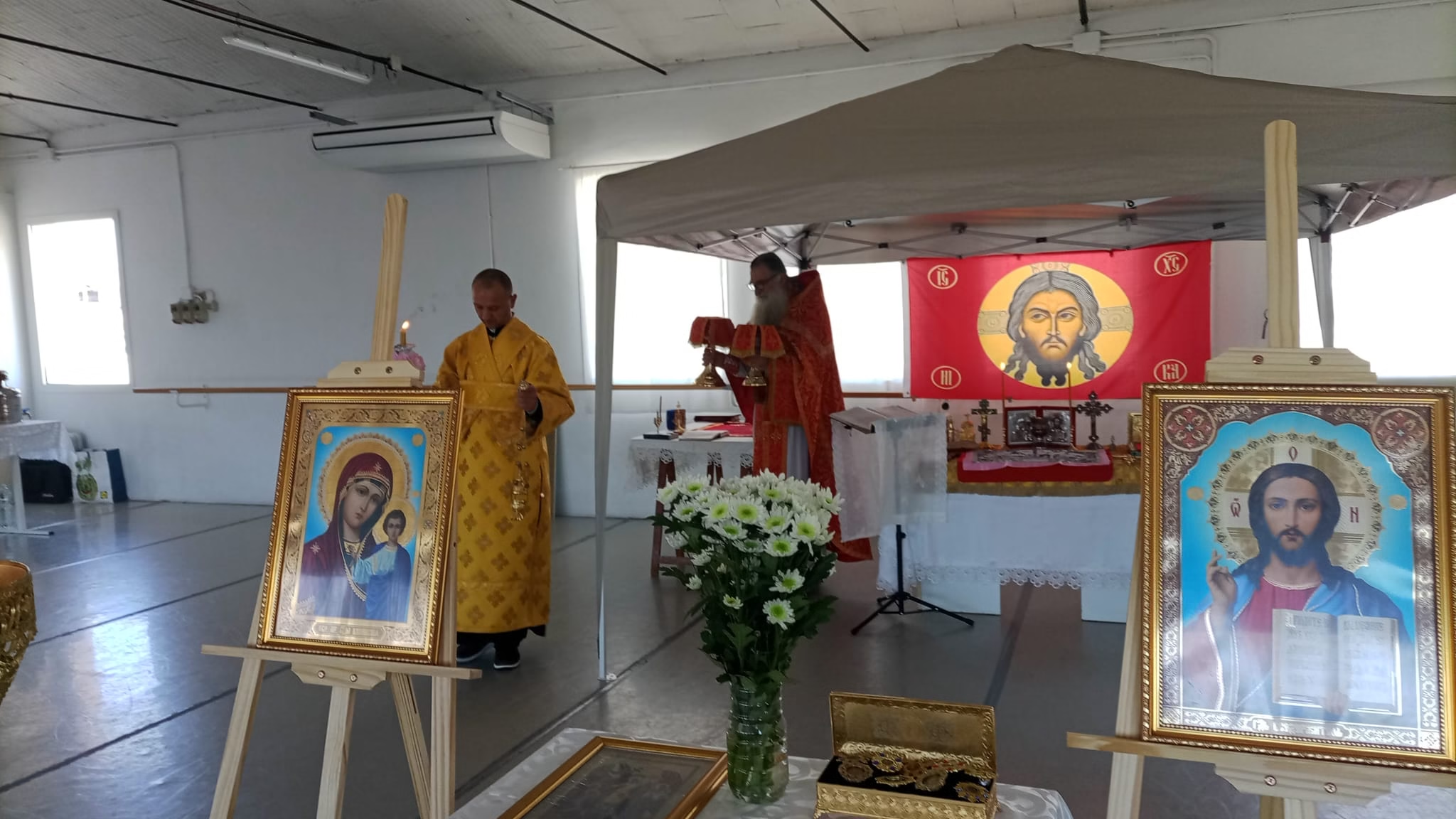
By applying this separation, our small community lost access to the official churches and is often compelled to serve in private homes or improvised spaces, where every Sunday, when we celebrate the Divine Liturgy, we first arrange the small chapel with everything necessary, perform the Blessing of the Lesser Waters, sanctify the place, and then celebrate the Divine Liturgy. At the end of the service, we gather all the items, and each person joyfully returns home.
There are Christians who come to the services from other cities besides Padua, traveling distances of 150–200 kilometers, from places such as Venice, Bologna, Brescia, Verona, and others.
In order to maintain unity and ensure continuity of liturgical life in improvised spaces, we adapt quickly and in an organized manner. We set up an altar with a clean table, the Holy Antimension, a Holy Gospel Book, a cross, vigil lamp, and candles. We use a partition to separate the altar area from the rest of the room. Members of the community bring beloved icons from their homes to create a temporary iconostasis.
We alternate between Romanian and Italian during key moments of the Liturgy (the Litanies, the Our Father).
The center of the community’s life remains the Divine Liturgy, celebrated strictly according to the traditions and dogmas of the Ecumenical Councils, without any modernizing concessions. The emphasis is on the pure confession of the Faith, rigorous catechesis, fasting, prayer, and ascetic life, regarded as essential weapons in times of spiritual confusion.
This situation represents a profound challenge for preserving the Faith and the unity of the community. When official spaces become inaccessible, organizing services in improvised locations requires adaptation, but at the same time offers an opportunity to strengthen the bonds among the members of the community.
The Christians in our community come from Romania, the Republic of Moldova, and Russia. Adapting services to improvised spaces transforms a crisis into an opportunity for strengthening the community. For the Christians in the area (Romanians, Moldovans, and Russians), preserving unity is essential. This solidarity can be cultivated through common prayer and respect for the traditions of each culture.
The organization of a private chapel under our own administration, or the identification of a traditional location that refuses ecumenical compromises, is the next challenge for the entire community.
The work of the Orthodox Christian community in Padua is a testimony of sacrifice and a preservation of the “Tradition of the Saints” in its unaltered form. For the Christian seeking spiritual edification, the history of this community is a reminder that, in the Orthodox vision, the unity of the Church is not based on administrative structures, but on unity in the Truth of the Faith handed down from the Apostles.
So may God help us!