
There is a question confronting Orthodox Christians with increasing urgency:
Can the Church change her Tradition in order to accommodate the modern world?
We hear the language everywhere: “The Church must adapt.” “We must reinterpret Tradition.” “We cannot remain trapped in the past.” “We must find new ways of expressing Christianity for modern man.”
Some of these statements may sound reasonable. After all, the Church has always spoken to people living in different cultures and circumstances.
But there is a fundamental distinction that must never be forgotten:
The Church may explain the Faith more clearly. She may apply the Faith to new circumstances. She may use new languages and address new questions. But she cannot rewrite the Faith that she has received.
For Orthodox Christians, this is not a matter of nostalgia.
It is a matter of fidelity.
What Is Holy Tradition?
Holy Tradition is not simply everything that Christians happened to do in the past.
Nor is it merely a collection of customs accumulated over the centuries.
Holy Tradition is the life of the Holy Spirit within the Church: the Faith received from Christ and the Apostles, confessed by the Fathers, guarded by the Councils, expressed in the worship of the Church, and lived in the lives of the Saints.
The Apostle commands:
“Stand fast, and hold the traditions which ye have been taught, whether by word, or our epistle.”
He does not tell the Thessalonians to preserve the traditions until a more enlightened generation comes along.
He tells them to stand fast.
And elsewhere the Apostle warns the Christians of Colossae:
“Beware lest any man spoil you through philosophy and vain deceit, after the tradition of men.”
Here we find an essential distinction.
There is Apostolic Tradition, which must be preserved.
And there are human traditions, which must be examined.
Orthodoxy does not teach that everything old is automatically holy. But neither does it permit everything handed down by the Church to be discarded whenever modern sensibilities become uncomfortable.
The question is always:
What have we received from the Church?
This point is easily forgotten.
We did not create the Gospel.
We did not invent the Divine Liturgy.
We did not compose the Nicene-Constantinopolitan Creed.
We did not establish the dogmas of the Ecumenical Councils.
We did not create the sacramental life of the Church.
We received these things.
And because we received them, we are stewards, not owners.
A steward has no authority to alter the treasure entrusted to him.
This is why the Orthodox Christian does not approach Holy Tradition as an editor approaches an old manuscript, crossing out what seems outdated and replacing it with something more suitable to the present age.
The Christian approaches Tradition with reverence.
He asks:
“What did the Church receive?”
“What did the Fathers confess?”
“What did the Saints live?”
And then:
“How can I remain faithful to it?”
The Criterion of St. Vincent of Lérins (Fell asleep in the Lord c. 445)
One of the most famous patristic descriptions of this principle comes from St. Vincent of Lérins.
He famously taught that in matters of the Universal Faith, we should hold to what has been believed “everywhere, always, and by all.”
This does not mean that every Christian in every century has understood every theological question with identical terminology.
Nor does it mean that legitimate theological development is impossible.
Rather, St. Vincent gives us a principle of continuity.
A genuine clarification of Christian doctrine must remain recognizably the same Faith.
The Church may speak more precisely without believing something different.
This distinction is crucial.
The Fathers did not invent the divinity of Christ at the First Ecumenical Council.
They defended it.
They did not create the doctrine of the Holy Trinity at Nicaea.
They confessed and clarified the Faith that had been handed down.
The Councils were not laboratories for religious innovation.
They were guardians of the Apostolic deposit.
Consider what happened when Arianism threatened the Church.
The Church did not say:
“Perhaps the divinity of Christ was appropriate for the ancient world but needs to be reconsidered for modern intellectual culture.”
She confessed:
“God of God, Light of Light, true God of true God.”
When Nestorianism threatened the confession concerning Christ, the Church did not say:
“Perhaps our Christology needs to be made more acceptable to contemporary philosophical thought.”
She defended the truth concerning the one Person of Christ.
When Iconoclasm attacked the veneration of holy icons, the Church did not surrender because icons were difficult for some people to understand.
She defended the Incarnation and the Orthodox understanding of matter, grace, and sanctification.
Again and again, the Church confronted innovation by returning to what had been received.
This is one of the defining characteristics of Orthodoxy.
The Church does not discover a new Faith every time a new controversy appears.
She returns to the Faith she has received.
St. Athanasius did not apologize for the Apostolic confession.
St. Basil did not attempt to make Orthodoxy more fashionable.
St. Gregory the Theologian did not seek approval from the intellectual fashions of his time.
St. Maximus the Confessor did not compromise the truth concerning Christ in order to achieve an easier peace.
And the holy confessors did not say:
“Perhaps the Church must change because society has changed.”
They understood something that modern Christianity frequently forgets:
The world changes. Truth does not.
The Saints could speak to their particular age precisely because they did not surrender the Faith to that age.
This becomes especially important when we consider modern ecumenism.
There is a legitimate Christian desire that those who have separated from the Church might return to the fullness of the Orthodox Faith. We should desire the salvation of every human being.
But there is a profound difference between calling those outside the Church to the truth and changing our understanding of the Church in order to make separation seem insignificant.
The first is missionary love.
The second can become theological compromise.
If Orthodox Christians begin speaking as though the divisions between Orthodoxy and heterodox confessions are merely differences between equally valid expressions of Christianity, then we have already begun to alter the ecclesiological consciousness of the Church.
The Apostles did not preach: “There are many equally legitimate forms of Christianity; choose whichever suits you.”
They preached Christ.
The Fathers did not suffer exile, persecution, imprisonment, and death because they considered dogma unimportant.
They understood that false teaching concerning God is not an academic disagreement.
It concerns salvation.
This is why the Orthodox Church has always treated heresy with seriousness.
Not because Orthodox Christians hate those who are deceived.
Precisely the opposite.
We reject falsehood because we love the person who has been deceived by it.
A physician does not demonstrate hatred for a sick person by naming his illness.
He demonstrates love by telling the truth about it.
Unity Without Truth Is Not Orthodox Unity
Modern ecumenical language often places unity above truth.
But the Church cannot be united by pretending that doctrinal differences do not matter.
Christian unity cannot be manufactured through declarations, conferences, or diplomatic language.
True unity is unity in the Truth.
Christ prayed that His disciples might be one.
But He did not establish unity by abolishing truth.
The unity of the Church is grounded in the one Faith, the one Eucharistic communion, and the one confession of the Apostolic Church.
Therefore, when someone proposes that Orthodoxy should change her dogmatic teaching in order to achieve unity with those who reject that teaching, the Orthodox Christian must ask:
What kind of unity are we seeking?
If unity requires us to surrender the Truth, then it is not the unity for which Christ prayed.
Pride has Wi-Fi.
Vanity has social media.
Greed has become globalized.
Lust is available at the touch of a screen.
But the human heart remains the human heart.
The Gospel therefore remains necessary.
Christ does not need to be modernized.
Repentance does not need to be modernized.
The Cross does not need to be modernized.
Holiness does not need to be modernized.
The world needs Christ precisely because the fundamental sickness of man has not changed.
Someone may object:
“But Orthodox theology developed.”
Yes.
But development is not the same thing as contradiction.
The Fathers developed theological terminology because heresies forced the Church to articulate more precisely what she already believed.
There is an enormous difference between saying:
“Let us explain more precisely what the Church has always believed.”
and saying:
“Let us believe something different because modern people no longer like what the Church has always taught.”
The first is faithful theology.
The second is innovation.
The Fathers did not create a new Faith.
They protected the old Faith from those who wanted to replace it.
That is why the dogmatic definitions of the Councils are so precious to Orthodox Christians.
They are not museum pieces.
They are boundaries protecting the treasure of the Faith.
The latest theological opinion is not necessarily better than the oldest.
A new interpretation is not automatically more enlightened.
A modern scholar is not necessarily wiser than an ancient Father.
And a doctrine does not become true because it has become popular.
The Church is not a fashion house.
She does not replace doctrines every season.
The Faith is not redesigned according to the preferences of each generation.
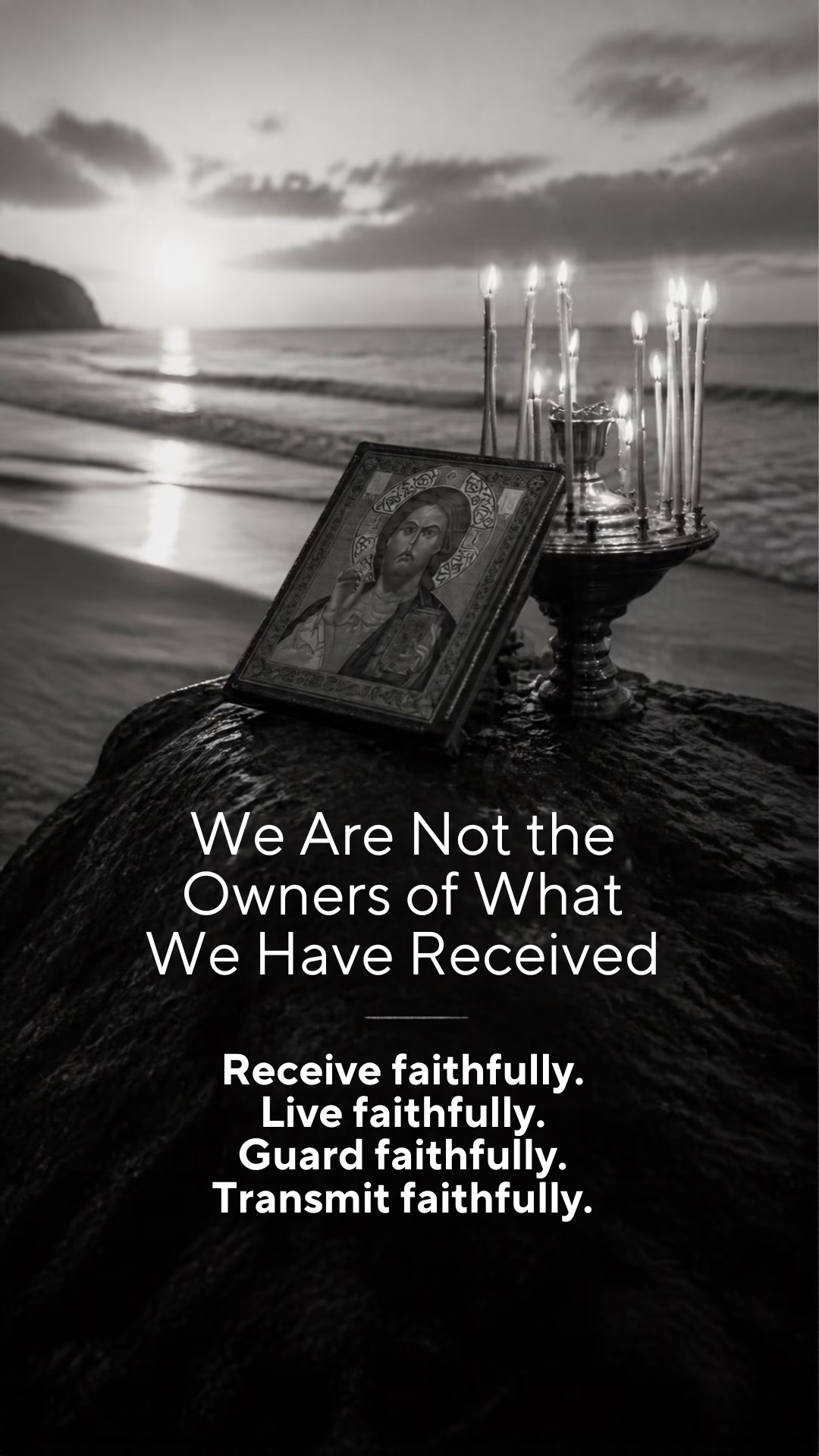
We Are Not the Owners of What We Have Received
Perhaps this is the heart of the matter.
We are living in a time when people believe that everything belongs to them.
We modify photographs.
We edit texts.
We redesign institutions.
We rewrite history.
We alter language.
We customize almost everything.
And we can begin to imagine that religion should be treated in the same way.
But the Faith is not our personal possession.
We belong to the Faith.
We belong to the Church.
We stand within something much greater than ourselves.
And one day, we will have to answer for what we did with what we received.
Did we preserve it?
Did we live it?
Did we teach it?
Did we hand it to our children?
Or did we modify it until it became indistinguishable from the spirit of the age?
Every generation is temporary.
The Church is not.
We will die.
Our children will grow old.
The political and cultural systems around us will disappear.
But the Church will continue until the end of the age.
Therefore our task is not to make Orthodoxy fashionable.
It is to remain Orthodox.
We do not need to make the Faith attractive by removing everything difficult from it.
We need to live it so faithfully that people can encounter in us something that the modern world cannot provide.
The world already has enough religion that changes with the wind.
It needs Christians who stand firm.
The Apostle’s words therefore sound especially powerful in our own time:
“Stand fast, and hold the traditions which ye have been taught.”
Stand fast.
Not because we are afraid of the future.
Not because we worship the past.
Not because every ancient custom is sacred.
But because the Faith is precious.
The Church has carried this Faith through persecution, martyrdom, exile, poverty, war, heresy, and apostasy.
Countless Christians before us suffered so that the Gospel might reach us intact.
We have no right to treat their inheritance as disposable.
We are links in a chain stretching backward to the Apostles and forward toward generations we will never meet.
Our calling is simple, though it is not easy:
Receive faithfully. Live faithfully. Guard faithfully. Transmit faithfully.
We are not the authors of the Orthodox Faith.
We are its servants.
And what has been entrusted to us by Christ through His Church is not ours to rewrite.
The world may change.
Languages may change.
Empires may rise and fall.
Ideas may come and go.
But Jesus Christ remains the same:
“yesterday, and today, and for ever.”
And therefore His Truth does not need to be rewritten.