

The difficult path of Christian faithfulness in an age that wants reassurance without repentance
We live in an age in which people speak frequently about truth, yet often become uncomfortable when truth demands something of them. We welcome words that reassure us, encourage us, and confirm what we already believe. But when truth exposes our pride, challenges our habits, or requires us to change, we may suddenly become less interested in hearing it.
This is not a new problem. It is an ancient struggle of the human heart.
From the beginning, humanity has been tempted to prefer what is pleasing over what is true. We want the blessings of God without the demands of His commandments. We want peace without sacrifice, forgiveness without repentance, and salvation without the struggle against sin.
Yet the Orthodox Christian life cannot be built upon comfort. It must be built upon truth.
Our Lord Jesus Christ declared:
“And ye shall know the truth, and the truth shall make you free.” (John 8:32)
Notice that Christ does not say that the truth will always make us comfortable. He says that it will make us free.
And freedom, in the spiritual sense, often begins with the painful recognition that we are not yet what God calls us to become.
1. The Comfort of Believing What We Want to Believe
One of the greatest obstacles to spiritual growth is our desire to hear what pleases us.
We naturally welcome those who agree with us. We appreciate those who praise our decisions and reassure us that we are doing well. We are inclined to trust voices that confirm our opinions and suspicious of those that challenge them.
But agreement is not necessarily truth, and reassurance is not necessarily love.
A person may tell us precisely what we wish to hear while leading us further into self-deception. Another may tell us something difficult that wounds our pride but ultimately helps us recognize a danger to our soul.
The difference lies not simply in whether a message is pleasant or unpleasant, but in whether it is true and whether it is offered with the proper spirit.
We must not assume that everyone who criticizes us is correct. Neither should we assume that everyone who comforts us has our spiritual welfare at heart.
The question we must learn to ask is not, “Does this agree with what I want to hear?” but, “Is this true before God?”
This question requires humility, because it allows for the possibility that our own judgment may be mistaken.
It also requires courage, because the truth may demand that we abandon an opinion, acknowledge a fault, or change a course of action that we have defended for years.
The person who sincerely seeks God must be willing to be corrected.
2. Why the Truth Hurts
Truth can be painful because it reveals the difference between what we imagine ourselves to be and what we actually are.
We may consider ourselves patient until someone repeatedly tests our patience. We may consider ourselves humble until our opinions are challenged. We may believe that we have forgiven someone until the memory of that person’s actions fills us with resentment once again.
We may even regard ourselves as defenders of the Faith while discovering that our zeal is mixed with vanity, anger, or a desire to be admired.
Such discoveries are uncomfortable.
It is easier to believe that we are already spiritually mature than to acknowledge how much healing we still need. It is easier to identify the faults of others than to examine our own hearts.
Yet this painful recognition can become the beginning of genuine repentance.
The truth does not expose our weaknesses merely to humiliate us. When received with humility, it can help us understand what must change.
Consider the words of the Publican in the Gospel:
“God, be merciful to me, a sinner.” (Luke 18:13)
The Publican did not attempt to protect his reputation before God. He did not compare himself with those whom he considered worse than himself. He stood before God in humility and acknowledged his need for mercy.
The Pharisee, by contrast, was satisfied with his own self-assessment and looked down on others.
Christ tells us that the publican went down to his house justified.
The lesson is profound: spiritual progress begins when we stop using our strengths to conceal our weaknesses and begin asking God to heal us.
3. The Difference Between Truth and Harshness
We must make an important distinction here.
To prefer truth does not mean that we should become harsh, argumentative, or eager to expose the faults of others. Nor does speaking uncomfortable truths automatically make someone courageous or faithful.
Truth must be joined to humility, discernment, and love.
A person can speak accurately about another’s faults while doing so from pride. Another can remain silent for a time, not because he fears the truth, but because he is seeking the proper moment and manner in which to speak.
Our Lord Jesus Christ was never separated from the truth, yet He knew when to rebuke, when to instruct, when to show mercy, and when to remain silent before His accusers.
We must therefore beware of confusing bluntness with spiritual courage.
Sometimes we use the language of truth as a weapon. We tell ourselves that we are merely being honest when, in reality, we are indulging our anger or seeking to wound someone who has offended us.
This is not Christian truthfulness.
The question is not simply whether our words are factually correct. We must also examine the purpose for which we speak them.
Do we seek the correction and salvation of our neighbour, or the satisfaction of proving ourselves right?
Do we speak because the truth must be defended, or because our pride cannot tolerate disagreement?
Do we want the other person to come closer to God, or do we merely want to win?
Truth does not need our vanity to defend it.
We are called to stand firmly in the truth of the Orthodox Faith, while remembering that we ourselves remain sinners in need of God’s mercy.
4. When Comfort Becomes a Spiritual Danger
Comfort is not inherently wrong. There are moments when the weary soul needs encouragement, when the grieving need consolation, and when those who have fallen need to be reminded that despair is not the answer.
The Church offers us the consolation of prayer, the Holy Mysteries, the hymns of her services, the wisdom of the Holy Fathers, and the hope of the Resurrection.
But there is a difference between the consolation that strengthens us to continue the spiritual struggle and the comfort that persuades us to abandon it.
False comfort tells us that we need not change.
False comfort tells us that our sins are unimportant because God is merciful.
False comfort assures us that we are right without requiring us to examine ourselves.
False comfort allows us to blame others indefinitely while refusing to take responsibility for our own actions.
- The mercy of God is real, but it must never become an excuse for presumption.
Christ did not come into the world merely to reassure us that everything was acceptable as it was. He came to save us from sin and death, to reconcile us with the Father, and to open the way to eternal life.
His love does not mean that our spiritual condition is irrelevant. It means that even in our fallen condition, we are not abandoned.
The same Lord who forgives the repentant sinner commands us to repent.
The same Lord who receives the lost calls us to return.
And the same Lord who promises eternal life tells us to take up our Cross and follow Him.
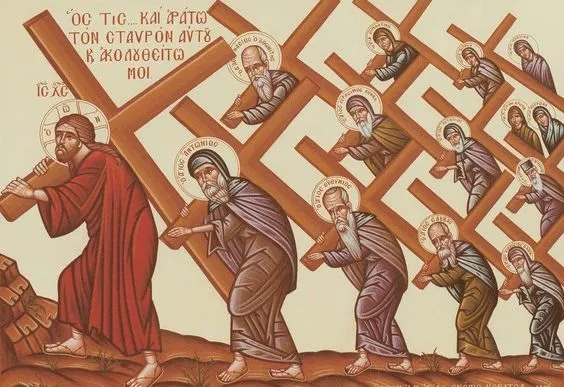
A spirituality that speaks only of comfort, while neglecting repentance, is offering an incomplete picture of the Gospel.
5. The Fear of Losing What We Have Built
Sometimes people resist the truth not because they cannot understand it, but because accepting it would require them to surrender something they value.
We may have built our identity around a particular opinion. We may have spent years defending a decision. We may have become accustomed to a certain way of life and fear what will happen if we admit that it is wrong.
To acknowledge the truth may require an apology, a change of direction, or the loss of admiration from people whose approval we have come to depend upon.
It may even require us to admit that we have misunderstood something important.
Pride whispers that such an admission would be humiliating.
But humility teaches us something different: it is better to acknowledge an error and turn towards the truth than to preserve our reputation by remaining in error.
The Christian is not called to protect his image at all costs. He is called to seek salvation.
What profit is there in appearing correct before other people if we refuse correction before God?
What value is there in winning every argument if, in doing so, we nourish anger and pride within ourselves?
What have we gained if we protect our reputation but damage our soul?
Our Lord asks: “For what is a man profited, if he shall gain the whole world, and lose his own soul?” (Matthew 16:26)
These words should cause us to examine our priorities.
The truth may sometimes cost us something in this world. But the desire to avoid every cost can itself become a spiritual bondage.
6. Christ Himself Was Rejected Because People Did Not Want the Truth
The rejection of truth is not merely a modern phenomenon.
Throughout His earthly ministry, our Lord encountered people who resisted His words, misunderstood His mission, or sought to silence Him.
His teaching challenged the pride of those who considered themselves righteous. His words exposed hypocrisy. His presence revealed the condition of human hearts.
Some received Him with faith and repentance. Others became increasingly hostile.
Christ did not alter His teaching merely to gain acceptance.
He did not abandon the truth because it was unpopular, nor did He measure the success of His mission by the number of people willing to applaud Him.
The Cross reveals the terrible consequences of a world that can prefer its own desires, power, and self-justification to the truth of God.
For the Orthodox Christian, this is a sobering lesson.
We must not assume that something is false merely because it is unpopular. Neither should we assume that something is true simply because it is popular.
Truth is not established by public approval.
Our task is to remain faithful to Christ and to the Faith delivered to the Church, even when doing so is difficult. At the same time, we must examine ourselves carefully, lest we mistake our personal preferences or prejudices for the teaching of the Church.
Faithfulness requires both conviction and humility.
7. How Can We Learn to Love the Truth?
The first step is to ask God for humility.
Without humility, we will continually seek confirmation of our own opinions. We will hear correction as an insult and disagreement as an attack.
With humility, however, we can begin to listen more carefully.
We can ask ourselves:
Am I willing to acknowledge when I am wrong?
Do I judge others more readily than I examine myself?
Do I seek the teaching of the Church even when it challenges my preferences?
Do I accept correction from those who have genuine responsibility for my spiritual guidance?
Do I use truth to help others or to exalt myself?
Am I prepared to change when I recognize that I have acted wrongly?
These are not questions to answer casually. They require prayerful self-examination.
We should also cultivate a genuine love for the Scriptures, the services of the Church, and the writings of the Holy Fathers, approaching them not merely to find support for our existing opinions but to be instructed in the life of the Church.
Above all, we must remember that the pursuit of truth is inseparable from repentance.
It is not enough to recognize the truth intellectually. We must be willing to live according to it.
We may know that we should forgive, yet continue to nourish resentment. We may know that pride is sinful, yet refuse to acknowledge our own arrogance. We may know the commandments of Christ, yet repeatedly choose what is easier.
Knowledge must lead us towards obedience.
The goal is not simply to become people who can speak about the truth. It is to become people whose lives are increasingly shaped by it.
Conclusion: The Truth That Leads to Life
Why do people prefer comfort to truth?
Because comfort can leave us undisturbed, while truth may demand repentance. Comfort can preserve our self-image, while truth reveals our weaknesses. Comfort can allow us to remain where we are, while truth calls us to follow Christ along the difficult path of salvation.
But the comfort that keeps us imprisoned in our sins is not the freedom Christ offers.
The Lord does not call us to a life of perpetual self-condemnation, nor does He ask us to despise ourselves. He calls us to repentance, which is possible because His mercy is greater than our sins.
We need not fear the truth about ourselves if we are willing to bring that truth before God.
We need not despair when our weaknesses are revealed, because the purpose of repentance is not despair but healing.
And we need not protect our pride at the expense of our salvation.
Let us therefore love the truth more than our own opinions, more than our reputation, and more than the comfort of believing that we are always right.
Let us defend the Orthodox Faith with conviction, but without arrogance. Let us receive correction with humility. Let us speak the truth with love, and let us never use the faults of others as an excuse to neglect our own repentance.
Above all, let us remember that the truth is not merely an idea to be defended. We are called to know and follow Jesus Christ, who said:
“I am the way, the truth, and the life.” (John 14:6)
The question is not whether the truth will always make us comfortable.
The question is whether we love Christ enough to follow Him when the truth requires us to change.
For the Christian, the ultimate goal is not comfort, popularity, or the preservation of our pride.
It is salvation in Christ.
A Prayer for the Love of Truth
O Lord Jesus Christ, Thou who art the Way, the Truth, and the Life, grant us the humility to recognize our errors and the courage to turn away from them.
Deliver us from pride, self-deception, and the desire to hear only those things that please us. Teach us to love Thy truth more than our own opinions, and to seek Thy will above our personal comfort.
Grant us discernment to distinguish truth from falsehood, humility to receive correction, and love to speak without hatred or vanity.
When our sins are revealed, do not permit us to fall into despair. Instead, grant us sincere repentance and the strength to amend our lives according to Thy holy commandments.
Preserve us in the true Orthodox Faith, strengthen us in every good work, and lead us along the path of salvation, that we may glorify Thee with the Father and the Holy Spirit, now and ever, and unto the ages of ages. Amen.