
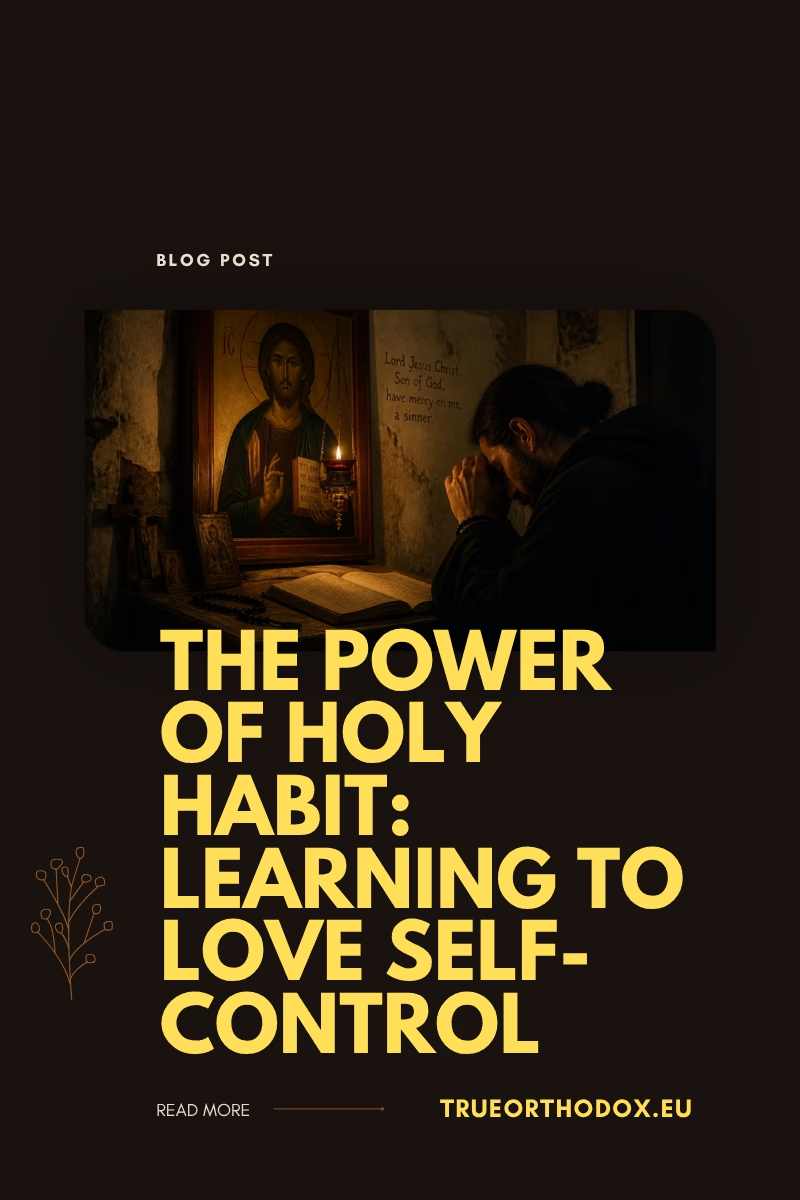

Why the Christian life becomes easier when we train ourselves in virtue
One of the greatest obstacles in the spiritual life is that we often regard virtue as a burden and sin as something natural. We imagine that self-control deprives us of happiness, that fasting is an unnecessary hardship, that prayer interrupts our daily activities, and that resisting our passions makes life less enjoyable.
Yet the Holy Fathers remind us that our perception of what is difficult or desirable can be shaped by habit. What initially seems burdensome may gradually become familiar, while what we repeatedly indulge in can become a powerful master.
A short saying attributed to Saint Asterius of Amasea expresses this truth beautifully:
“Because of your bad habit, self-control is considered an enemy, although it is not naturally burdensome. Accustom yourself to self-control, and in time it will become an agreeable companion to you.” (Saint Asterius of Amasea, Homily 14, on the Gospel account of the Rich Man and Lazarus, specifically sections 14.11.2 and 14.12.1. The text is preserved in Patrologia Graeca, volume 40)
These words invite us to reconsider our approach to the Christian life. Perhaps the difficulty we experience in practising virtue does not mean that virtue is contrary to our nature. Perhaps we have simply become accustomed to living otherwise.
The Chains We Forge Through Habit
Consider how easily a person can become accustomed to almost anything. Repeated indulgence can make a passion seem indispensable. What once troubled the conscience may eventually seem entirely normal. What we initially resisted may become something we defend.
This is one of the dangers of sin: it does not merely tempt us to commit individual wrongs; it gradually educates our desires in the wrong direction.
A person who continually gives in to anger may eventually consider anger a justified response to every inconvenience. Someone who habitually indulges in unnecessary pleasures may begin to regard any form of restraint as deprivation. Someone who neglects prayer may find even a few minutes of quiet recollection difficult to endure.
In this way, our habits shape our expectations, our desires, and even our understanding of freedom.
We may tell ourselves that we are free because we can follow our desires whenever we wish. But if we cannot resist those desires even when we know they are harming us, are we truly free?
The Orthodox spiritual tradition teaches us that freedom is not simply the ability to do whatever we want. It is also the ability to resist what enslaves us and to choose what leads us towards God.
The word self-control can sound unpleasant to modern ears. We tend to associate it with restriction, discomfort, and the denial of pleasure.
Yet Christian self-control is not an end in itself, nor is it a rejection of the goodness of God’s creation. It is the discipline by which we learn to use created things rightly, rather than becoming enslaved to them.
Fasting, for example, is not merely a matter of eating less. It teaches us that we need not obey every appetite immediately. Through fasting, prayer, and almsgiving, we learn to turn away from self-centredness and become more attentive to God and our neighbour.
Likewise, regular prayer teaches us to place communion with God above the constant distractions of daily life. Guarding our speech helps us resist the impulse to wound others. Forgiving those who offend us teaches us not to allow resentment to govern our hearts.
At first, these practices may require considerable effort. Our minds wander during prayer; fasting seems difficult; patience disappears when we are contradicted. But we should not conclude that the struggle is pointless.
A beginner in the spiritual life should not expect to possess immediately the ease and stability that come through years of faithful practice.
The saying attributed to Saint Asterius of Amasea directs our attention to a simple but important principle: we must accustom ourselves to virtue.
We do not acquire patience merely by admiring patient people. We learn patience by repeatedly restraining our anger.
We do not become prayerful merely by appreciating the beauty of prayer. We become prayerful by establishing a regular rule of prayer and returning to it even when we feel distracted or uninspired.
We do not overcome selfishness merely by condemning it. We struggle against it through concrete acts of generosity, sacrifice, and love.
The first steps may seem difficult because we are resisting an established pattern. Yet, with perseverance and God’s help, the good practice can become more familiar and more deeply rooted in our lives.
This does not mean that spiritual struggle will disappear. Even experienced Christians face temptations, weariness, and periods of dryness. Nor should we imagine that holiness can be achieved through willpower alone. The Christian life is a life of repentance, sustained by the grace of God.
Nevertheless, our repeated choices matter. Each time we turn towards what is good, we practise saying yes to God and no to the passions that would dominate us.
Begin with Small and Faithful Steps
Sometimes we make the mistake of attempting too much at once. We establish an ambitious spiritual rule, fail to maintain it, and then become discouraged.
A wiser approach is to begin with something appropriate to our circumstances and to persevere faithfully.
We might begin by setting aside a regular time for prayer, keeping the Church’s fasting days according to our circumstances and guidance, reading a short passage from Holy Scripture, or making a conscious effort to refrain from harsh words.
When we fall, we should repent and begin again rather than surrender to despair.
The goal is not to congratulate ourselves on our discipline or to judge others who struggle. The goal is to acquire humility, repentance, and love through a life of faithful obedience to Christ.
Our progress may be slow, and we may not always recognise it. But a small good practice, faithfully maintained, can become a foundation for further growth.
Ultimately, the question of habit is a question of love.
Our daily actions reveal what we are learning to desire. If we continually give our attention to distractions, we may find silence increasingly difficult. If we continually feed resentment, forgiveness may seem impossible. If we continually seek immediate satisfaction, sacrifice may seem unreasonable.
But the opposite is also true. Through prayer, repentance, fasting, and acts of mercy, we can learn to desire what is good.
The purpose of the Christian ascetic life is not to make us miserable. It is to free us from the tyranny of the passions so that we may love God and our neighbour more fully.
Let us therefore not regard every difficulty in the spiritual life as proof that we are incapable of virtue. Sometimes the difficulty is simply the beginning of a new habit—a habit of prayer instead of distraction, patience instead of anger, generosity instead of selfishness, and obedience instead of self-will.
May God grant us the perseverance to begin, the humility to repent when we fall, and the grace to persevere in what is good.
For what seems burdensome today may, through faithful practice and the help of God’s grace, become a familiar and cherished part of our lives tomorrow.
“Accustom yourself to self-control, and with time it will become unburdensome and familiar.”
Let us begin today.