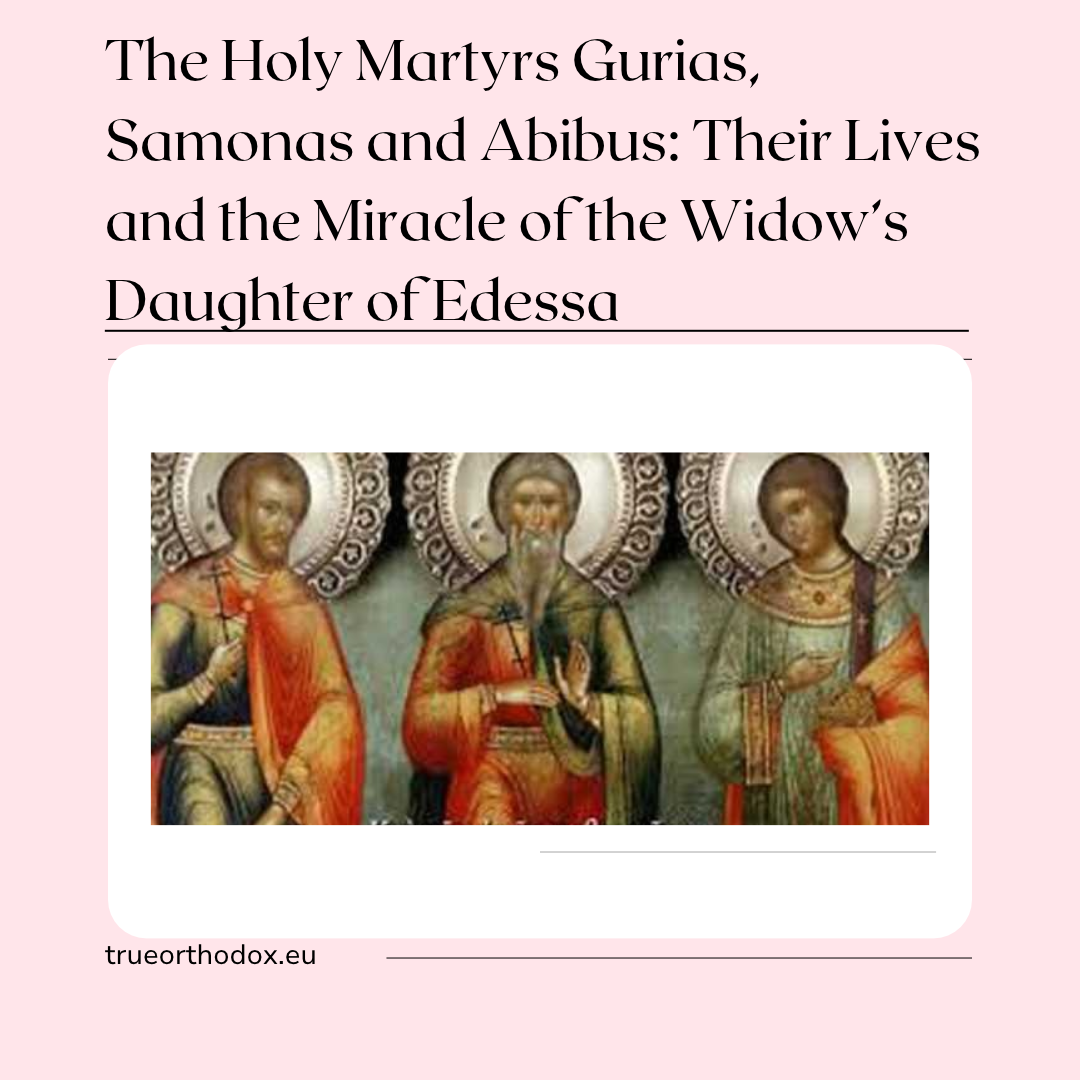

Commemorated on November 15
The Lives and Martyrdoms of the Saints
The Holy Gurias and Samonas lived during the reign of Emperor Diocletian, when the Church of Christ endured terrible persecutions. They were devout men, zealous for the true Faith, who withdrew from the vanity of the world and devoted themselves to prayer and the ascetic Christian life.
They did not limit themselves to their own spiritual struggle, however, but also instructed others in the truth of the Gospel, leading many to the knowledge of the true God.
When the governor Antoninus learned of their activities, he ordered their arrest. Because the Saints refused to offer sacrifice to the idols, they endured terrible tortures. They were suspended while bound, with stones attached to their feet, and were imprisoned for a prolonged period.
Despite the tortures, hunger and thirst, they remained steadfast in their Faith. Finally, on November 15, they were beheaded, surrendering their souls to the Lord.
Saint Abibus lived a few years later, during the reign of Emperor Licinius. He was a deacon of the Church and came from the village of Apothelsaia, near Edessa.
He was distinguished by his piety, his zeal for the Church and his love for preaching the Gospel. He boldly proclaimed the word of God, visiting the faithful and leading many pagans to the Christian Faith.
When Governor Lysanias learned of his activities, he ordered his arrest. The Saint endured terrible tortures: he was suspended and torn with iron claws because he refused to worship the idols. Finally, he was cast into the fire, where he surrendered his spirit to God.
His body, however, was found unharmed after the fire had died out. His relatives reverently received it and buried it beside the Saints Gurias and Samonas.
Thus the three Saints became one united company of holy martyrs, and the Church commemorates them together on November 15.
The Miracle of the Daughter of the Widow of Edessa
Among the many miracles attributed to the Saints Gurias, Samonas and Abibus, a particularly remarkable place belongs to the miracle of Euphemia, the daughter of a devout widow named Sophia, who lived in Edessa.
Sophia’s only consolation was her daughter Euphemia, whom she loved dearly and protected with great care.
At that time, Roman troops had arrived in Edessa. A soldier of Gothic origin was lodged in the house of the widow Sophia. When he saw Euphemia, he was captivated by her beauty and asked to take her as his wife.
Sophia hesitated because there were reports that the soldier already had a wife in his homeland. He assured her, however, that he was unmarried and that he would treat her daughter with honour and love.
The widow, not having complete confidence in his words, led him to the church of Saints Gurias, Samonas and Abibus. There, before their holy reliquary, she made him swear that he would honour Euphemia and acknowledge her as his lawful wife.
The soldier took the oath before the Saints, promising that he would remain faithful to his wife.
Euphemia departed with him for his homeland, believing that she was going towards a happy married life.
The Betrayal of the Soldier
When they arrived at his home, however, his deception was revealed. The soldier already had a wife and children. Instead of presenting Euphemia as his wife, he dressed her as a servant and handed her over to his lawful wife, who was filled with jealousy and hatred.
Euphemia endured her situation with great patience, never ceasing to invoke the Holy Martyrs, to whom her mother had entrusted her.
After some time, Euphemia gave birth to a boy. When the lawful wife saw the child, she realised that her husband had deceived her as well. Consumed by hatred, she decided to take revenge upon Euphemia and poisoned the infant.
When Euphemia returned and found the child dead, she noticed poison on his lips. Carefully, she wiped the poison away with a little wool and kept it.
During a meal, Euphemia placed the wool containing the poison into the drink of her mistress. The woman drank it and subsequently died.
The relatives of the deceased woman, unaware of the truth, accused Euphemia of being responsible for her death. They then decided to punish her in a terrible manner: she was to be buried alive in the tomb of the deceased woman.
They opened the grave and shut the unfortunate girl inside, beside the dead body of the woman.
The Miraculous Appearance of the Three Saints
Euphemia, surrounded by the darkness and horror of the tomb, called upon God with tears, as the Prophet Jonah had called from the belly of the whale. She remembered the soldier’s oath and invoked the help of the Holy Gurias, Samonas and Abibus, who had witnessed his promise.
And then the miracle took place.
The three Saints appeared before her, radiant and shining with heavenly light, and the foul stench of the tomb was replaced by a heavenly fragrance.
They told her not to be afraid, for God would deliver her. They covered her with a gentle sleep and, through their miraculous power, transported her from that distant place to Edessa.
Within a short time, Euphemia found herself beside the reliquary of the Saints, inside their church, at the hour when Matins was being celebrated.
When she awoke, she recognised the church and realised that she had been saved through the miraculous intervention of the Saints. With tears of joy, she venerated their holy relics and thanked God for her deliverance.
The priests and the faithful marvelled at what had happened. Her mother, Sophia, was summoned to the church and reunited with her daughter, whom she had believed lost forever.
Their joy and emotion were indescribable. The entire city of Edessa learned of the miracle and glorified God, Who had glorified His Saints.
The Revelation of the Truth and the Vindication of Euphemia
Several years later, the same soldier returned to Edessa with his army.
He visited Sophia’s house, believing that Euphemia had died in the tomb. Sophia, however, decided to let him reveal the truth himself.
When asked about Euphemia, the soldier boldly replied that her daughter was well and that she had given birth to and was raising his child.
Then Sophia called Euphemia and presented her before him.
The soldier was struck speechless when he saw standing alive before him the woman whom he believed had been buried alive.
The truth was revealed. Bishop Eulogius recorded the miracle and the events, and the soldier confessed his unfaithfulness and injustice.
Finally, the soldier was condemned to death for his murder and perjury.
Thus the power of the Holy Martyrs was made manifest. They had defended the innocent Euphemia and revealed the truth.
The Saints as Protectors of Marriage and Fidelity
This miracle has remained alive in the ecclesiastical tradition, and Saints Gurias, Samonas and Abibus are especially honoured as protectors of married couples, marital fidelity and all those who suffer injustice and trials in their family lives.
Their intercession reminds us that the Saints are not merely figures of the distant past, but living servants of God who continue to pray for the faithful.
The account of Euphemia is particularly moving because it reveals the importance of the oath taken before God and His Saints. The soldier had invoked the holy martyrs as witnesses to his promise, yet he betrayed both his oath and the innocent woman entrusted to him.
But the Saints did not abandon Euphemia. Through their intercession, she was delivered from an apparently hopeless situation, reunited with her mother and vindicated before those who had wronged her.
The faithful therefore invoke these three holy martyrs in times of marital difficulties, injustice, betrayal and distress, asking for their prayers and protection.
Holy Martyrs Gurias, Samonas and Abibus, intercede for us!