
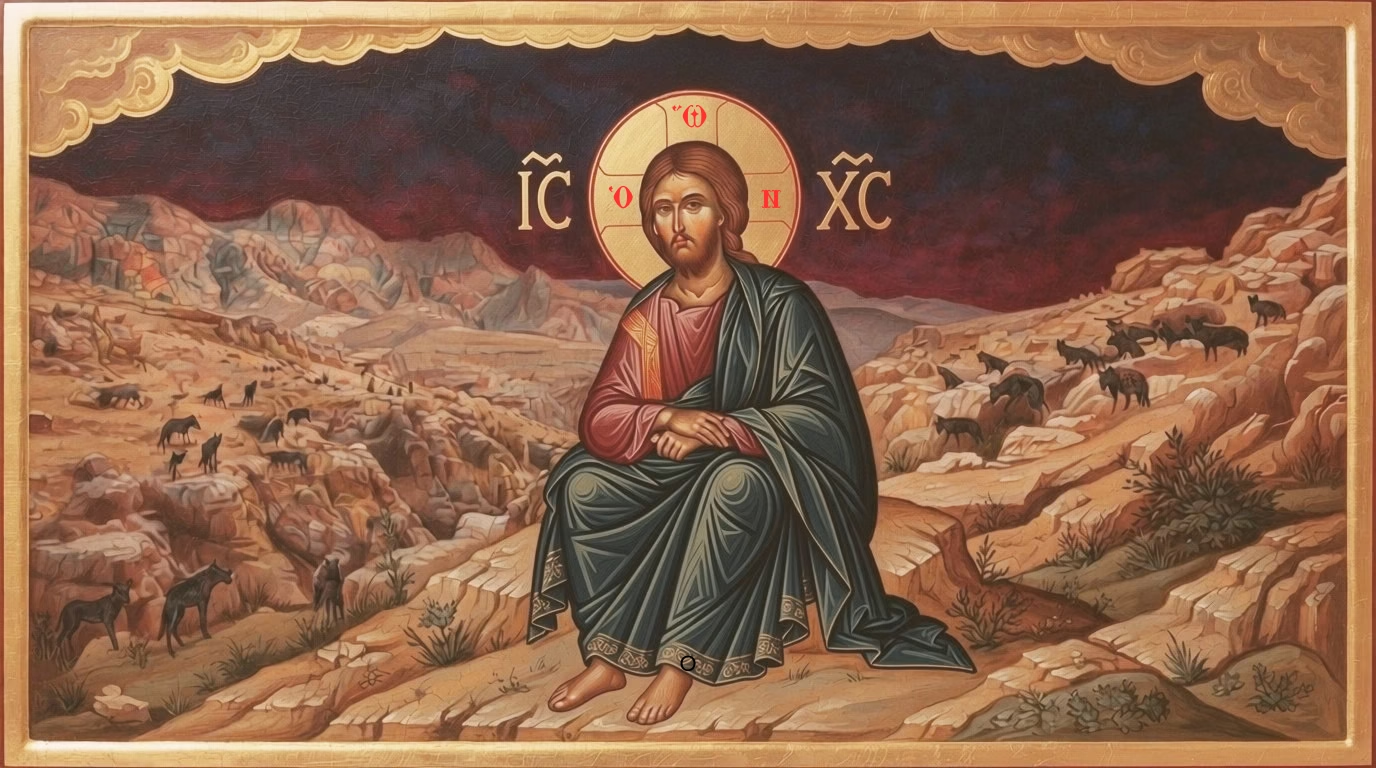

In the Gospel of Mark, Christ’s presence with wild beasts during His forty days in the wilderness highlights His role as the New Adam. Unlike the first Adam who fell in Paradise, Christ resists temptation in a hostile environment, signaling the beginning of creation’s spiritual restoration.
The wilderness also serves as a model for individual Christians experiencing personal trials and small faith communities facing isolation. These periods of hardship do not signify divine abandonment, but rather offer opportunities to demonstrate humility, spiritual discipline, and quiet perseverance through faithful devotion to Christ.
“And immediately the Spirit driveth Him into the wilderness. And He was there in the wilderness forty days, tempted of Satan; and was with the wild beasts.”
— Mark 1:12–13
There is a sentence in the Gospel that almost everyone reads past.
It is only a few words:
“And He was with the wild beasts.”
Why did St Mark include this?
At first, it seems like a small detail. Our Lord has gone into the wilderness. He is fasting for forty days. He is being tempted by Satan. The wilderness is, by its very nature, a place where wild animals might be found. Perhaps St. Mark is simply describing the surroundings.
But Scripture does not waste words.
And when we stop before this little sentence, we begin to see something much larger.
The Wilderness
Immediately after His Baptism, Christ is led by the Spirit into the wilderness.
He has just stood in the Jordan. The heavens have been opened. The Father has proclaimed:
“Thou art My beloved Son, in whom I am well pleased.”
And then comes the wilderness.
There is something important here.
The beginning of Christ’s public ministry is not a palace, a crowd, or a celebration. It is solitude, fasting, temptation, and the wilderness.
And St. Mark tells us that in this wilderness, He was with the wild beasts.
Why?
To understand this, we have to go back—not merely to the beginning of Christ’s ministry, but to the beginning of humanity itself.
Another Garden, Another Man
The first man was placed in a garden.
Christ enters the wilderness.
Adam was surrounded by the abundance of Paradise.
Christ is surrounded by the barrenness of the desert.
Adam was commanded to fast from one tree.
Christ fasts from food for forty days.
Adam was tempted by the serpent.
Christ is confronted by Satan.
Adam fell.
Christ does not fall.
The comparison is too important to overlook.
Christ has come as the New Adam.
He enters into the very territory in which the first Adam failed.
But there is one detail that St. Mark gives us that we might easily miss:
Christ is with the wild beasts.
What Happened to Creation?
The Bible begins with harmony.
God creates the world, and creation is good.
Man is placed within this creation not as a tyrant, but as its steward. Adam gives names to the animals. Humanity is given a unique place within creation, called to cultivate and guard what God has made.
But then comes sin.
And the relationship between man and creation is no longer what it was.
The ground is cursed because of man’s disobedience. Work becomes toil. Creation becomes hostile. Man, who was created to live in harmony with God, finds himself alienated from God, from his neighbor, from himself, and even from the world around him.
The wilderness becomes an image of this fallen condition.
It is not Paradise.
And into this wilderness, Christ comes.
Christ Does What Adam Could Not Do
The Gospel does not present Christ merely as a teacher who has come to give humanity better instructions.
He comes to restore humanity.
He takes upon Himself our human nature and enters into the consequences of the Fall—hunger, weariness, temptation, suffering, and ultimately death—without ever becoming a sinner.
Where Adam reached out his hand and took what God had forbidden, Christ refuses the bread offered to Him by the tempter.
Where Adam listened to the voice of the serpent, Christ answers Satan with the Word of God.
And where Adam’s paradise was lost, Christ begins the work of restoring creation.
This is why the presence of the wild beasts is so beautiful.
Christ does not need to flee from them.
He is not another fallen man trying to survive in a hostile world.
He is the Creator who has entered His creation.
The Wild Beasts
There is something almost mysterious about those words:
“He was with the wild beasts.”
St. Mark does not tell us what they did.
He does not say that they attacked Him.
He does not say that He miraculously subdued them.
He simply tells us that He was with them.
The Church has often seen in Christ the restoration of what was broken through Adam’s sin. The presence of the animals around Christ can therefore be read within this larger biblical picture: the New Adam enters a world that has been disordered by the Fall.
And He brings with Him the beginning of its restoration.
We see something similar throughout the life of Christ.
He commands the winds and the sea, and they obey Him.
He speaks to creation as its Lord.
He multiplies bread.
He walks upon the waters.
He causes the fish to gather in the nets.
At His death, the sun is darkened, and the earth shakes.
At His Resurrection, creation itself witnesses the defeat of death.
The Gospel is not about escaping creation.
It is about the transfiguration and restoration of creation through Christ.
The Christian Does Not Need to Fear the Wilderness
We often imagine that the presence of temptation means that something has gone terribly wrong.
But look at Christ.
He was led by the Spirit into the wilderness.
He was tempted.
He was hungry.
He was surrounded by wild beasts.
The presence of temptation is not itself sin.
The presence of a thought is not consent to that thought.
The presence of struggle is not necessarily failure.
What matters is what we do with the struggle.
Christ shows us the way.
He remains faithful.
He remains obedient.
He remains rooted in the Word of God.
And He does not make peace with Satan.
The New Adam in the Wilderness
Perhaps this is why those five words deserve our attention.
“And He was with the wild beasts.”
They are not merely a geographical detail.
They belong to the great biblical story of creation, fall, and restoration.
The first Adam lived in Paradise and fell.
The New Adam enters the wilderness and triumphs.
The first Adam was surrounded by the abundance of creation and reached for what God had forbidden.
The first Adam listened to the serpent.
Christ silences the tempter with the Word.
And so Christ begins His ministry not by avoiding the consequences of Adam’s fall, but by entering into the wilderness where fallen humanity finds itself.
He goes where we are.
And He begins to restore what we have lost.
When You Find Yourself in the Wilderness
There will be times when your own life feels like a wilderness.
Perhaps prayer seems dry.
Perhaps you are carrying a temptation that refuses to disappear.
Perhaps you feel alone.
Perhaps circumstances have stripped away the comforts upon which you depended.
Do not immediately conclude that God has forgotten you.
Remember the Gospel.
Christ was in the wilderness.
And St Mark tells us something else:
He was with the wild beasts.
The wilderness did not place Him outside the Father’s will.
The temptation did not defeat Him.
The solitude did not separate Him from the Father.
And the wild beasts did not have the final word.
The wilderness was not the end of His journey.
It was the beginning of His ministry.
For the Christian, the wilderness can likewise become a place of encounter—not because the wilderness itself is holy, but because Christ is there.
And wherever Christ is, even the wilderness is no longer without hope.
The New Adam has entered the wilderness.
And He has begun to lead humanity home.
The Wilderness Is Not the Destination
There is one more thing we should notice.
Christ does not remain in the wilderness forever.
After the forty days, He comes out of the wilderness and begins to proclaim:
“The time is fulfilled, and the kingdom of God is at hand: repent ye, and believe the gospel.”
The wilderness has prepared Him for His ministry.
And eventually, His path will lead to another mountain, another garden, another night of prayer, and finally to the Cross.
And beyond the Cross comes the Resurrection.
This is the pattern of the Christian life.
There may be wilderness.
There may be struggle.
There may be repentance.
There may be tears.
But death does not have the final word.
Christ has entered the deepest wilderness of the human condition—even death itself—and He has come out victorious.
So when you find yourself in your own wilderness, do not ask only, “How can I get out of this?”
Ask also:
“Where is Christ asking me to meet Him here?”
Perhaps the wilderness is revealing a sin that needs repentance.
Perhaps it is teaching you patience.
Perhaps it is stripping away an attachment that has quietly taken God’s place.
Perhaps it is teaching you to pray without relying upon feelings.
Perhaps it is showing you that you cannot save yourself.
And perhaps, in the silence, you are beginning to discover something that comfort had hidden from you:
You need God.
That realization is not defeat.
It is the beginning of repentance.
The Church in the Wilderness
There is also another way in which these words of the Gospel speak to us.
There have been periods in the history of the Church when the faithful were fewer.
There have been times when churches were closed, monasteries emptied, priests persecuted, bishops exiled, and Christians forced to worship in secret.
The Church has known catacombs.
She has known deserts.
She has known the wilderness.
And perhaps we should not be surprised when faithful Christians find themselves there again.
The True Orthodox Christian can sometimes experience something of this wilderness personally.
There may be little recognition from the world.
There may be misunderstanding even among other Orthodox Christians.
There may be no impressive buildings, no large crowds, no influence, and no worldly prestige.
There may simply be a small church, a priest, a handful of faithful people, and the struggle to preserve the Faith that was handed down to us.
From the perspective of the world, this can look like weakness.
But the Gospel gives us a different measure.
Christ Himself entered the wilderness.
He did not begin His earthly ministry surrounded by worldly power.
He did not seek the approval of the multitude.
He went into the wilderness.
And there He fasted.
There He prayed.
There He was tempted.
There He was with the wild beasts.
The wilderness, therefore, is not necessarily a sign that God has abandoned His people.
Sometimes it is precisely the place where faithfulness becomes visible.
When Being Faithful Means Being Small
We live in an age in which numbers can easily become our measure of success.
A large congregation appears successful.
A famous church appears important.
A powerful institution appears secure.
But the Gospel never teaches us to measure the truth by numbers.
Our Lord Himself says:
“Fear not the little flock; for it is your Father’s good pleasure to give you the kingdom.”
— Luke 12:32
Little flock.
Those words should be precious to Christians who find themselves in the wilderness.
The Church does not become the Church because she is numerous.
The truth does not become true because many people accept it.
And the Faith does not become more faithful because it possesses worldly influence.
The question is much simpler and much more demanding:
Have we remained faithful to Christ?
The wilderness therefore requires something that comfort does not always require:
faithfulness without applause.
To continue praying when no one notices.
To preserve the services when the congregation is small.
To teach the Faith to children when the world teaches them something else.
To keep the fast when nobody praises you for it.
To repent when pride tells you that you have nothing to repent of.
To forgive.
To endure misunderstanding.
To remain in the Church.
To keep Christ at the center.
This is not glorious in the eyes of the world.
But neither was the Cross.
Do Not Romanticize the Wilderness
Yet there is a danger here.
We should not become proud of being in the wilderness.
The wilderness is not an excuse for bitterness, anger, contempt, or spiritual pride.
It is possible to suffer for the Faith and still lose the spirit of Christ.
It is possible to defend Orthodoxy with our lips while denying its spirit through our conduct.
If the wilderness teaches us anything, it should teach us humility.
The more isolated we become, the more carefully we must guard our hearts.
The smaller the flock becomes, the more deeply we must love one another.
The more misunderstood we are, the more necessary it becomes to speak the truth without hatred.
For Christ did not enter the wilderness in order to become hardened.
He entered it in order to remain perfectly obedient to the Father.
That must also be our purpose.
The Wilderness and the Promise
Perhaps, then, these words of St Mark have something to say not only to an individual Christian, but also to a small and struggling Orthodox community.
“And He was with the wild beasts.”
The wilderness is a lonely place.
But Christ was there.
And if we find ourselves in a wilderness today—whether personally or as a small Orthodox flock—we should not measure God’s presence by our numbers, our buildings, our recognition, or our worldly circumstances.
We should measure it by our faithfulness to Christ.
The wilderness is not our glory.
Christ is our glory.
The smallness of the flock is not our boast.
The Cross is our boast.
And our hope is not that the wilderness will suddenly become comfortable.
Our hope is that, wherever Christ leads us, He will not leave us.
For the One who entered the wilderness before us is the same One who said:
“Lo, I am with you always, even unto the end of the world.”
And therefore, even in the wilderness, we are not abandoned.
The Church has been in the wilderness before.
The saints have been there.
The martyrs have been there.
And Christ Himself has been there.
“And He was with the wild beasts.”
That may be a small sentence in the Gospel.
But for the Christian who finds himself standing in a wilderness, it can become a great consolation:
Where Christ is, the wilderness is never empty.