
A reflection for the Feast of the Elevation of the Holy and Life-Giving Cross
There is something profoundly prodigious about the Cross.
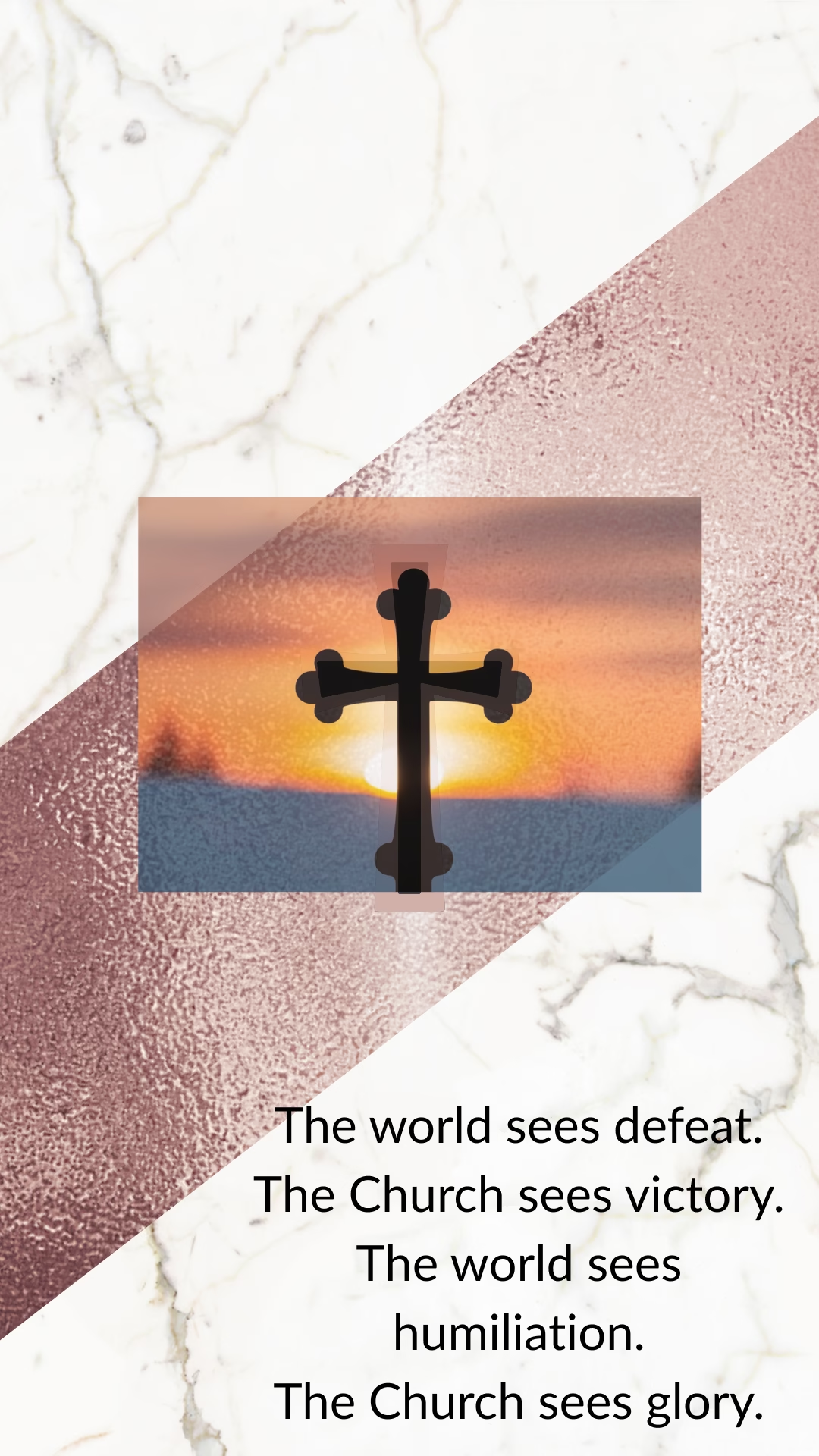
The world sees an instrument of death.
The Church sees the source of life.
The world sees defeat.
The Church sees victory.
The world sees humiliation.
The Church sees glory.
On the Feast of the Elevation of the Holy and Life-Giving Cross, the Church places the Cross before us and calls us to bow down before it—not as before a mere symbol, but as before the mystery of our salvation.
The Apostle Paul tells us:
“The word of the Cross is foolishness to those who are perishing, but to us who are being saved it is the power of God.”
— 1 Corinthians 1:18
This is the great paradox of Christianity: the instrument of Christ’s death became the instrument of our life.
The Cross Was Not Christ’s Defeat
To the eyes of the world, Christ’s Crucifixion appeared to be the end.
He had been betrayed.
He had been abandoned.
He had been mocked.
He had been beaten.
He had been nailed to the Cross.
But the Church sees something deeper.
Christ did not lose on the Cross.
He conquered through the Cross.
The Cross became the place where death itself was confronted. The One who is Life entered into death, and by His death destroyed death.
This is why the Orthodox Church does not hide the Cross. We do not soften it or remove it from our churches because it is difficult to look upon. We place it before our eyes precisely because it tells us the truth about Christ—and the truth about our own salvation.
There is no Resurrection without the Cross.
The Cross Is Not Only Something We Look At
It is easy to venerate the Cross in church.
We bow before it.
We kiss it.
We make the sign of the Cross upon ourselves.
But the Christian is also called to carry the Cross.
Christ Himself says:
“If anyone desires to come after Me, let him deny himself, and take up his cross, and follow Me.”
Our personal cross may take many forms.
It may be illness.
It may be loneliness.
It may be an injustice we cannot correct.
It may be the burden of caring for another person.
It may be the struggle against a particular passion.
It may be forgiving someone who has wounded us.
It may simply be the daily struggle to remain faithful to Christ when we are tired, discouraged, or spiritually dry.
The Cross does not always look dramatic.
Sometimes it is simply remaining faithful when faithfulness is difficult.
Sometimes it is continuing to pray when we feel nothing.
Sometimes it is refusing to answer hatred with hatred.
Sometimes it is saying, “Thy will be done,” when everything within us wants to say, “My will be done.”
That too is the Cross.
Do Not Carry Your Cross Alone
There is, however, one very important distinction.
Christianity does not teach us to worship suffering.
We do not seek suffering for its own sake. We do not imagine that pain itself makes us holy.
What makes the Cross life-giving is Christ.
The Christian does not carry his cross alone.
Christ has already gone before us.
He knows what it means to be rejected, betrayed, misunderstood, abandoned, mocked, wounded, and crucified. Therefore, when we find ourselves in suffering, we are not entering a place where Christ has never been.
He is there before us.
This is one of the deepest consolations of the Cross.
The Shape of the Christian Life
Even the shape of the Cross teaches us something.
Its vertical line points upward toward God.
Its horizontal line reaches outward toward our fellow man.
The Christian life requires both.
We cannot claim to love God while refusing to love our brother.
And neither can we understand true Christian love merely as human kindness separated from God. The love revealed on the Cross is sacrificial love—love that gives itself.
The Cross therefore calls us both upward and outward:
toward God in prayer,
and toward our neighbor in love.
This is why the Cross stands at the center of Orthodox Christian life.
We make its sign when we pray.
We see it in our churches.
We place it in our homes.
We wear it upon our bodies.
We place it over the graves of our departed.
And every time we make the sign of the Cross, we are confessing something immense:
Our hope is not in the power of this world. Our hope is in the Crucified and Risen Christ.
When Your Own Cross Becomes Heavy
Perhaps someone reading this is carrying a cross today that nobody else can see.
Perhaps you are tired.
Perhaps you have prayed for something for years, and nothing seems to change.
Perhaps you have been treated unjustly.
Perhaps you are struggling against a sin or passion that seems stronger than you.
Perhaps you are carrying grief.
Perhaps you are simply wondering how you will continue.
Do not imagine that the weight of your cross means that God has forgotten you.
Look again at the Cross of Christ.
And therefore we do not say that every suffering is good. We say something deeper:
No suffering is beyond the reach of Christ.
The Cross leads to the Resurrection.
Death does not have the final word.
Darkness does not have the final word.
Suffering does not have the final word.
Christ has the final word.
Let Us Venerate the Cross
On this Feast of the Elevation of the Holy and Life-Giving Cross, let us not merely look upon the Cross.
Let us examine our lives beneath its shadow.
Where do I need greater patience?
Whom do I need to forgive?
Where have I chosen my own will instead of God’s?
Where have I abandoned prayer because it became difficult?
What cross has God permitted me to carry—and am I carrying it with Christ, or am I carrying it alone?
The Cross calls us to repentance, but it also gives us hope.
For the Cross we venerate is not separated from the empty tomb.
The One who died is the One who conquered death.
And therefore, as Orthodox Christians, we proclaim with confidence:
“We venerate Thy Cross, O Master, and we glorify Thy Holy Resurrection.”
The Cross is not the end.
The Cross is the road to Resurrection.
Я Вам очень благодарна за статью . Очень интересно.