
By Archimandrite Adrian of the Diocese of Western Europe
A teaching from the Life of the Holy Martyrs Epictetus the Priest and Astion the Monk:
“(…) The devil, seeing himself put to shame not only by the elder but also by the young Astion, was deprived of the profit he had gained from human souls and was torn with envy. Therefore, he armed himself against them with all his cunning devices, yet he accomplished nothing. Then the devil prepared a favorable opportunity against the young man in the following manner. One day Astion went out to the river to draw water without the blessing of the elder. Seeing that he was no longer protected by the elder’s blessing, the enemy immediately—by God’s permission—rushed upon him with impure thoughts and troubled the soul of the young monk. Returning to his cell, Astion was ashamed to confess to his spiritual father those thoughts by which he had been overcome. For three days he struggled against them, fasting and praying with tears. He wearied his body with ascetic labors, yet the impure thoughts would by no means depart from him, and through them the enemy wounded him like invisible arrows.
Seeing his disciple disturbed and sorrowful, the elder said to him: ‘What is this, my son? I see that you are troubled. This sorrow that I see in you is not the sorrow of the saints who labor for their salvation, but rather it reveals spiritual despondency. I believe that your sorrow is a deadly grief, like the grief that destroyed Ahithophel, the counselor of Absalom, and the grief that brought Judas, the betrayer of Christ, to ruin.’
Then Astion began to confess, saying: ‘Father, three days ago you were speaking with certain honorable men about the heavenly mysteries, and I needed to go and fetch water. I was ashamed to ask your blessing in front of those men because I did not wish to interrupt your conversation. So, without your knowledge, I went to the river without your blessing. But on the way a dark cloud of impure thoughts suddenly came upon me. Now three days have passed during which I have struggled against them, yet I cannot drive them away, and because of this I am deeply afflicted.’
The holy elder looked at him with awe and said: ‘Why did you leave the door of your cell without my command? Why did you go to the river without the blessing of Christ’s priest? Do you not know that the blessing of one’s superior is an impregnable wall for the younger, a mighty sword and an invincible weapon against the devil?’ Saying this, he commanded him to lie on the ground in prayer in the form of the Holy Cross, and the elder himself also lay down. Thus they both prayed together to God. After rising from the ground following long prayer, the blessed Astion saw a dark child carrying a burning candle fleeing from him, saying: ‘Your confession, Astion, has shattered my great powers today, and your prayer has left me without weapons.'”
“Do you not know that the blessing of one’s superior is an impregnable wall for the younger, a mighty sword and an invincible weapon against the devil?” (Holy Martyr Epictetus)
At a time when more and more people guide their lives solely according to their own judgment, and obedience is regarded as a weakness, the life of the Holy Martyrs Epictetus the Priest and Astion the Monk reveals to us one of the greatest mysteries of the spiritual life: the power of blessing and obedience in the Church of Christ.
Saint Astion did not fall because he had committed some grave sin. He simply went out to fetch water—but he went without the blessing of his spiritual father.
That seemingly insignificant act of disobedience was enough for the enemy to find an opening for attack.
After three days of struggling with impure thoughts, Saint Epictetus said to him:
“Do you not know that the blessing of one’s superior is an impregnable wall for the younger, a mighty sword and an invincible weapon against the devil?”
This saying concerns not only monastic life, but the entire order of the Church.
BLESSING IS NOT MERELY A GEST!
Many people believe that a blessing is simply a gesture made with the hand or a courteous expression.
In reality, a blessing is the invocation of God’s grace upon the person who desires to live not according to his own will, but according to the will of Christ.
When a Christian says:
“Father, bless!”
he confesses that he does not wish to be guided solely by his own judgment, but seeks the will of God through the minister of the Church.
Such humility draws down the grace of God.
THE CHAIN OF BLESSING IN THE CHURCH
But here we must understand a mystery that many people forget.
Just as the faithful receive a blessing from the priest, so too must the priest minister under the blessing of his bishop.
This is the order established by the Holy Apostles and preserved by the Orthodox Church for nearly two thousand years.
A priest is not an independent minister.
He does not assume for himself the authority to preach, to baptize, to hear confessions, or to celebrate the Divine Liturgy.
He receives this ministry through Holy Ordination, and he exercises it in obedience to his bishop.
Yet the bishop himself is not the master of the truth.
He, too, is bound to preserve the Apostolic Faith undefiled and to proclaim the word of truth rightly.
The Holy Apostle Paul exhorts Timothy:
“Be diligent to present yourself approved to God, a worker who does not need to be ashamed, rightly dividing the word of truth.”
(II Timothy 2:15)
For this reason, in the Orthodox Church there is no obedience separated from the truth.
There is obedience in the truth.
OBEDIENCE IS NOT BLIND!
Sometimes people say:
“We must obey without asking questions.”
The Holy Fathers never taught such a thing.
They taught that obedience must always remain within the limits of the truth revealed by Christ.
The Holy Apostle Paul says plainly:
“But even if we, or an angel from heaven, preach any other gospel to you than what we have preached to you, let him be accursed.”
(Galatians 1:8)
Therefore, every Christian is bound to seek the blessing of an Orthodox priest who rightly confesses the true faith.
The priest, in turn, is bound to remain in obedience to his bishop.
And the bishop is bound to preserve intact the Orthodox Faith handed down by the Holy Apostles, proclaimed by the Ecumenical Councils, and safeguarded by the Holy Fathers.
Only in this way does the chain of blessing remain unbroken.
If the truth is abandoned, obedience can no longer be invoked as a justification for error.
THE DANGER OF SELF-WILL
The devil does not begin with great sins.
He begins by convincing a person that he has no need of counsel.
“Decide for yourself.”
“Do not ask anyone.”
“You know better.”
This is the root of self-will.
Astion learned through experience that the absence of a blessing opens the door to temptation.
We, too, should learn not to make important decisions without prayer, without a blessing, and without spiritual counsel.
THE CONFESSION THAT SHATTERS THE ENEMY’S POWER
His own strength did not deliver Saint Astion.
He was delivered when he revealed his thoughts and prayed together with his spiritual father.
Then the demon himself confessed:
“Your confession, Astion, has shattered my great powers today, and your prayer has left me without weapons.”
This is the power of life within the Church: humility, confession, and prayer in communion with those whom God has appointed to shepherd His flock.
A LESSON FOR EVERY ORTHODOX FAMILY!
How often do we make important decisions without seeking counsel?
We change jobs. We move to another city. We start a business. We begin a relationship. We make investments. We become involved in various projects. And only after difficulties arise do we begin to ask ourselves where we went wrong.
This does not mean that every step in life must be taken only after asking a priest. However, when it comes to important decisions that affect our lives and the lives of our families, it is wise to seek the blessing and counsel of an Orthodox spiritual father who preserves the true Faith.
Not because the priest replaces our freedom or our personal responsibility, but because God blesses the humility of the one who seeks enlightenment and does not rely exclusively upon his own judgment.
CONCLUSION
The life of Saint Astion teaches us that a blessing is not a mere formality, but a work of divine grace.
It is a shield for the faithful, a source of strength for the priest, and a responsibility for the bishop.
Yet this blessing is effective only when each person remains in the place appointed by God and preserves the Orthodox Faith in its purity.
The faithful remain in obedience to the priest.
The priest remains in obedience to the bishop.
The bishop remains in obedience to Christ and to the teaching of the Holy Apostles and the Holy Fathers.
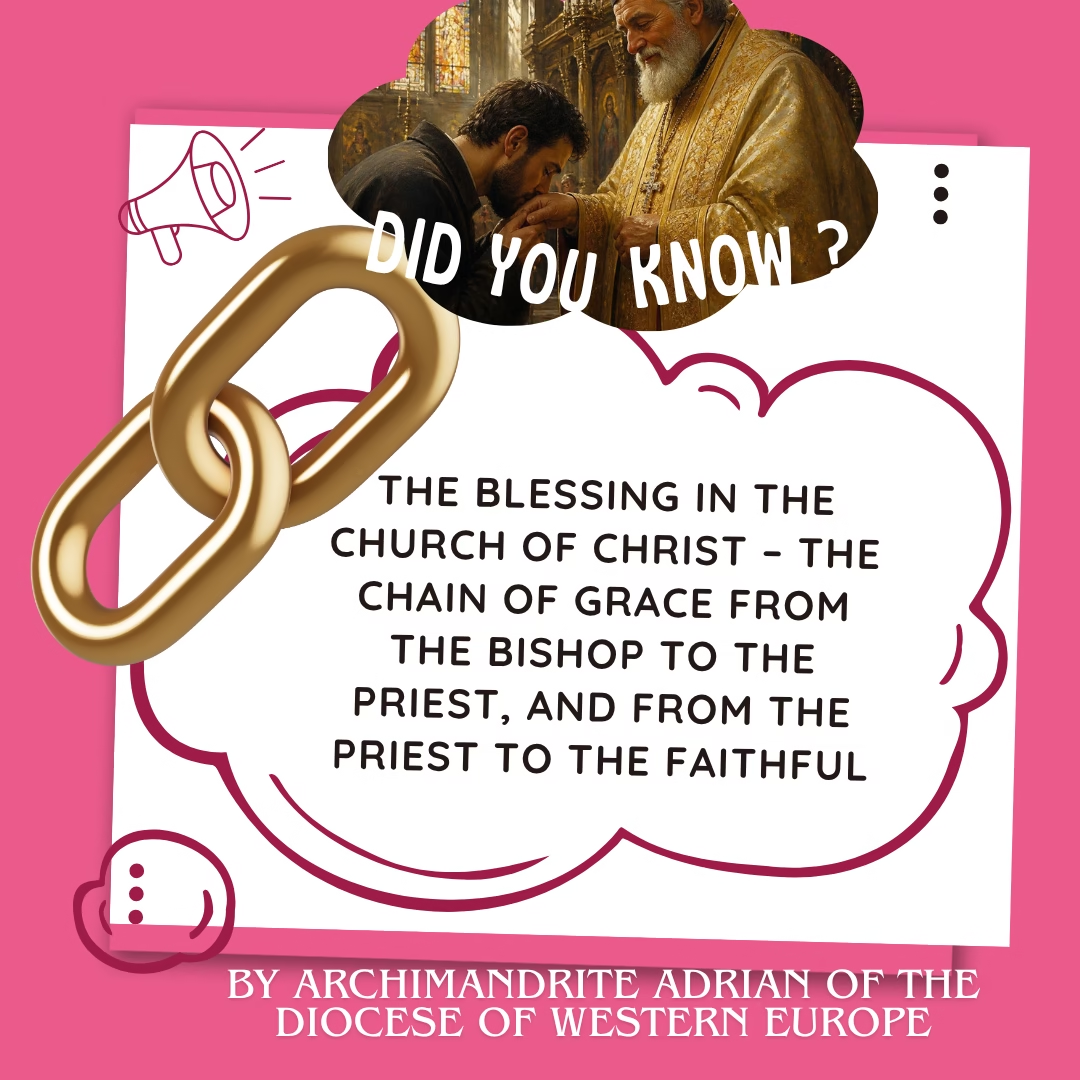
This is the holy chain of grace within the Church.
When this chain remains united through truth and love, the words of Saint Epictetus are fulfilled:
“Do you not know that the blessing of one’s superior is an impregnable wall for the younger, a mighty sword and an invincible weapon against the devil?”