
What Happens to the Human Soul When It Turns Away from God
The teaching of the ancient Fathers on the spiritual consequences of separation from God
There is a short but extraordinarily profound saying found in the writings of the Holy Fathers:
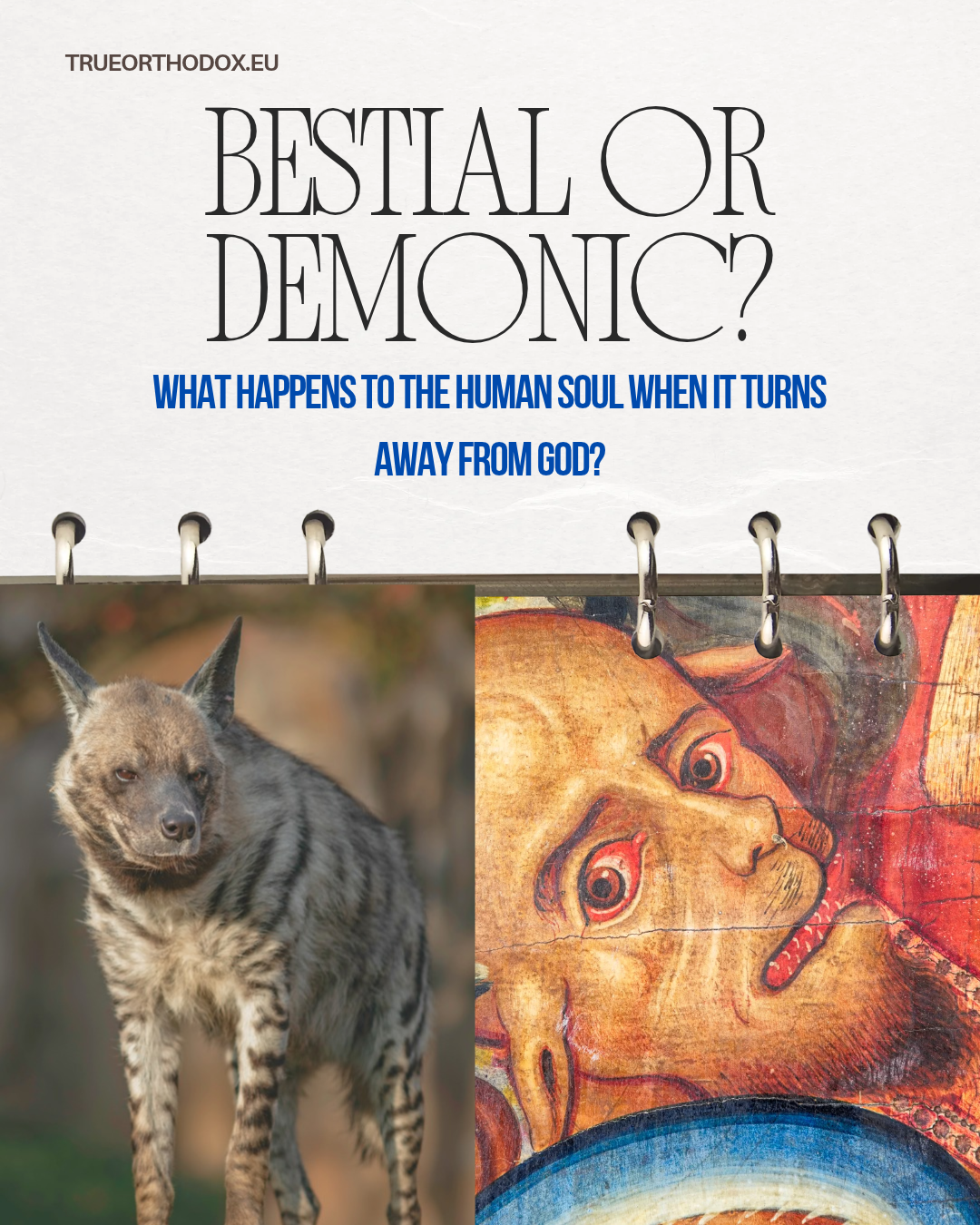
“The nous, having departed from God, becomes either bestial or demonic.”
These words, associated with Saint Gregory Palamas, express a fundamental truth of Orthodox spiritual anthropology: man was created for communion with God, and when his spiritual faculty turns away from its Creator, it does not remain in a neutral condition. It becomes corrupted, taking one of two destructive directions.
The origins of this teaching can be traced to an earlier account preserved by Palladius of Helenopolis in his Lausiac History, where he records the words of an Egyptian ascetic named Diocles.
This earlier account is particularly valuable because it does not merely state the principle but also explains precisely what is meant by the two conditions.
The Ancient Teaching of Diocles
In Chapter LVIII, section 3, of the Lausiac History, Palladius recounts his encounter with Diocles, an educated, learned ascetic who abandoned worldly philosophical studies and devoted himself to Christ.
Diocles expressed the following teaching:
“Intelligence which is separated from the thought of God becomes either a demon or a brute beast.”
When Palladius and his companions asked him to explain what he meant, Diocles continued:
“Intelligence separated from the thought of God inevitably falls into concupiscence or anger.”
He then made the distinction unmistakably clear:
Concupiscence is beast-like, while anger is demonical.
Palladius further asked how the human mind could remain continually with God. Diocles answered with another important observation:
“Whenever the soul is engaged in a thought or action that is pious and godly, then it is with God.”
Here we encounter a remarkable understanding of the spiritual life. Communion with God is not restricted to moments of formal prayer. The soul can be with God through every thought and action directed towards piety and godliness.
This teaching provides the foundation for understanding the profound warning contained in the saying.
What Do the Fathers Mean by the Nous?
The Greek word nous is frequently translated into English as mind or intellect. However, its meaning in Orthodox patristic theology is considerably deeper than our ordinary understanding of the intellectual faculty.
The nous is traditionally understood as the eye of the soul, the innermost spiritual faculty through which man is capable of knowing and communing with God.
It must be distinguished from the rational faculty, which enables us to analyse, reason, calculate and acquire intellectual knowledge.
A person may possess extraordinary intellectual abilities, extensive education and considerable worldly wisdom while remaining spiritually blind.
Indeed, intellectual achievement does not necessarily indicate spiritual enlightenment.
The nous was created to be directed towards God. Its natural and proper condition is communion with its Creator. When it turns away from Him, it loses its proper orientation and becomes subject to the passions.
This is the tragedy described by the Eldeer Diocles.
The First Condition: The Bestial Nous
The first consequence of the separation of the nous from God is described as bestial.
Diocles identifies its characteristic passion as concupiscence: the disordered desire that enslaves the human being to the satisfaction of bodily passions.
Man was created with a body, and the Orthodox Church does not regard the body or its natural functions as evil. The body is part of God’s good creation and is destined for resurrection and eternal life.
The problem arises when the proper order of human existence is reversed.
Instead of the spiritual faculty governing and directing the passions, the passions begin to govern the human being.
Pleasure, appetite, sensual gratification, and the satisfaction of desires become the principal concerns of existence.
Man, who was created in the image of God and called to communion with Him, begins to live according to the impulses of his fallen nature.
His spiritual dignity is obscured by his enslavement to the passions.
This is what the Fathers mean when they describe the nous as becoming bestial.
It is not that man ceases to be human by nature, but that he abandons the spiritual vocation for which he was created and increasingly lives according to the irrational impulses of the passions.
The Second Condition: The Demonic Nous
The second condition is described as demonic.
Here Diocles identifies anger as the characteristic passion.
This is particularly important because anger, unlike the pursuit of bodily pleasure, can sometimes disguise itself as righteousness, zeal, or even spiritual conviction.
Unrestrained anger can become a destructive force within the human soul. It produces hostility, resentment, hatred, and an inability to receive correction.
The human being becomes increasingly governed by opposition rather than love, by hostility rather than peace.
This condition has a demonic character because it reflects the rebellious and hostile disposition of the fallen spirits.
Pride is also closely associated with this condition. The demonic rebellion against God was inseparable from the exaltation of self and the refusal to submit to the divine order.
A person may therefore become enslaved to anger, self-righteousness, and pride while convincing himself that he is defending truth.
This is a particularly dangerous spiritual deception.
Religious language and outward expressions of zeal do not necessarily indicate that the nous is illumined by God. Even the defence of what is true can become corrupted when it is motivated by hatred, arrogance and the passions.
The distinction between righteous zeal and sinful anger must therefore be carefully maintained.
Two Manifestations, One Fundamental Problem
At first glance, the bestial and demonic conditions may appear quite different.
The first is associated with the enslavement of man to bodily desires,
while the second is associated with anger and the destructive disposition of the demons.
Nevertheless, they have one common origin: the separation of the nous from God.
In both cases, man has lost the proper spiritual orientation of his existence.
One becomes enslaved to desire; the other becomes enslaved to anger.
One descends towards the irrational satisfaction of the passions; the other manifests a destructive and rebellious disposition.
Both represent a distortion of human nature.
This is why the teaching is so important. It demonstrates that the spiritual life is not simply a matter of avoiding certain outward sins. It requires the healing of the inner person.
A man may avoid certain bodily passions while remaining consumed by anger, pride, and hatred. Another may appear peaceful while being entirely enslaved to sensual desires.
Neither condition represents spiritual health.
The healing of the nous requires the purification of the entire inner life.
Can Man Remain With God?
Perhaps the most beautiful part of Palladius’ account is the question he asks Diocles:
How can the human mind remain continually with God?
The answer is illuminating.
Whenever the soul is engaged in a thought or action that is pious and godly, it is with God.
This is not a suggestion that man must withdraw from every ordinary responsibility or that he must spend every moment engaged in formal prayer.
Rather, it reveals that the entire life of a Christian can become oriented towards God.
Our thoughts, words, decisions, relationships and actions can all be directed towards Him.
Prayer, humility, charity, forgiveness, obedience to the commandments and the struggle against the passions are not separate activities unrelated to one another. They are expressions of a single spiritual orientation.
The Christian life is therefore not merely the observance of external religious duties. It is the restoration of the human person to communion with God.
The Restoration of the Nous
The Fathers do not present this teaching as a condemnation without hope.
The purpose of exposing the corruption of the nous is to reveal the necessity of its healing.
Through repentance, humility, prayer, participation in the sacramental life of the Church, and the struggle against the passions, man begins to recover his proper spiritual orientation.
This process is not simply a matter of intellectual understanding or moral improvement.
It is a transformation of the entire human person through divine grace.
The nous must be purified. The passions must be brought under control. The heart must be cleansed of hatred, resentment, and pride.
Above all, man must turn again towards God.
The Orthodox ascetic tradition has always understood that the purification of the heart is indispensable to genuine spiritual life. Without it, religious knowledge can remain merely intellectual, and outward religious activity can coexist with an inward condition that is far removed from God.
The goal is not simply to become a more respectable or disciplined person. It is to be restored to the communion with God for which man was created.
Where is the human nous directed?
Is it directed towards God, or has it become enslaved to the passions?
Is it governed by humility, or by pride?
Is it characterised by love and peace, or by anger and hostility?
Does it seek the truth of God, or does it attempt to establish its own truth independently of Him?
These are not merely theoretical questions. They concern the very condition of our souls.
The Fathers remind us that the greatest tragedy of man is not his lack of worldly knowledge, material possessions, or intellectual accomplishments. It is the loss of his proper relationship with God.
The human being was not created to live independently of his Creator. His true dignity and fulfilment are found in communion with Him.
When the nous departs from God, it does not remain unchanged. It becomes either bestial or demonic.
But when man turns again towards God, through repentance and the healing grace of the Church, the path of restoration is opened before him.
Let us therefore guard our nous, struggle against the passions and seek that purity of heart through which man is able to approach God.
For this is the purpose of our existence: not merely to live, but to live in communion with the living God.
“Blessed are the pure in heart, for they shall see God.” (Matthew 5:8)
Patristic Sources and References
- Palladius of Helenopolis, Lausiac History, Chapter LVIII, section 3, “The Monks of Antinoë.” The account of Diocles and his teaching concerning the nous, concupiscence and anger.
- Saint Gregory Palamas, Homily 51, section 6 (1861 edition, p. 114), for the closely related formulation: “The nous, having departed from God, becomes either bestial or demonic.”
- The account of Diocles in Palladius should be distinguished from the later formulation associated with Saint Gregory Palamas. The former provides the earlier source and the explicit explanation of the two passions.