
The life and ecclesiastical legacy of Archbishop John (Pommers), who was murdered in 1934.
A Bishop in an Age of Persecution
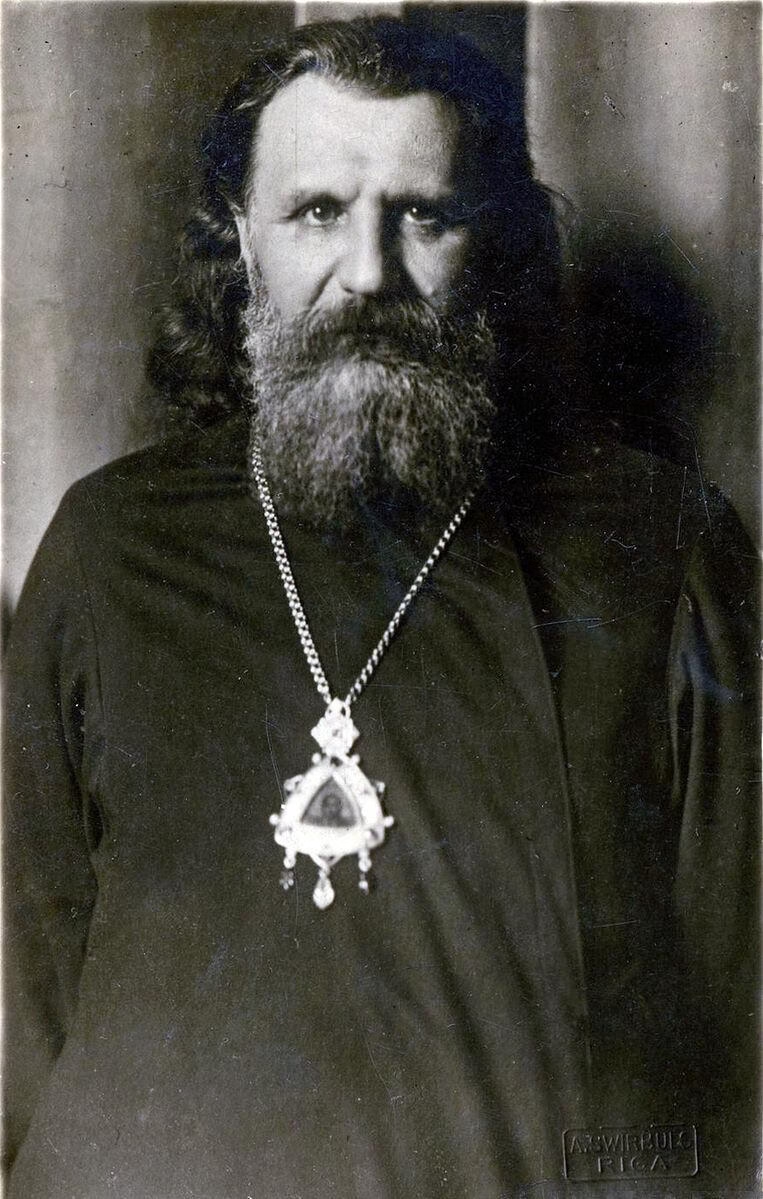
Among the Orthodox hierarchs who suffered during the turbulent years of the twentieth century, Archbishop John (Jānis Pommers) of Riga occupies a place worthy of our attention. His life was marked by monastic dedication, episcopal service, opposition to militant atheism, and a violent death that shocked the Orthodox faithful of Latvia.
For True Orthodox Christians, his story raises questions that deserve careful consideration. What does it mean to defend the Church when the world turns against her? How should we evaluate the witness of a hierarch who suffered for the Faith while serving within the complicated ecclesiastical circumstances of his time? And how do we distinguish the courage of an individual bishop from the question of his ecclesiastical allegiance?
These are not merely historical questions. They concern the relationship between confession, suffering, and fidelity to Christ.
From the Monastery to the Episcopate
John Pommers was born in 1876 into a poor Orthodox Latvian family. He received a theological education in Riga and Kyiv and entered monastic life in 1903, taking the name John.
He was ordained a priest in 1904 and subsequently served in theological education and monastic administration. In 1912, he was consecrated Bishop of Slutsk. His subsequent episcopal ministry brought him into direct contact with the upheavals that followed the Russian Revolution.
The Revolution brought persecution upon the Orthodox Church. Churches and monasteries were threatened, clergy were arrested, and the new authorities sought to suppress religious life. Bishop John opposed these attacks and endured imprisonment himself.
In Penza, he faced violent opposition during a period of ecclesiastical conflict. He survived an assassination attempt and was later arrested by the Soviet authorities. His experiences were not those of a distant observer of persecution: he personally suffered under the revolutionary regime.
In 1921, he became Archbishop of Riga and All Latvia.
Defending the Orthodox Church in Latvia
Archbishop John lived in Latvia at a difficult time. The country had recently become independent, and the Orthodox Church faced substantial political, financial, and administrative difficulties. Church properties had been lost, and the future of important ecclesiastical institutions was uncertain.
The Archbishop worked to preserve the life of the Church. He travelled among the faithful, supported parishes, encouraged the construction of churches, and sought to maintain unity among Orthodox Christians of different ethnic backgrounds.
He was also elected to the Latvian Parliament, where he worked to defend the rights of the Orthodox community.
His public activity should be understood in its historical context. He was attempting to preserve the Church’s ability to worship, educate the faithful, and maintain her institutions during a period of considerable pressure.
His episcopate demonstrates that defending the Church sometimes requires not only spiritual courage but also endurance, administrative skill, and a willingness to face public hostility.
His Martyrdom in 1934
On the night of 11–12 October 1934, Archbishop John was brutally attacked at his summer residence near Riga. He suffered torture and was murdered. A fire was set, apparently in an attempt to conceal the crime.
The murder was never conclusively solved. Although suspicions of political involvement have circulated, the identity of those responsible has not been definitively established.
His funeral drew an enormous crowd of mourners. For the Orthodox faithful of Latvia, his death was a terrible loss. Many regarded him as a shepherd who had remained steadfast in the face of persecution and who ultimately suffered a violent death after years of defending the Church.
His life and death subsequently became part of the history of Orthodox veneration of the twentieth-century New Martyrs.
The 1981 Glorification and Archbishop John’s Place in It
The question of Archbishop John’s glorification requires particular care.
In 1981, the Council of Bishops of the Russian Orthodox Church Outside Russia (ROCOR) solemnly glorified the New Martyrs and Confessors of Russia who had suffered under the atheist Soviet regime. The ceremony took place in New York at the Synodal Cathedral of the Icon of the Mother of God of the Sign.
Historical accounts of ROCOR’s veneration of the New Martyrs associate Archbishop John of Riga with this glorification. His name also appears in later published lists of the New Martyrs and Confessors.
Nevertheless, the documentary record must be described accurately. The surviving published account of the 1981 Council records that the list of names was to be reviewed, edited, and submitted for approval at a subsequent session. I have not located an original decree from 1981 that individually names Archbishop John.
Thus, while later Orthodox sources report his inclusion among the New Martyrs associated with ROCOR’s 1981 glorification, the precise documentary basis for his individual inclusion deserves further examination.
How Should True Orthodox Christians Regard Archbishop John?
For us, the question cannot be settled simply by appealing to the title of saint or to the fact of a violent death. Orthodox discernment requires us to consider the confession of the Faith, the conduct of the individual, the circumstances of his suffering, and the ecclesiastical history in which his life unfolded.
First, we should acknowledge Archbishop John’s courage in defending the Church against militant atheism. His imprisonment, his endurance of violence, and his pastoral labours are important historical facts.
Second, we should distinguish his personal witness from the broader ecclesiastical circumstances of the Russian Church during the revolutionary and post-revolutionary period. A hierarch’s suffering does not automatically resolve every question concerning his ecclesiastical position; neither should his historical circumstances be used as a reason to dismiss his courage without examination.
Finally, we should remember that the Orthodox Church’s understanding of martyrdom concerns fidelity to Christ and the truth of the Faith. A martyr’s death is not simply a tragic political event. It is understood in relation to the Christian confession for which the martyr suffered.
Archbishop John’s life therefore deserves serious study rather than either uncritical enthusiasm or premature condemnation.
The Witness of a Persecuted Hierarch
The Ecclesiastical Struggle in Latvia and the Legacy of Archbishop John
Following the establishment of an independent Latvian state, increasing efforts were made to secure greater ecclesiastical independence for the Orthodox Church in Latvia. Although the Church had received extensive self-government under the authority of Patriarch Tikhon, questions concerning its canonical relationship with the Russian Church remained unresolved.
These developments took place against the background of the grave ecclesiastical crisis in Russia, where the Renovationist movement had challenged the authority of Patriarch Tikhon. The recognition accorded to the Renovationists by the Ecumenical Patriarchate under Gregory VII further complicated the situation and provoked serious canonical objections among those who remained faithful to the traditional ecclesiastical order.
Archbishop John of Riga, a hierarch closely associated with Patriarch Tikhon, stood within this difficult historical context. His ecclesiastical course reflected a determination to preserve the Church’s integrity amid political pressures and competing claims to canonical authority.
After his murder in October 1934, the question of the Latvian Church’s future jurisdiction was reconsidered, ultimately resulting in its transfer to the jurisdiction of Constantinople in 1936. This development must be distinguished from the personal ecclesiastical position of Archbishop John during his lifetime.
The history of these events illustrates the profound difficulties faced by Orthodox Christians during a period of political upheaval, ecclesiastical division, and competing claims of authority. It also reminds us of the importance of examining historical events through the documentary record, while carefully distinguishing established facts from later interpretations of their canonical and theological significance.
The twentieth century produced many Orthodox Christians who suffered under atheistic regimes. Some were bishops, others priests, monks, nuns, or ordinary laypeople. Their experiences remind us that the Church’s life cannot be measured by political success, public recognition, or worldly security.
Archbishop John of Riga served his flock amid great difficulties and died in circumstances of terrible violence. His example invites us to consider the responsibilities of a shepherd: to defend the Faith, to care for the faithful, to preserve the life of the Church, and to remain steadfast when these duties become dangerous.
For True Orthodox Christians, remembering such figures should lead us not merely to admire their courage but to examine our own fidelity to Christ.
The ultimate question is not whether a bishop enjoyed earthly honour, but whether he sought to serve Christ and His Church faithfully.
May the study of the New Martyrs and Confessors deepen our understanding of the price paid by those who defended the Orthodox Faith during the dark years of persecution.
Published by TrueOrthodox.eu — A witness to the Orthodox Faith and the inheritance of the Holy Fathers.