
The inseparable relationship between faith, repentance, and good works
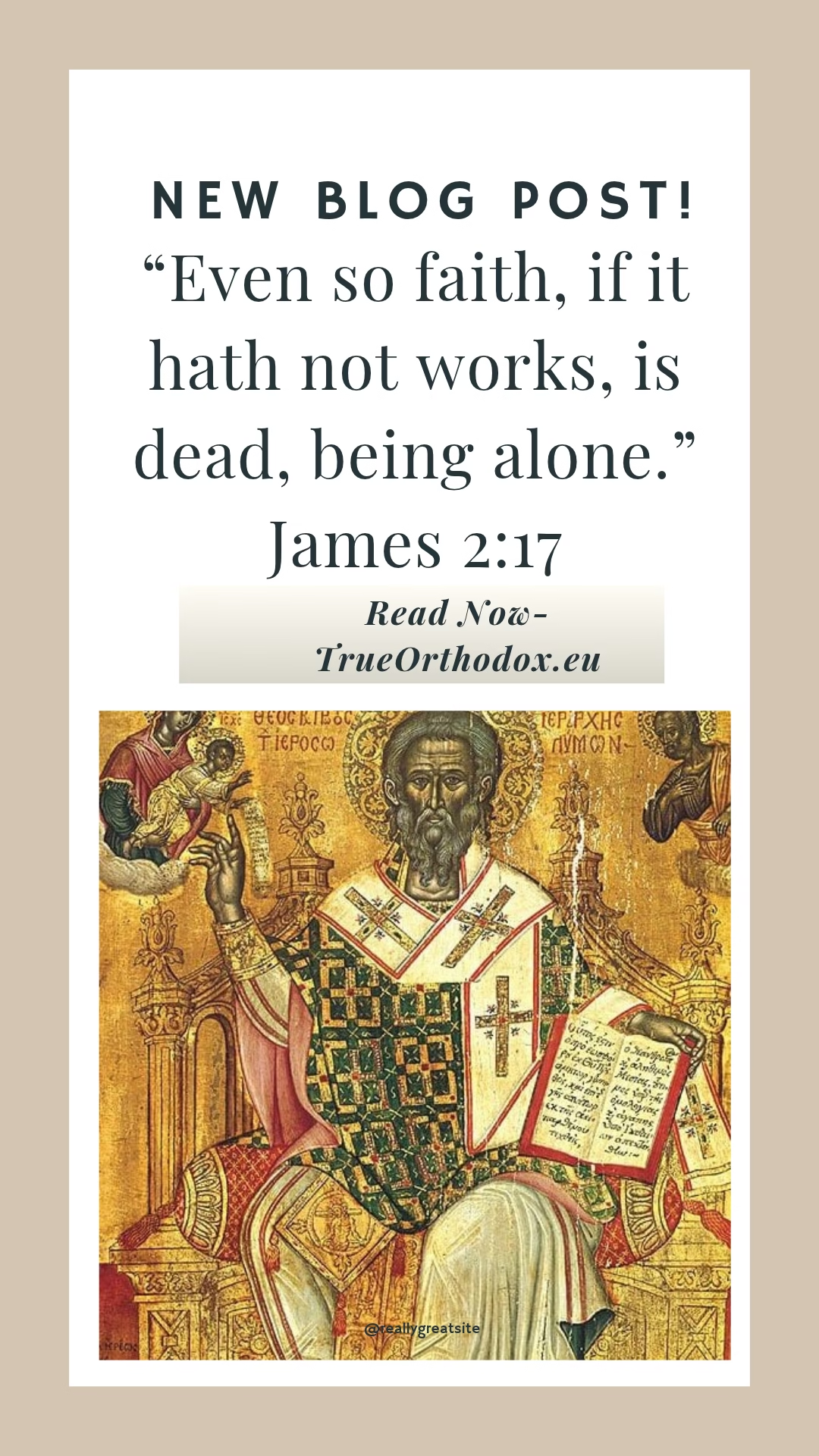
“Even so faith, if it hath not works, is dead, being alone.” (James 2:17)
There is a truth in the Epistle of the Holy Apostle James that every Christian should consider carefully, for it touches the very heart of our spiritual life. It is possible to speak about faith, to defend the doctrines of the Church, to know the Scriptures, to attend the Divine Services, and even to appear outwardly religious, while our hearts and our daily lives remain largely unchanged.
The Apostle James leaves no room for such complacency. His words are direct and uncompromising: “Faith, if it hath not works, is dead, being alone.”
These words are not an invitation to replace faith with good deeds, nor do they suggest that man can earn his salvation through human effort. Rather, they reveal something essential about the nature of genuine Christian faith: true faith is living, and whatever is truly alive must manifest itself through life.
In our day, there is a tendency to reduce Christianity to a matter of intellectual conviction. A person may believe that God exists, acknowledge the divinity of Christ, accept the teachings of the Church, and even defend Orthodox doctrine against those who distort it. All these things are important. Yet the Apostle James reminds us that intellectual acknowledgment alone does not constitute saving faith.
He writes:
“Thou believest that there is one God; thou doest well: the devils also believe, and tremble.” (James 2:19)
This is a sobering statement. Even the demons know that God exists. They know the truth, yet they do not love God, submit themselves to Him, or desire communion with Him.
Therefore, knowing the truth and living according to the truth are not the same thing!!
Orthodoxy has never understood faith as a mere intellectual acceptance of propositions. Faith involves the whole person: the mind, the heart, the will, and the manner in which we conduct our lives. To believe in Christ means not simply to acknowledge who He is, but to follow Him, to obey His commandments, and to struggle against everything within ourselves that separates us from Him.
We cannot sincerely confess Christ with our lips while deliberately refusing to allow His commandments to govern our lives.
If faith is living, it must lead us to repentance.
The Lord began His public preaching with the words: “Repent ye, and believe the Gospel.” (Mark 1:15). These two commands belong together. Repentance is not an optional addition to faith, reserved for those who have committed particularly serious sins. It is the continual disposition of the Christian soul.
The Greek word metanoia (μετάνοια) signifies a change of mind, a transformation of our understanding and orientation. It is not merely feeling sorry for something we have done. It means turning away from sin and turning towards God.
A person who truly believes begins to see his own life differently. He becomes aware of his passions, his pride, his impatience, his judgment of others, his selfishness, and his lack of love. He begins to recognise that the greatest obstacle to his spiritual life is not found in the behaviour of other people, but within his own heart.
We will stumble. We will fall. We will discover weaknesses that we thought we had overcome. But the person who possesses living faith does not make peace with sin. He rises again through repentance, seeks God’s mercy, and continues the struggle.
Good works are not a substitute for faith. They are its natural fruit.
Saint Paul teaches that we are saved by grace through faith, “not of works, lest any man should boast” (Ephesians 2:8–9). Yet in the very next verse he explains that we are created in Christ Jesus “unto good works” (Ephesians 2:10).
There is no contradiction between the teaching of Saint Paul and that of Saint James. We are not saved by the independent merit of our deeds, but neither can living faith be separated from the works of love that grace produces within us.
Our works do not purchase God’s mercy. Rather, they demonstrate whether we are responding to that mercy.
We must be especially careful not to confuse defending the truth with living the truth. Orthodox Christianity is not merely something we defend. It is something we must live.
Faith Must Transform Every Part of Our Lives
Saint James concludes his teaching with the example of Abraham, whose faith was made perfect through his works (James 2:21–23). Abraham did not merely acknowledge God intellectually. He trusted Him, obeyed Him, and demonstrated that trust through his actions.
This is the faith to which we are called.
We should therefore examine ourselves, not with despair, but with honesty. Do we pray while neglecting to forgive? Do we fast while remaining uncharitable? Do we speak about humility while seeking recognition? Do we profess the truth while refusing to correct our own conduct?
And when we discover these contradictions, we must not become discouraged. Rather, we should recognise them as opportunities for repentance.
The Church does not call us to an imaginary perfection, nor does she promise that the path of salvation will be without struggle. She calls us to continual repentance, participation in the sacramental life, prayer, obedience, and the cultivation of the virtues through the grace of God.
Let us not be satisfied with a faith that exists only in our words. Let us seek a faith that transforms our hearts, directs our actions, and makes us increasingly conformed to the image of Christ.
For, as the Apostle James reminds us, “faith without works is dead.”
And a living faith, nourished by God’s grace, will never remain without fruit.
May the Lord grant us not merely to confess the Orthodox Faith with our lips, but to manifest it through repentance, obedience, humility, and love, so that our entire lives may become a testimony to the truth of the Gospel. Amen.