
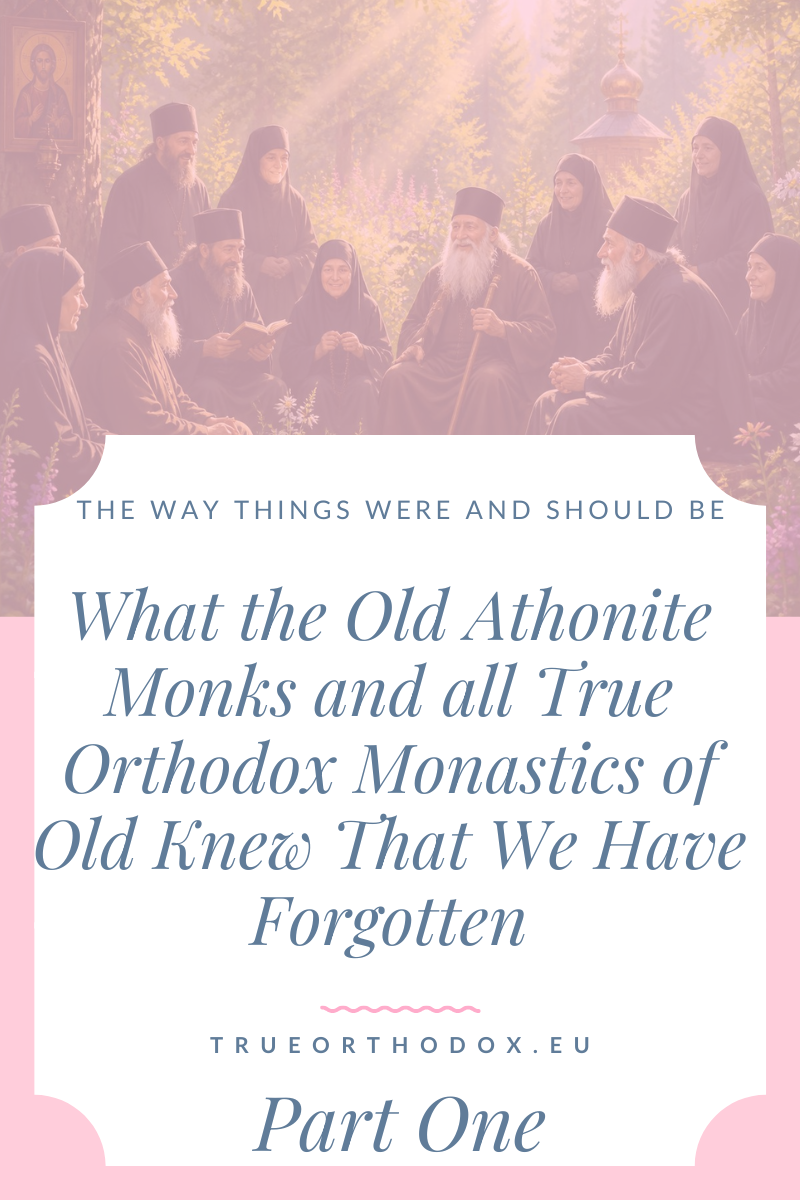
Part One – What the Old Athonite Monks and all True Orthodox Monastics of Old Knew That We Have Forgotten
Every generation believes that it has advanced beyond the one before it. We have more knowledge, more technology, and greater access to information than any previous age. Yet there is one thing that I fear we have lost along the way: simplicity of heart.
Many years ago, I was blessed to know monks and nuns of an older generation. They were not famous. They did not write books, cultivate followers, or seek recognition. Few outside their monasteries knew their names.
If they possessed one remarkable characteristic, it was this: they were not interested in appearing holy.
They wanted only to become holy.
At first glance, this distinction may seem insignificant, but it marks the difference between authentic spiritual life and subtle hypocrisy.
The old Athonite monks were often rough around the edges. They were not polished speakers, nor did they always possess refined manners. They could be direct, even abrupt at times. Yet beneath that outward simplicity was a heart that had been shaped by years of repentance, prayer, obedience, and hidden struggle.
They had no interest in creating an image.
Indeed, many of them seemed almost determined to avoid admiration. If someone praised them, they quickly changed the subject. If visitors spoke of their holiness, they became visibly uncomfortable. They feared praise far more than criticism.
They knew something we are in danger of forgetting.
The spiritual life is lived before God, not before an audience.
Today we live in a world where appearances have become everything. Through social media and the constant pressure to present ourselves, we are encouraged to build an image, to manage a reputation, and to let others see only the version of ourselves that we wish to display.
Even Christians are not immune to this temptation.
We can begin to cultivate the appearance of humility rather than humility itself. We may wish to appear prayerful rather than quietly pray. We can become more concerned that others think we are spiritual than whether we are truly drawing nearer to Christ.
This temptation is especially dangerous because it disguises itself as virtue.
The Lord warned us against this spirit when He spoke of those who prayed publicly “to be seen by men.” Their actions appeared religious, but their reward had already been received in the admiration of others.
The old monks understood this instinctively.
Prayer belonged in the cell.
Repentance belonged in the heart.
Virtue belonged to God.
One did not advertise these things.
Another characteristic that deeply impressed me was their honesty.
They did not pretend to possess answers they did not have. If they knew something, they spoke simply. If they did not know, they admitted it without embarrassment. There was no need to appear wise.
Humility had set them free.
Their hospitality was equally remarkable. Visitors were not treated as interruptions but as gifts sent by God. Whether one was a bishop, a laborer, a pilgrim, or a child, each was welcomed with the same simplicity and warmth. A piece of bread, a cup of coffee, a glass of water, and sincere attention were offered without calculation.
One left feeling not impressed by the monk, but grateful to God.
Their love of prayer was equally quiet.
They did not constantly speak about prayer.
They prayed.
Many modern Christians read endlessly about the spiritual life while praying very little. The older generation spent far less time discussing prayer than standing before God in silence.
Perhaps that is why their words carried such weight.
They spoke from experience rather than theory.
I also remember something else about them. They rarely tried to look like saints. In fact, many seemed almost ordinary until one spent time with them. Only gradually did one begin to perceive a profound peace, a gentle wisdom, and a quiet love that could not be explained by natural means.
Holiness revealed itself naturally.
It did not need to be announced.
This is something our own generation desperately needs to recover.
The goal of the Christian life is not to convince others that we are holy.
The goal is to become humble enough that Christ alone is seen.
When St. John the Baptist said, “He must increase, but I must decrease,” he expressed the entire spiritual life in one sentence.
Every prayer, every fast, every act of charity, every prostration, every hidden struggle should lead us toward that one goal: that less of ourselves may remain and more of Christ may be reflected in us.
Perhaps we would all find greater peace if we spent less time shaping our image and more time shaping our soul.
The old Athonite monks would probably smile at such advice.
Then they would quietly return to their prayer rope, unnoticed by the world, content that God alone knew who they were.
And perhaps that is precisely why so many of them became saints.