
Between Service and Heart’s Calling
While I was staying at the bishop’s residence, preparations were being made for my assignment as priest to a small parish. At the same time, I was encouraged to begin looking for an apartment of my own, since it was assumed that I would settle there permanently.
The church was located in a neighborhood that had been established by Greek refugees from Asia Minor following the tragic events of 1922. It was a humble little church, built through the sacrifice of a brother and sister, though it was especially the sister who had devoted herself to making it a reality. Like many refugees of her generation, she spoke Turkish more easily than Greek, a reminder of the difficult history that had shaped their lives.
Unfortunately, the church itself had been built on land that did not legally belong to them but was adjacent to their family home. It was a tiny church, lovingly constructed, and attended by a small number of faithful Genuine Orthodox Christians. At the same time, many people from the State Church also came and went, and the parish lacked a clear identity.
The parish council was another matter altogether.
Although I respected the sacrifices that had been made to establish the church, it quickly became evident that our understanding of parish life and the priesthood was not the same. I was also uneasy about the expectation that I should rent an apartment and begin establishing myself there. Deep within my heart, I knew that this was not the life for which I had left America.
Then, through God’s providence, everything changed.
A father and daughter, monk and nun, both of whom had always shown me genuine kindness, told me about a small hesychasterion on Mount Parnitha. They suggested that I visit.
That visit changed the course of my life.
There I found not merely a place to stay but what I had been seeking for so many years: a spiritual home.
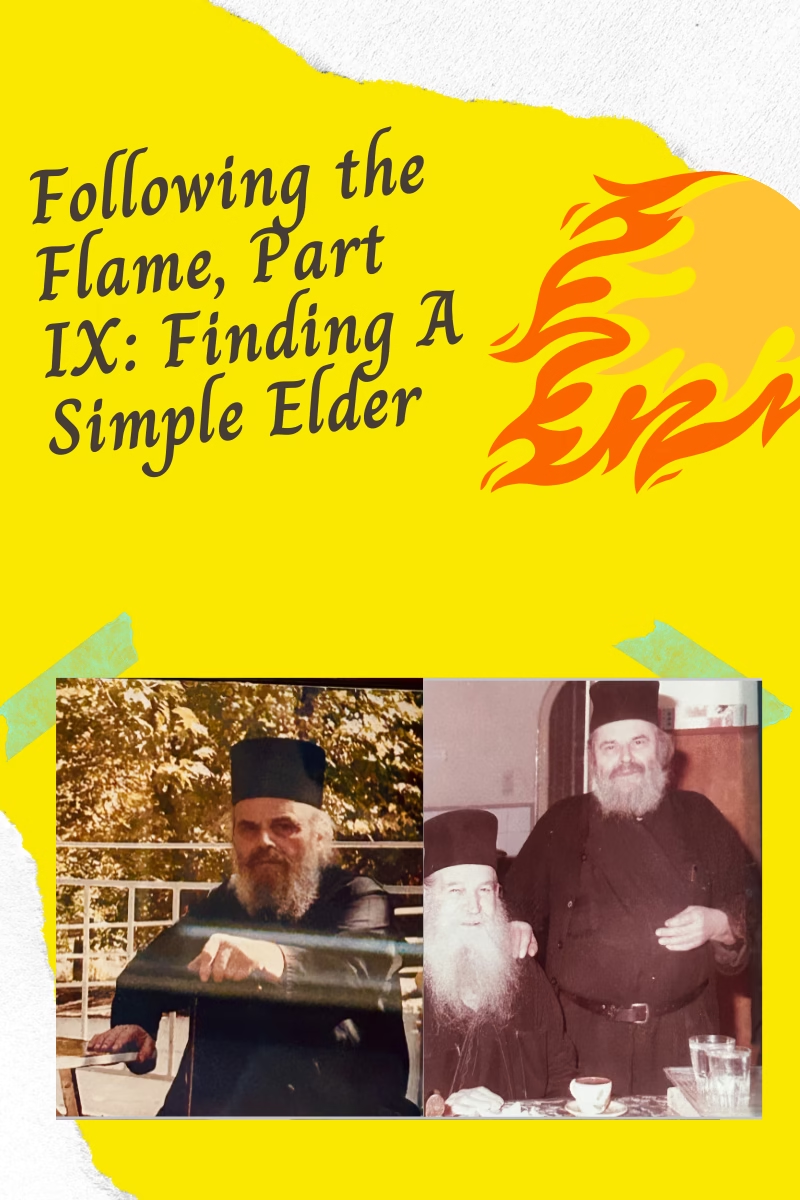
There I met Elder Ioasaph and the small brotherhood that lived with him. They welcomed me with love and simplicity, asking for nothing in return. After years of uncertainty, I finally had a place where I belonged even if the problems were so many (typical of small True Orthodox monasteries in Greece).
For that, I shall always remain grateful.
Elder Ioasaph belonged to that older generation of Athonite monks whose virtue was hidden beneath great simplicity. He never tried to appear holy or cultivate a spiritual image. There was nothing artificial about him. He was straightforward, unpretentious, and entirely genuine. Some might have been even scandalized by unpretensious ways.
Like many monks of his generation on the Holy Mountain, he could seem rough around the edges. His manner was direct, and he spoke plainly, without concern for outward refinement. Yet beneath that simplicity was a love for God.
He wasn’t the kind of man to heavily support you spiritually. The little monastery did not have a future due to legal matters and Elder Ioasaph not having a release from Mount Athos.
The hesychasterion became my refuge. It was there that I found stability, guidance, and the blessing of living with an elder. Instead of facing life’s struggles alone, I now had brothers with whom to pray, someone to seek counsel from, and a daily rhythm centered on the worship of God.
Every morning, the services began at two o’clock. It was exactly the life my heart had long desired.
Although I continued serving the small parish for a time, it soon became clear that our way of understanding the priesthood and parish life was not compatible. My stay there lasted only until Pascha.
God had not brought me to Greece simply to become another parish priest.
The flame had not led me astray.