


·
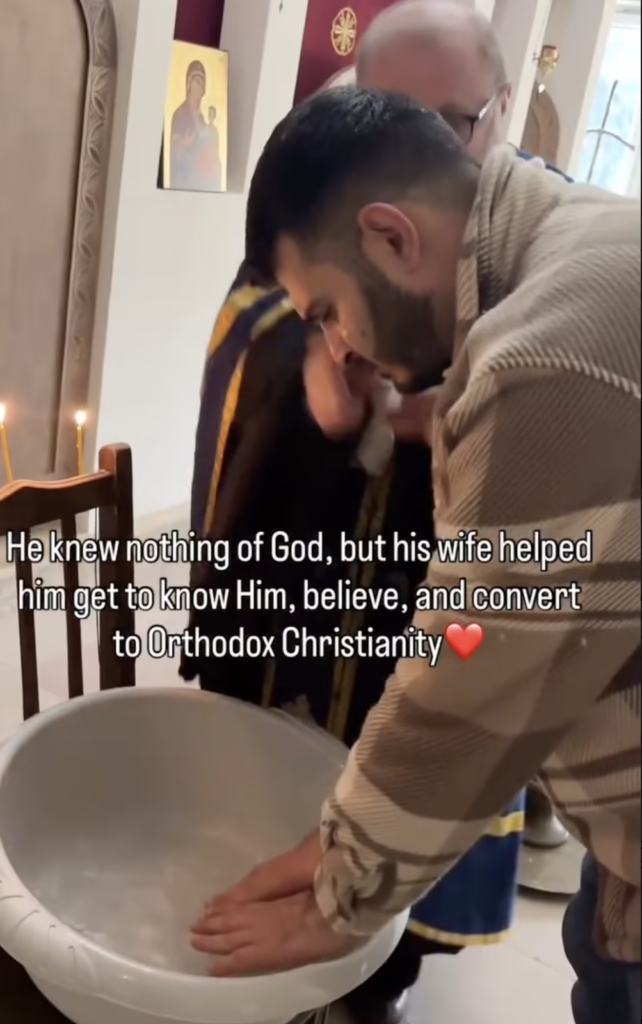
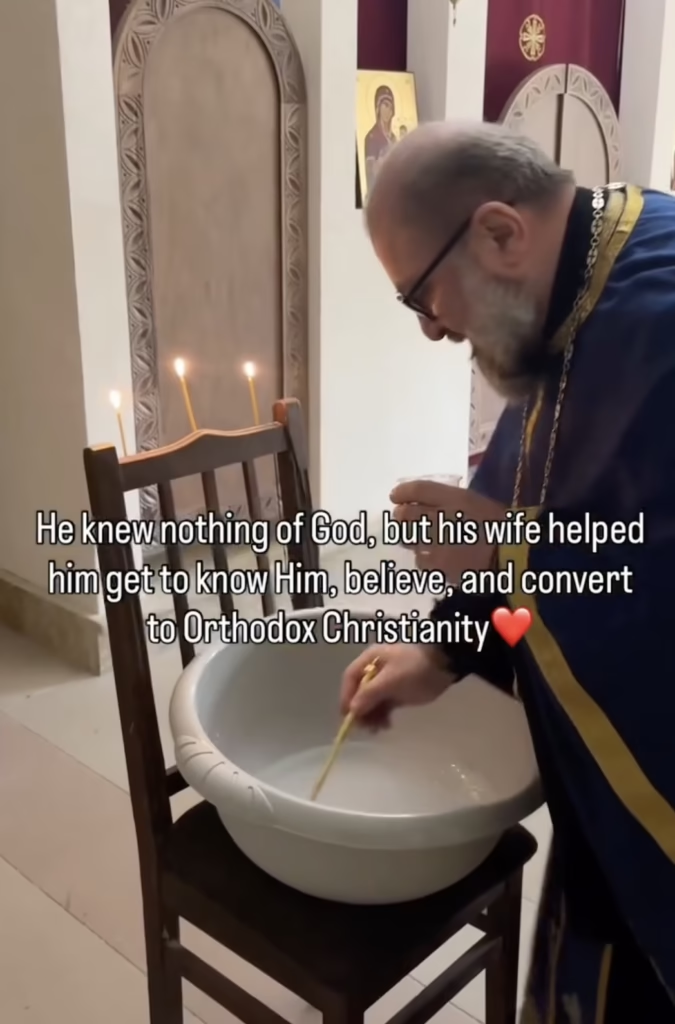
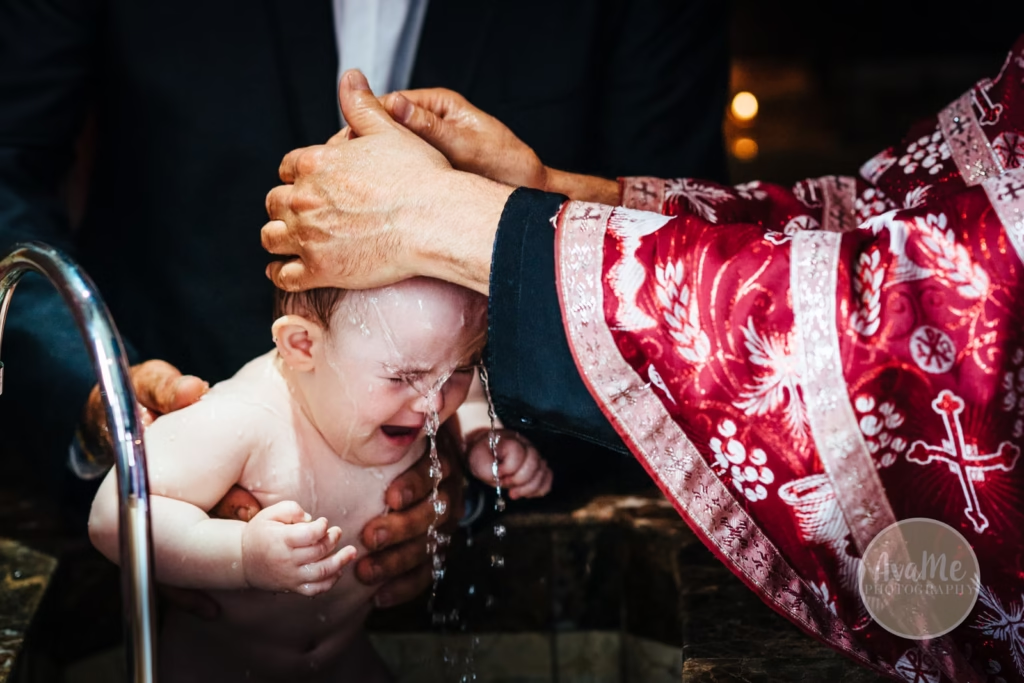
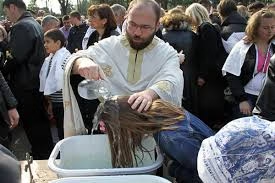
In recent years, a troubling trend has spread throughout so-called “Orthodox” circles—a trend so widespread that many now accept it without question, as though novelty were tradition and convenience were theology. The holy Mystery of Baptism, once guarded with fear and precision by the Fathers, is increasingly reduced to little more than the wetting of the head: a few drops of water, a brief gesture, and the assumption that the soul has been born again.
But we must ask plainly: is this truly Orthodox Baptism?
Or, to borrow the words of Shakespeare: “To be, or not to be: that is the question.”
Indeed, in our own day the question has become: To baptize, or not to baptize?
The Apostolic and Patristic Practice
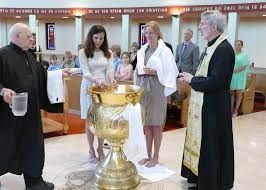
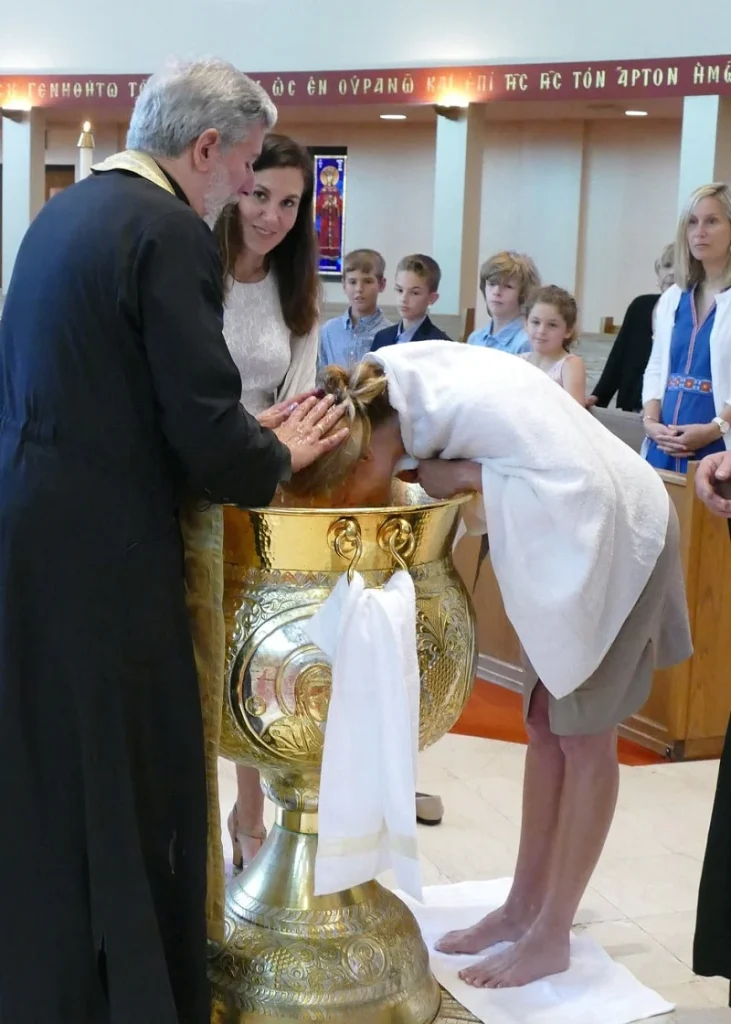
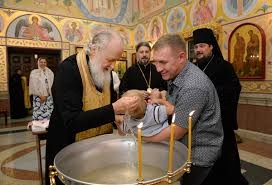
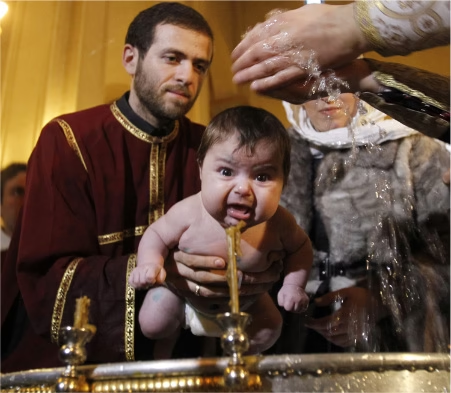
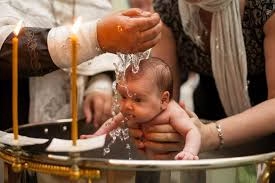
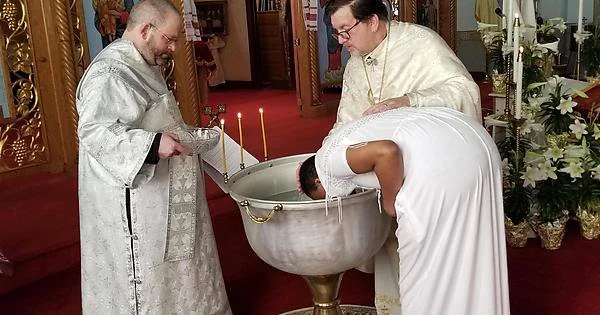
The Orthodox Church has always taught that Holy Baptism is performed by threefold immersion in water, in the Name of the Father, and of the Son, and of the Holy Spirit. This is not a matter of preference, local custom, or convenience. It is the apostolic and catholic practice handed down from the beginning.
The very word baptism (βάπτισμα) means immersion, dipping, burial in water. Saint Paul writes:
“Therefore we are buried with Him by baptism into death…”
(Romans 6:4)
Burial is not symbolized by a few drops on the forehead. One is not buried by sprinkling dust upon the head. Burial requires immersion.
Thus, the Church has always understood Baptism to be a real participation in the death, burial, and Resurrection of Christ. Threefold immersion is not symbolism alone—it is obedience to divine revelation.
Great Fonts, Small Faith:
It is especially painful to witness this innovation in places that outwardly preserve the appearance of tradition.
There are monasteries in Serbia with massive stone baptismal fonts—ancient-looking, impressive, seemingly prepared for proper baptism by immersion. One would expect the full apostolic rite to be performed there.
Yet often, despite these large fonts, the priest merely sprinkles or pours a little water upon the head.
Why build a baptismal tomb if no one is to be buried in it?
Why preserve the font but abandon the Faith?
This contradiction reveals something tragic: tradition is being displayed as decoration while its substance is quietly abandoned.
These Are New Methods!!
Some defend these practices by calling them “economy,” or by claiming “this is how it is done now.”
But the Church does not live by “how it is done now.”
She lives by what was handed down.
Sprinkling and mere wetting of the head are not the norm of Orthodox Baptism. They are later deviations, often adopted through Latin influence, pastoral laziness, or modern indifference.
These are new methods, not ancient tradition.
And novelty in the Mysteries is never a small matter.
The Witness of St. Cyprian of Carthage:
The holy Father St. Cyprian of Carthage spoke with great clarity concerning the Mysteries and the necessity of true ecclesial grace.
He firmly taught that the sacraments of heretics are not valid sacraments at all, because grace does not exist outside the true Church. One cannot receive sanctification where the Holy Spirit is absent.
If this is true concerning heretical baptisms—and the Church has repeatedly affirmed it—then we cannot simply assume that someone was validly baptized merely because water was used somewhere by someone calling themselves Christian.
Form matters. Faith matters. Apostolic continuity matters. The Church is not a vague spiritual sentiment; she is concrete, visible, and sacramental.
As St. Cyprian of Carthage taught: outside the Church there is no salvation, and outside the Church there is no true sacramental grace.
We Cannot Assume
Today many say:
“They were baptized somewhere else, so let us not be strict.”
But the Fathers did not reason this way.
They examined carefully.
They asked:
Was there true baptism?
Was there threefold immersion?
Was it performed in the Orthodox Faith?
Was it done within the Church?
Without these questions, we fall into sentimentality rather than theology.
The salvation of souls is too serious for assumptions.
Fidelity, Not Fashion:
The issue is not harshness. It is faithfulness.
The issue is not legalism. It is obedience.
If the Church for two thousand years has baptized by triple immersion, who are we to improve upon the Apostles? Who are we to replace burial with sprinkling, precision with approximation, and Holy Tradition with convenience?
We must not confuse pastoral weakness with theological truth.
The Church does not need new methods. She needs old faith.
Holy Baptism is not a ceremony to be abbreviated. It is the entrance into Christ, the death of the old man, the birth of the new creation.
Threefold immersion is not optional ornamentation—it is the Orthodox form of the Mystery itself.
To reduce Baptism to a symbolic wetting of the head is not a harmless simplification. It is a departure from the apostolic inheritance.
And so we return to the question:
To baptize, or not to baptize?
If we mean Orthodox Baptism, then the answer is clear:
Not by novelty.
Not by convenience.
Not by modern compromise.
But by the ancient path—
by water,
by triple immersion,
by the Holy Trinity,
and by the unchanging Faith of the Orthodox Church.
1. The Apostolic Canons
Apostolic Canon 50
“If any bishop or presbyter does not perform the three immersions of the one initiation, but one immersion given into the death of the Lord, let him be deposed. For the Lord did not say, ‘Into My death,’ but, ‘Go ye and teach all nations, baptizing them in the Name of the Father, and of the Son, and of the Holy Spirit.’”
2.
St. Basil the Great
On the Holy Spirit, Chapter 15
“The baptism, then, is given in three immersions and the invocation of the Trinity…”
Where found:
On the Holy Spirit, Chapter 15 (sometimes numbered Chapter 27 depending on edition)
Importance:
St. Basil the Great directly states triple immersion as the received apostolic form.
3.
St. John Chrysostom
Homily on John 25
“To be baptized and to submerge oneself, then to emerge, is a symbol of the descent into Hades and return therefrom.”
Where found:
Homilies on the Gospel of John, Homily 25
Importance:
He explicitly connects Baptism to immersion and burial with Christ.
4.
St. Cyril of Jerusalem
Catechetical Lectures, Lecture 20 (Mystagogical Catechesis 2)
“For as our Saviour spent three days and three nights in the heart of the earth, so you also in the first immersion imitated the first day of Christ in the earth, and by your emergence, the first night…”
Where found:
Mystagogical Catechesis II
Importance:
This directly explains the symbolism of the three immersions.
5.
St. Cyprian of Carthage
on Heretical Baptism
Epistle 73 to Jubaianus
“How can he who is himself unclean and with whom the Holy Spirit is not, cleanse and sanctify water?”
and
“There is one God, and one Christ, and one Church, and one Chair founded upon Peter by the word of the Lord. Another altar cannot be constituted, nor a new priesthood be made, except the one altar and the one priesthood.”
Where found:
Epistle 73 (also numbered Epistle 69 in some collections)
Importance:
St. Cyprian of Carthage teaches that sacraments outside the true Church are not valid sacraments.
6.
St. Nicodemus of the Holy Mountain
in the Pedalion
On Apostolic Canon 50, he strongly states:
“Those Latins who perform baptism by affusion are not rebaptized because they were never baptized.”
Where found:
Commentary on Apostolic Canon 50 in the Pedalion (The Rudder)
Importance:
This is one of the strongest Orthodox statements against affusion replacing immersion.