
“Archbishop” Elpidophoros and “Diversity” in the Body of Christ
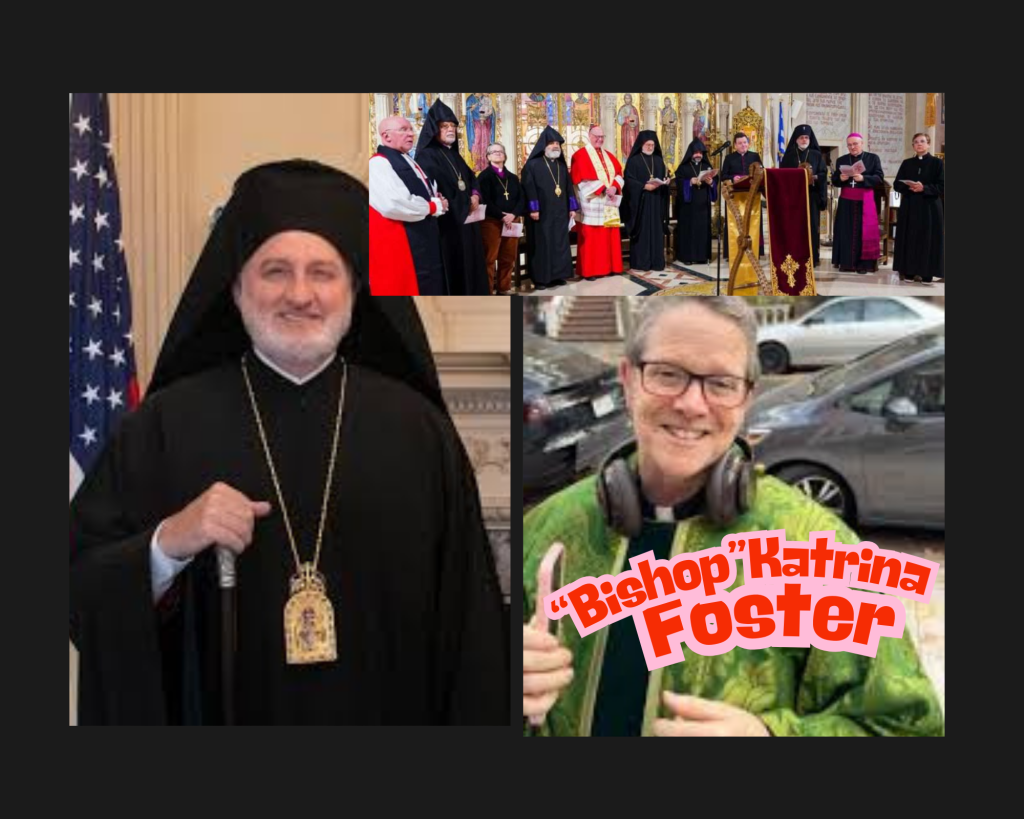
“Bishop”Katrina and Elpidophoros and "Diversity"
Diversity exists in the body of Christ, Archbishop Elpidophoros says at ecumenical prayer service.
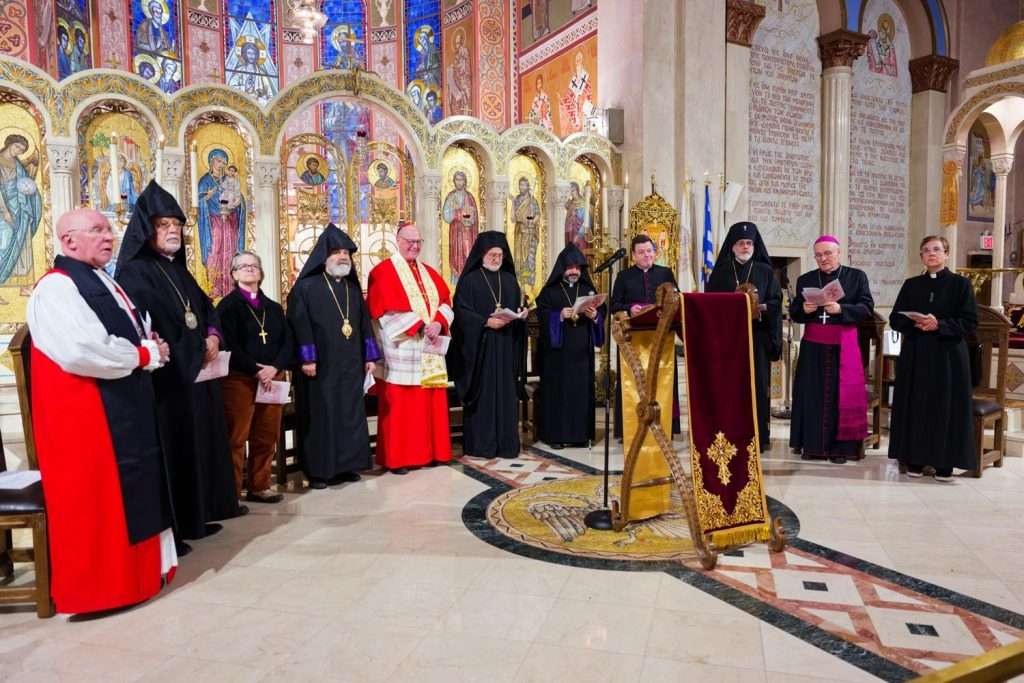
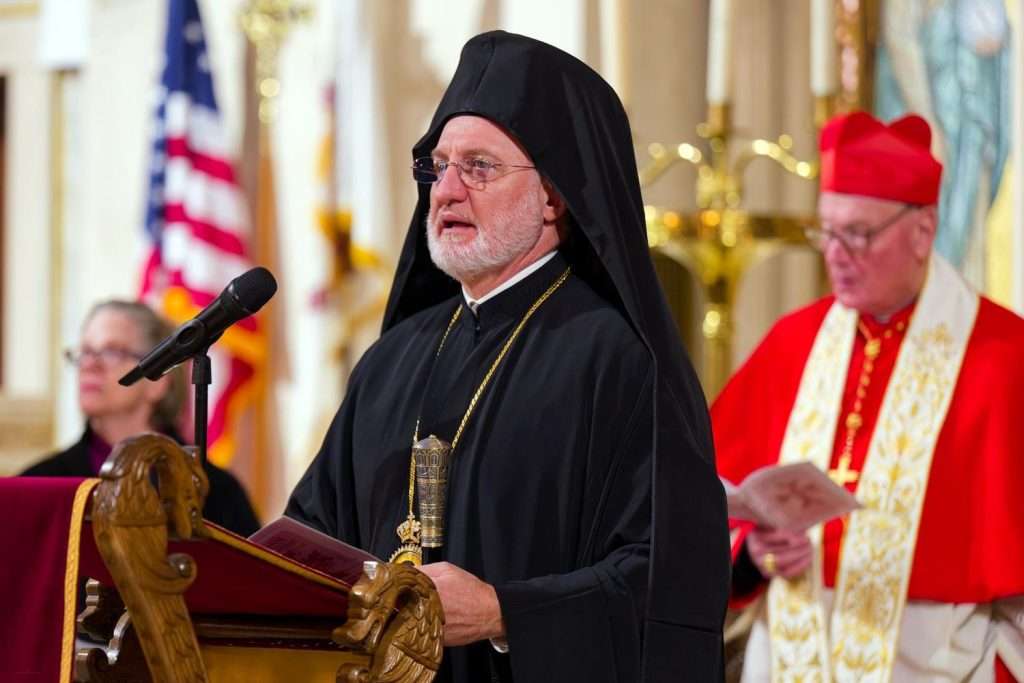
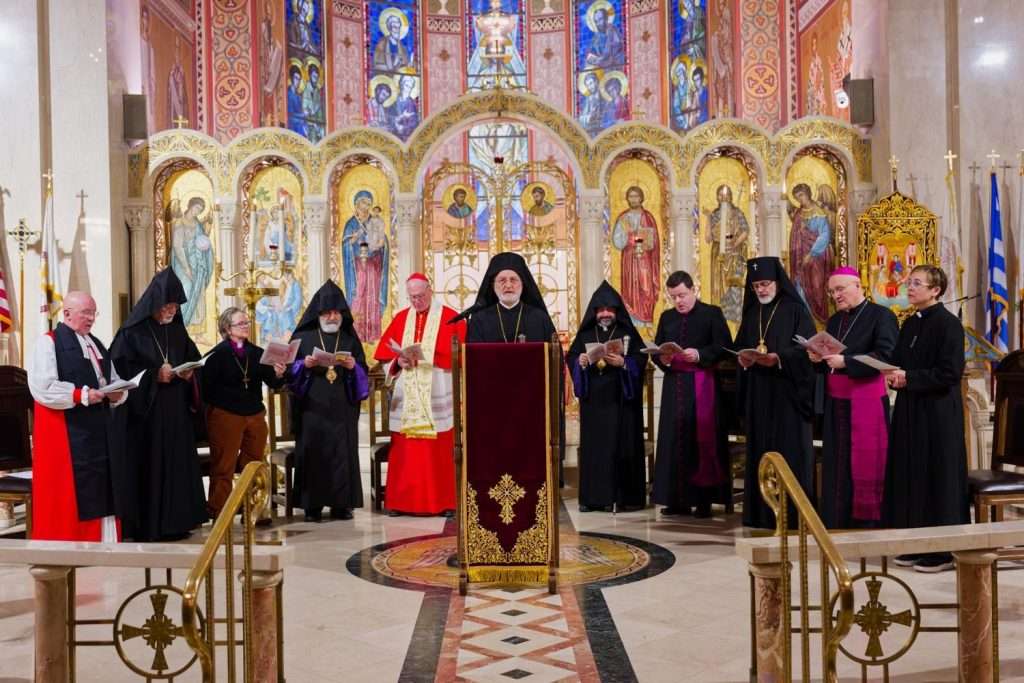
On the evening of January 29, 2026, an ecumenical “prayer” service took place at the Greek Archdiocesan Cathedral of the Holy Trinity, led by clergy from several Christian traditions. The service was part of the World Council of Churches’ 58th annual Week of Prayer for Christian Unity. Participants included His Eminence Archbishop Elpidophoros of America
His Eminence Cardinal Timothy Dolan, Apostolic Administrator of New York (Roman Catholic Church)
His Grace Bishop Mesrop Parsamyan, Primate of the Eastern Diocese of the Armenian Church of America (Armenian Apostolic Church – The Mother See of Holy Etchmiadzin)
His Eminence Archbishop Anoushavan Tanielian, Primate of the Armenian Prelacy of the Eastern USA (Armenian Apostolic Church – The Holy See of Cilicia)
His Eminence Archbishop Vicken Aykazian, Ecumenical Director and Diocesan Legate of the Eastern Diocese of the Armenian Church of America (Armenian Apostolic Church – The Mother See of Holy Etchmiadzin)
His Eminence Archbishop Daniel of Pamphilon (Ukrainian Orthodox Church of the USA)
The Right Reverend Bishop Peter Eaton, Diocese of Southeast Florida (Episcopal Church)
The Right Reverend Bishop Katrina Foster, Presiding Bishop of the Metropolitan New York Synod – ELCA (Evangelical Lutheran Church in America) ( She is the first woman and the first openly gay person to serve as bishop of the Metropolitan New York Synod. (Well, I guess that is diversity!)
His Excellency Bishop James Massa, Auxiliary Bishop of the Diocese of Brooklyn and Rector of St. Joseph’s Seminary (Roman Catholic Church)
Monsignor Robert D. Murphy, Deputy Permanent Observer of the Holy See to the United Nations and Chargé d’Affaires
Dr. Kirsten Guidero, Ecumenical and Interreligious Officer (Episcopal Church)
Is There “Diversity” in the Body of Christ?
A Patristic Clarification
In contemporary ecumenical discourse, one often hears statements such as: “We must move beyond ecclesial insularity and recognize the diversity that already exists within the Body of Christ.” (Archbishop Elpidophoros, January 29, 2026)
While such language may sound charitable or inclusive, it represents a departure from the patristic understanding of what the Body of Christ actually is.
For the Holy Fathers, the Body of Christ is not an abstract, invisible collection of Christian groups, nor a spiritual category wide enough to include mutually contradictory confessions. Rather, it is a concrete, visible, sacramental reality: the One, Holy, Catholic, and Apostolic Church.
This was not a marginal opinion, but the universal teaching of the ancient Church.
The Body of Christ Is the Church — and the Church Is One
The Apostle Paul teaches unambiguously:
“There is one Body and one Spirit” (Eph. 4:4).
The Fathers consistently interpret this “one Body” as the one ecclesial communion, united in faith, sacraments, and hierarchy.
St. John Chrysostom explains this plainly:
“There is one Body and one Spirit.
Not two bodies, not three, not many.
Therefore, if anyone is not of this Body, he is not of Christ.”
(Homily on Ephesians 4:4, PG 62:85)
For St. John Chrysostom, separation from the Church is not a secondary problem; it is separation from Christ Himself.
Heresy and Schism Are Not “Diversity” but Rupture
The modern tendency to describe doctrinal division as “diversity” would have been unintelligible to the Fathers.
St. Ignatius of Antioch, a disciple of the Apostles, writes with apostolic severity:
“Let no man deceive himself: if anyone follows a schismatic, he will not inherit the Kingdom of God.
If anyone walks in strange doctrine, he has no part in the Passion.”
(Epistle to the Smyrnaeans 6–7, PG 5:713)
To have “no part in the Passion” is to have no share in Christ, and therefore no place in His Body.
Outside the Church, there Is No Participation in the Body of Christ
St. Irenaeus of Lyons, writing in the second century against the Gnostics, ties the Body of Christ directly to the Church as the locus of the Holy Spirit:
“Where the Church is, there is the Spirit of God; and where the Spirit of God is, there is the Church and every grace.
But those who do not partake of Him are neither nourished unto life from the Church’s bosom, nor do they enjoy that most pure fountain which flows from the Body of Christ.”
(Against Heresies III.24.1, PG 7:966)
Here, the Body of Christ is not an invisible ideal, but a life-giving fountain from which heretics are explicitly excluded.
Unity Is Not Emotional or Sociological — It Is Ecclesial
Perhaps no Father speaks more clearly on ecclesial unity than St. Cyprian of Carthage:
“He cannot have God as his Father who does not have the Church as his Mother.”
(On the Unity of the Church 6, PL 4:503)
And again:
“The Church is one… though spread abroad into a multitude, yet preserving the unity of her origin.”
(On the Unity of the Church 4, PL 4:502)
Unity, therefore, does not mean coexistence of contradictory teachings, but oneness of faith flowing from one source.
Augustine, often misused to justify ecumenism, explicitly rejects the idea that outward Christianity constitutes belonging to the Body of Christ:
“A man may have everything except salvation: he may have the sacraments, he may sing Alleluia, he may answer Amen, he may hold the Gospel… but never can he find salvation except in the Catholic (Universal) Church.”
(On Baptism, Against the Donatists V.27, PL 43:189)
External forms may remain, but the Body is absent where unity is broken.
The Patristic Conclusion
The Fathers speak with one voice:
The Body of Christ is identical with the One Church
Unity is doctrinal, sacramental, and hierarchical
Heresy and schism are not “diversity” but separation from the Body
Love for those outside the Church never requires redefining the Church herself
To speak of “diversity within the Body of Christ” is therefore not patristic language, but modern ecclesiological innovation.
True unity is not achieved by lowering the boundaries of the Church, but by calling all men to repentance, truth, and full communion within her.